
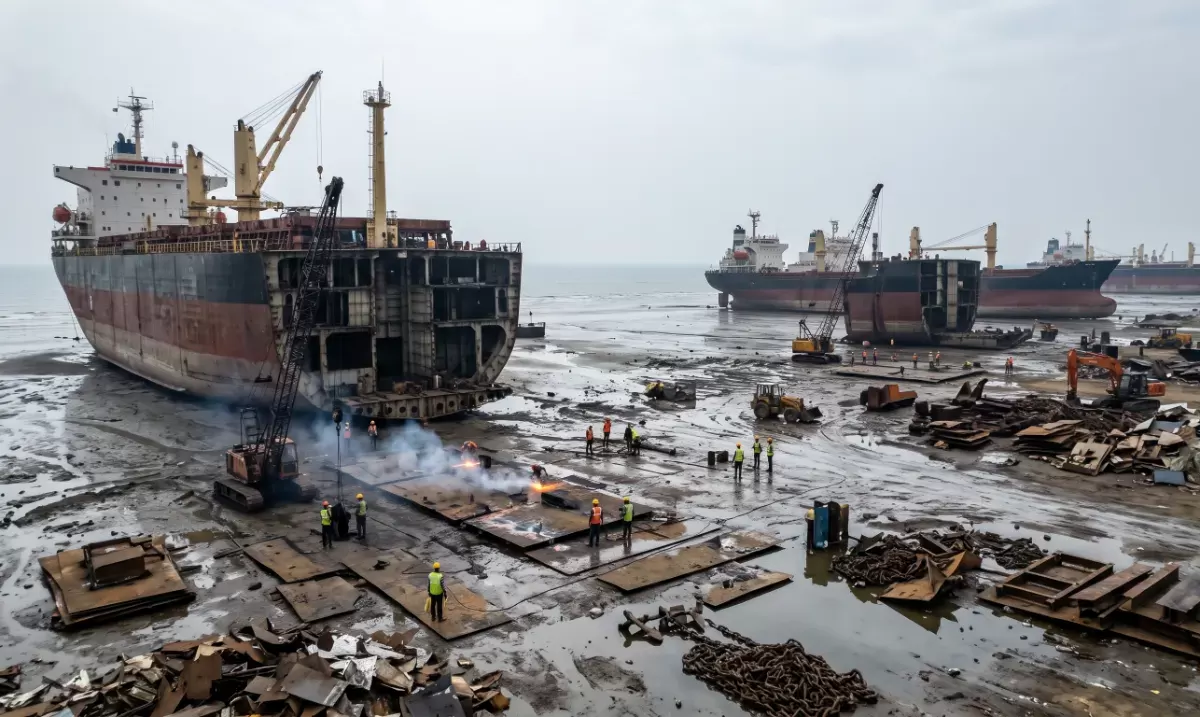
India's attempt to gain access to the European List of Ship Recycling Facilities suffered a major setback on November 25, 2026, when the European Parliament voted to reject the European Commission's proposal to include two Alang shipbreaking yards—Shree Ram Vessel Scrap Pvt Ltd and YSI Recyclers LLP—in the EU's approved list. The vote was 377 in favor, 214 against, with 24 abstentions, reflecting the European Parliament's firm stance on the controversial "beaching" dismantling method.
The origins of this setback can be traced back to July 22, 2026, when the European Commission issued a draft implementing decision proposing the inclusion of these two Alang yards in the EU list following independent inspections that found them compliant with the EU Ship Recycling Regulation (EU SRR). At the time, Indian officials viewed this as a historic breakthrough, as it would have made India the first non-OECD country to have shipbreaking facilities included in the EU list, granting Alang direct access to dismantle EU-flagged end-of-life vessels. The Alang-Sosiya shipbreaking cluster is the world's largest shipbreaking center.
The Indian government invested substantial political capital in this effort. In its submission to the European Commission on August 29, India's Directorate General of Shipping refuted the claim in the draft annex that Indian law lacked procedures for approving ship recycling plans, calling it "factually outdated." The Gujarat Maritime Board also formally supported the inclusion of both yards. On November 24, eight global shipping organizations including BIMCO, the International Chamber of Shipping, and the World Shipping Council issued an open letter urging Members of the European Parliament to respect the independent inspection reports.
However, the European Parliament's Committee on the Environment, Climate and Food Safety (ENVI) had already voted against the proposal on November 4, and this objection was upheld in the November 25 plenary vote. The core dispute centers on the "beaching" method: ships are driven onto intertidal mudflats for dismantling. The Belgian NGO Shipbreaking Platform argues this practice makes it impossible to meet EU requirements for impermeable floors and effective drainage systems to control oil leaks and hazardous materials. The European Commission's position is that if the hull remains intact during initial cutting and the yard follows strict operating procedures, it can contain waste, and therefore assessments should be made on a facility-by-facility basis rather than a blanket ban on tidal sites.
The shipping industry expressed strong disappointment at this outcome. BIMCO issued a statement saying the decision "ignores the evidence," noting that the European Commission's own inspection reports confirmed both yards meet EU SRR requirements and its Technical Guidance Note. ECSA Secretary-General Sotiris Raptis stated: "If a yard complies with the EU's high safety and environmental standards, then location is irrelevant." GMS, the world's largest buyer of scrapped ships, has long argued that the EU's continued refusal to list Indian yards is a "failure of political will" rather than a lack of standards, pointing out that Alang's annual dismantling capacity (approximately 4.5 million light displacement tons) exceeds the combined capacity of all facilities currently on the EU list.
The timing of this vote is particularly sensitive. The EU and India are scheduled to sign a free trade agreement in mid-December 2026, and there are reports that the EU is considering a compromise to allow India to continue importing EU scrap metal to avoid affecting the trade agreement. The European Parliament's vote is not legally binding, and the European Commission can still override it and publish an updated list. However, the Commission must first consider Parliament's objection, and the 27 member states will vote before the Commission makes a final decision.
India's shipbreaking industry has made significant progress in regulatory compliance in recent years. The Indian government has provided ₹53.5 crore in financial assistance to help 115 facilities achieve Hong Kong Convention compliance, and 35 Alang shipbreaking yards have applied for EU green-listing. However, India's shipbreaking industry also faces internal challenges: only approximately 36-40 facilities have obtained the Document of Authorisation for Ship Recycling (DASR), fewer than half of the Hong Kong Convention-certified facilities, which has caused some shipowners to hesitate when choosing Indian yards.
The fate of this issue will have implications for the global shipbreaking landscape. BIMCO estimates that approximately 15,000 vessels will need to be dismantled by 2032, far exceeding the capacity of the current EU list (41 facilities, primarily in Europe and Turkey). If Indian yards continue to be excluded from the EU list, EU shipowners will face a shortage of compliant dismantling capacity, while a large volume of end-of-life vessels will still flow to South Asia through non-EU flag registries. As GMS stated: "The data has been submitted, inspections have been conducted, capacity has been proven. What is missing is a decision."