
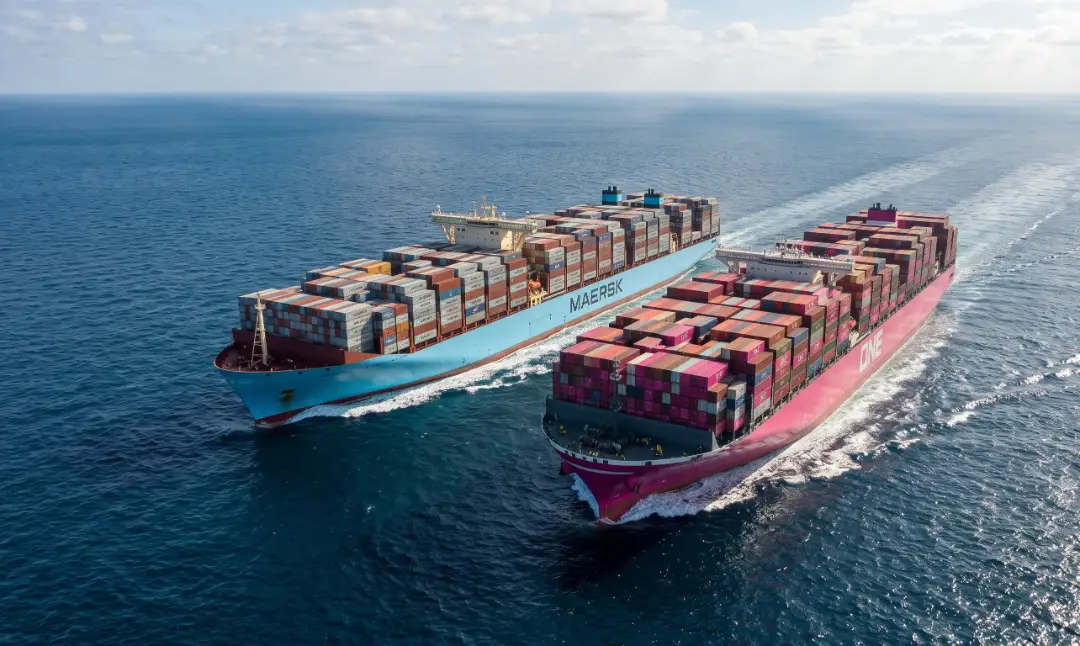
Maersk and ONE are reportedly working to establish a vessel-sharing agreement covering global north-south trade routes, a move that would create the container shipping industry's first alliance framework of this kind. The information originated from industry sources in Asia cited by The Loadstar, and both companies have not responded to requests for comment.
The novelty of this potential cooperation lies in its scope. Container shipping companies have traditionally treated north-south trades as a series of separate partnerships, selecting different partners based on the specific route, with each agreement typically covering only two or three services. This potential Maersk-ONE partnership would instead attempt to establish a global framework rather than negotiating route by route.
The core logic of the partnership rests on fleet complementarity. According to Alphaliner data, 36% of ONE's operated capacity consists of vessels in the 10,000–15,100 TEU range, compared to only 14% for Maersk. Among the 55 vessels ONE has on order, 29 fall within this size range, accounting for 60% of the total 647,000 TEU orderbook. Linerlytica data shows that the average vessel size on the Far East-Latin America route is already 10,032 TEU, precisely the segment where ONE has an advantage.
Why not choose Hapag-Lloyd, Maersk's Gemini Cooperation partner? The report points out two obstacles: first, CSAV holds 30% of Hapag-Lloyd and is a party to the shareholder agreement controlling over 70% of the company, meaning merging west coast South America networks would bring together two established carriers serving the same Chilean and Peruvian exporters. Second, Hapag-Lloyd's orderbook represents only 19% of its fleet, the lowest among the eight largest carriers, while capacity on the Far East-Latin America route has grown 14% in the past year.
Data on the Asia-West Coast South America route further supports the partnership rationale. Linerlytica data shows Maersk holds 16.1% of weekly capacity and ONE holds 9%, combining for approximately 25%, surpassing the individual shares of CMA CGM and MSC. This scale may attract attention from competition authorities in Chile and Peru, but it also means the combined capacity of the two carriers could provide more stable service coverage on this route.
However, implementing this agreement faces real obstacles. Hapag-Lloyd is a partner of ONE in several north-south service consortia, meaning the deal would require restructuring existing partnerships involving Maersk's Gemini partner. Meanwhile, Maersk continues to cooperate with CMA CGM on Asia-West Africa services, which would also require adjustment. The report notes that similar disentanglements may be necessary on other north-south routes.
The form of "global" may be more about scope than mechanism. North-south shippers pay for direct calls, Brazil reserves feeder legs for Brazilian-flag operators, and Mexican ports do little relay business. This suggests the partnership may take the form of: on core routes where one carrier's fleet fits, that carrier's vessels operate the service; on routes requiring mixed vessel deployment, services are shared—rather than adopting a Gemini-style hub-and-spoke network.
For the market, the key question is where ONE's 13,724 TEU newbuilds will be deployed in 2027. The industry has long assumed that north-south partners must be selected route by route. The Maersk-ONE framework tests a different premise: that the scarce input is having the right ships, and a carrier holding them can be a partner almost everywhere. If this model succeeds, it could reshape how the container shipping industry organizes north-south trade cooperation.