
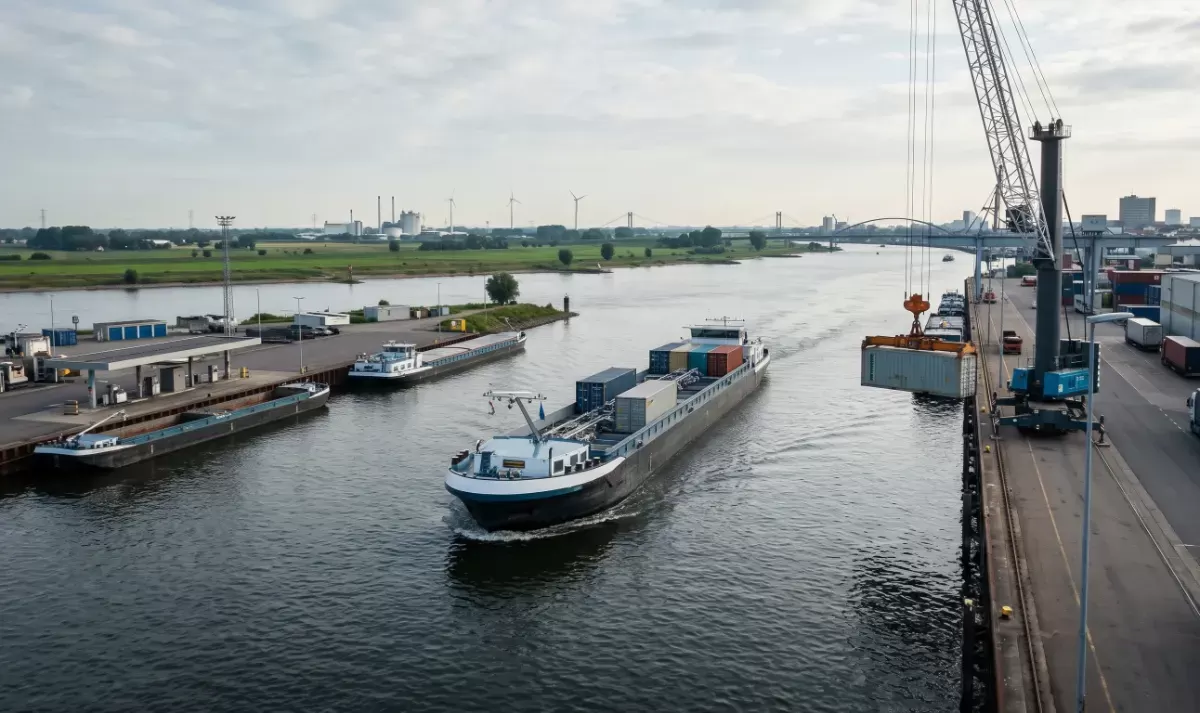
A study based on the PLATINA4Action project model found that cost modeling for European inland shipping significantly underestimates the actual market price of renewable diesel (HVO), thereby distorting the economic competitiveness comparison between battery swapping and renewable liquid fuels. The original model concluded that HVO had a cost advantage over battery swapping, but verification using real market data completely reversed this conclusion.
According to the PLATINA4Action model calculation, for a newly built 110-meter dry cargo vessel, HVO propulsion costs €1,798 per day, while battery swapping costs €1,964 per day. Under these assumptions, HVO appears more economical than battery swapping. However, this figure is based on the model's preset HVO price assumptions rather than actual market transaction prices.
When the actual Dutch HVO market price from October 2026 (including delivery costs) is applied to the calculation, the situation changes dramatically. The market price translates to approximately €2.59 per kilogram, bringing HVO's daily propulsion cost to €2,515, which is €551 higher than battery swapping's €1,964. This means battery swapping is actually more economically advantageous than renewable diesel.
The study further calculated that the price tipping point between the two is approximately €1.93 per kilogram. When HVO market prices exceed this level, battery swapping becomes the more economical choice. Given current market conditions, battery swapping is already below this tipping point, while actual HVO prices are significantly higher.
This discrepancy reveals a systemic bias in European inland shipping transition research. The analysis points out that European studies tend to provide favorable future price assumptions for renewable liquid fuels, while simultaneously expecting marine battery costs to remain high for a long time—an assumption that lags behind the broader battery market's cost decline trends. This bias directly influences policy recommendations and investment decisions.
The background to this issue is that the Central Commission for the Navigation of the Rhine (CCNR) commissioned the original transition study, whose scenario assumptions were inherited by PLATINA4Action and the SYNERGETICS project. Although these projects do not use completely identical models, their assumptions and recommendations collectively shape a policy landscape that expects multiple combustion pathways to maintain competitiveness with direct electrification.
The economic implications of price distortion cannot be overlooked. According to CCNR's 2026 cost index, fuel accounts for 35% of dry bulk transport costs, 30% of tanker costs, and 28% of container transport costs. Freight operators face competition from rivals still using diesel and cannot simply pass on the high costs of alternative fuels to customers. Additionally, HVO competes with aviation fuel for limited raw materials such as oils and fats, further pushing up its price.
The actual development of battery swapping technology provides a reference for the market. The pay-per-use battery swapping model operated by ZES (Zero Emission Services) in the Netherlands has been implemented on multiple inland vessels, with battery packs in standard 20-foot container form that can be swapped at multiple terminals. Shipowners need only pay for energy consumption, without bearing the high upfront costs of battery purchases. This model offers a practical alternative pathway for inland shipping decarbonization.