
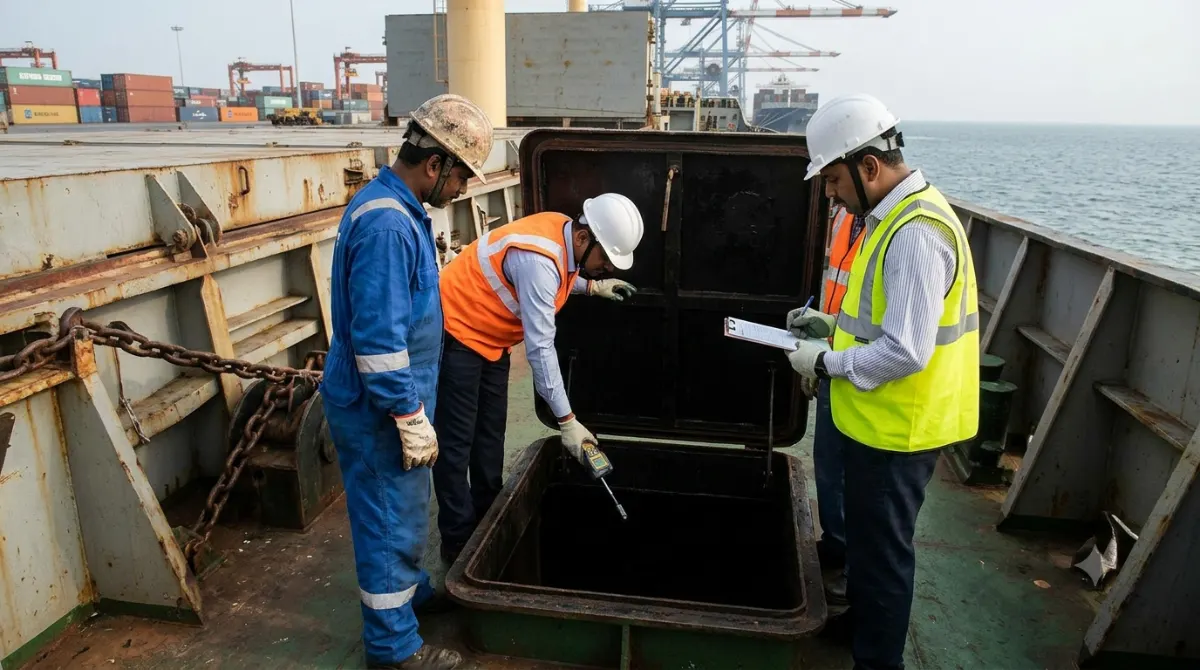
The Directorate General of Maritime Administration (DGMA) has issued Merchant Shipping Notice No. 09, mandating the implementation of revised International Maritime Organization (IMO) recommendations for entering enclosed spaces aboard ships. The regulatory directive applies across Indian-flagged vessels as well as foreign ships calling at Indian ports, aiming to eliminate preventable fatalities caused by oxygen depletion, toxic gases, and hazardous atmospheres.
Enclosed spaces on vessels—such as cargo holds, ballast tanks, double bottoms, fuel tanks, pump rooms, and void spaces—pose severe life-threatening risks when ventilation is inadequate or cargo residues emit harmful vapors. Despite existing international safety regulations, enclosed space incidents remain one of the leading causes of occupational fatalities in global shipping, frequently claiming both initial entrants and untrained rescuers.
Under the updated guidelines enforced by DGMA, shipowners, masters, and port terminal operators must carry out rigorous joint risk assessments prior to opening or entering any confined compartment. The notice places heightened emphasis on clear communication and shared safety accountability between shipboard crew and shore-based stevedores, surveyors, and repair workers.
A core requirement of the revised protocol is comprehensive pre-entry atmospheric testing using calibrated multi-gas detectors. Before any entry permit is authorized, responsible officers must verify safe oxygen levels alongside the absence of flammable vapors, carbon monoxide, hydrogen sulfide, and cargo-specific toxic gases across multiple levels of the compartment.
Continuous mechanical ventilation and ongoing atmospheric monitoring during occupancy are also reinforced under the directive. Whenever ventilation is interrupted or working conditions change inside a hold or tank, personnel must evacuate immediately and re-verify air quality before resuming operations.
Merchant Shipping Notice No. 09 further mandates that every crew member entering an enclosed space carry an operational personal gas detector and maintain continuous communication with a dedicated attendant stationed outside the entrance. Rescue equipment, including self-contained breathing apparatus (SCBA) and retrieval harnesses, must be staged and ready at the access point prior to entry.
To build stronger safety culture on board, shipping companies are required to conduct regular, realistic enclosed-space entry and rescue drills, ensuring seafarers recognize early warning signs and follow disciplined emergency response procedures rather than attempting impulsive, unprotected rescues.
Maritime safety experts and seafarer welfare bodies have welcomed DGMA’s proactive enforcement of the revised IMO framework, noting that harmonized ship-shore protocols and stricter compliance checks during port state control inspections will significantly strengthen occupational safety across Indian waters.