
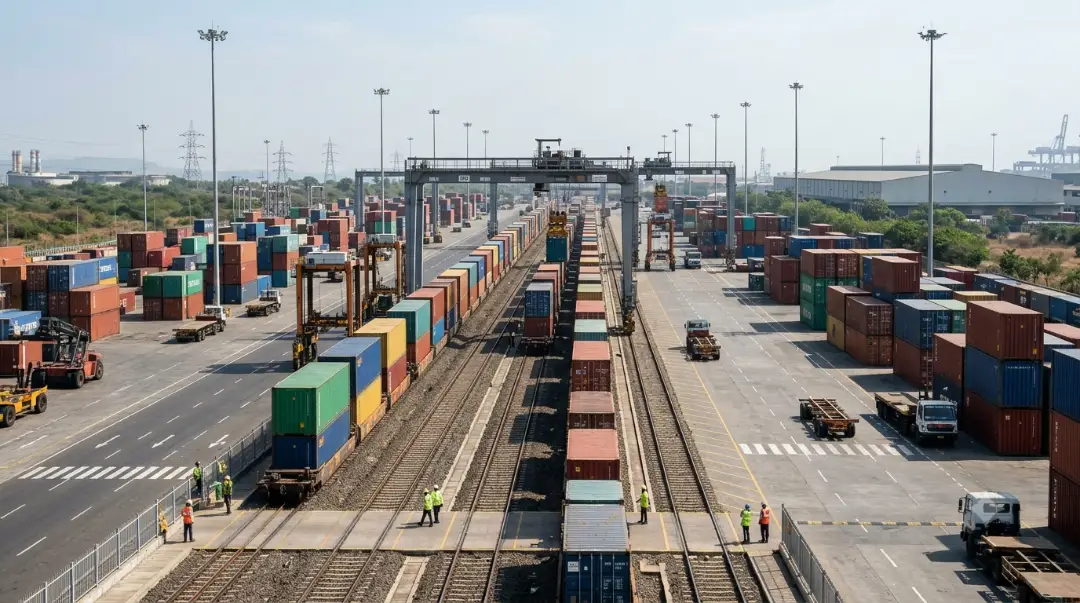
Jawaharlal Nehru Port Authority (JNPA) has awarded an eight-year contract to Gateway Distriparks Limited (GDL) for the operation and management of a Dedicated Freight Corridor (DFC)-compliant common rail yard at Nhava Sheva, Navi Mumbai. The agreement also includes an option for a two-year extension, establishing a long-term operational framework to streamline rail-borne container movement at one of India’s busiest maritime gateways.
Designed specifically to handle DFC-compliant rolling stock, the common rail yard serves as a critical interface between JNPA’s container terminals and the Western Dedicated Freight Corridor (WDFC). By enabling seamless handling of long-haul, double-stack container trains directly from the port precinct, the facility significantly expands rail evacuation capacity and reduces transit bottlenecks for EXIM cargo.
Under the contract terms, Gateway Distriparks will oversee end-to-end yard operations, rake handling, container sorting, and train dispatch coordination across multiple terminal operators and rail freight operators. Consolidating rail operations within a common-user facility eliminates fragmented shunting movements and improves overall track utilization within the port complex.
For exporters and importers across northern, western, and central India, faster rail turnaround at Nhava Sheva translates directly into shorter port dwell times and more predictable supply chain schedules. Improved rail connectivity to Inland Container Depots (ICDs) across the National Capital Region, Gujarat, Rajasthan, and Punjab enhances the competitiveness of Indian merchandise trade.
Gateway Distriparks brings extensive nationwide experience in operating rail-linked ICDs, container trains, and intermodal logistics parks. Taking charge of the common rail yard at JNPA reinforces the company's integrated network, creating tighter operational synergies between port-side rail terminals and its inland container hubs.
The initiative also aligns closely with JNPA’s broader sustainability and modal-shift objectives. Shifting high-volume container traffic from congested highway corridors onto electrified Dedicated Freight Corridor rail lines substantially lowers per-ton carbon emissions, eases road congestion around Mumbai, and brings down overall logistics costs.
Industry stakeholders note that standardized, high-efficiency common rail infrastructure is essential as JNPA scales up its annual container handling capacity and prepares for upcoming mega-port developments along the Maharashtra coast. Reliable DFC integration ensures that landside rail infrastructure keeps pace with growing vessel sizes and berth productivity.
With Gateway Distriparks set to manage the facility over the coming decade, trade and shipping lines anticipate higher rake availability, faster train formations, and greater reliability across India's flagship container rail corridor.