
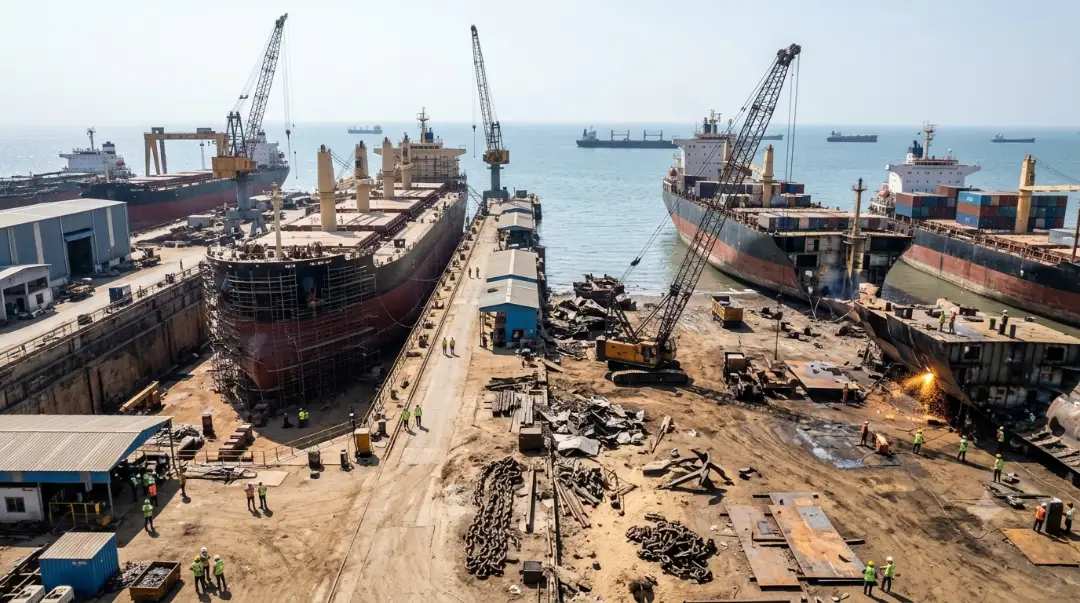
In a significant move to revitalize India’s maritime manufacturing sector, the Directorate General of Maritime Administration (DGMA) has issued 11 ship recycling credit notes totaling over ₹100 crore. Rolled out under the flagship Shipbuilding Financial Assistance Scheme (SBFAS), this policy mechanism directly connects environmentally responsible ship dismantling with fresh order books for domestic shipyards, accelerating the modernization of India’s commercial fleet.
The initial batch of 11 digital credit notes has been allocated to a diverse group of domestic and international maritime operators. Notable recipients include Care Cabotage Holding Pte Ltd, which secured the highest single allocation at ₹18.25 crore, alongside Bengaluru Shipping Corporation at ₹9.04 crore, and GMCC, which received two separate notes valued at ₹7.36 crore and ₹3.45 crore. Other beneficiaries in this tranche include Trade Bridge Inc (₹5.71 crore), Sea Line Inc (₹5.37 crore), Aries Navigation Ltd (₹4.78 crore), GSPL (₹4.5 crore), and East Youhui Trading (₹3.95 crore).
According to maritime officials, this rollout represents just the beginning of the credit disbursement pipeline. Seven additional credit notes are currently in the final stages of processing and are scheduled for issuance shortly, signaling strong early adoption among vessel owners looking to phase out older tonnage while capitalizing on government-backed financial incentives.
The credit note framework operates under a dedicated ₹4,001 crore budgetary allocation carved out from the broader ₹24,736 crore SBFAS corpus approved by the Union Cabinet. Under the scheme's guidelines, shipowners who send their end-of-life vessels to be dismantled at a Hong Kong Convention (HKC)-compliant recycling yard in India are granted a credit note equivalent to 40% of the vessel's fair scrap value.
By mandating that recycling take place exclusively at HKC-compliant facilities, the government is simultaneously reinforcing global environmental and worker safety standards across India’s shipbreaking hubs, particularly in Alang, Gujarat. The policy prevents aging vessels from being diverted to non-compliant yards while ensuring that valuable steel and maritime components are recovered sustainably within the domestic supply chain.
To maximize commercial flexibility for shipping companies, the DGMA has structured these digital instruments to be both stackable and freely transferable in the open market. Vessel owners who do not have immediate fleet expansion plans can monetize their credit notes by trading them to other maritime operators or investors, creating a liquid secondary market for maritime sustainability credits.
When redeemed, the credit notes can be used to offset up to 5% of the total contract value of a newly constructed vessel ordered from an Indian shipyard. Carrying a validity period of three years from the date of recycling completion, the notes provide shipbuilders and fleet operators with a predictable window to finalize vessel designs, secure financing, and execute new-build contracts.
Industry analysts view the issuance of these 11 credit notes as a timely catalyst for India's long-term maritime ambitions under the Maritime Amrit Kaal Vision 2047. By lowering the effective capital expenditure of ordering ships domestically and incentivizing the retirement of older, higher-emission vessels, the circular policy framework strengthens India's position as an integrated global hub for both green ship recycling and modern shipbuilding.