
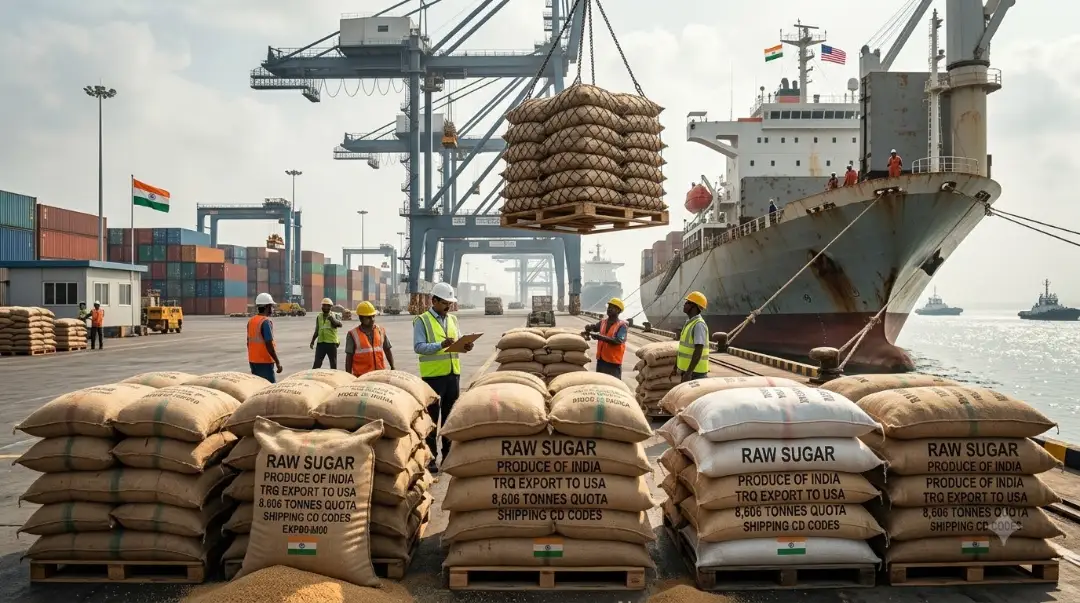
India has allocated 8,606 tonnes of raw sugar for export to the United States under its tariff-rate quota framework, a small but symbolically significant move that confirms the government is maintaining strict control over sugar exports even as domestic supply conditions improve . The allocation, reported by Chinese financial media on 24–25 November 2026, covers the TRQ period from 1 October 2026 to 30 September 2027 and will be implemented by the Agricultural and Processed Food Products Export Development Authority.
The TRQ mechanism allows a specified quantity of sugar to be exported to the US at a preferential tariff rate, separate from the general export restrictions that India has maintained to protect domestic supply. Exports to the US and EU under HS code 17010000 remain classified as "Free" subject to the conditions of the notification, meaning that the quota allocation does not change the broader export control framework but provides a defined channel for the TRQ quantity .
The timing of the allocation reflects favourable domestic supply conditions. India's early 2026-27 crushing season output is running at more than double the level recorded a year earlier, and the government has prioritised edible sugar supply over ethanol diversion, reinforcing domestic availability . The allocation therefore serves to fulfil India's WTO commitments and maintain trade relationships rather than to drive significant export volumes.
The scale of the quota is minimal relative to India's total sugar production. The 8,606-tonne allocation is a fraction of national output, and its impact on international sugar prices is negligible. However, the decision to allocate the quota at all, rather than withholding it, signals that the government is confident in domestic supply and is willing to maintain its reputation as a reliable supplier within the TRQ framework.
For India's agricultural export logistics, the sugar quota is a minor flow compared with the rice, wheat, and other commodities that dominate the export trade. The quota will move through Indian ports to US destinations, but the volumes involved are too small to have a material impact on port or shipping operations. The significance of the allocation lies in what it says about the government's policy stance: India remains committed to its international trade obligations even while maintaining domestic supply controls.
Looking ahead, the key question is whether the government will expand the TRQ allocation or maintain it at the current level. If domestic production continues to run ahead of last year and prices remain stable, there may be scope for a larger allocation. If supply conditions tighten or prices rise, the government could reduce or withhold the quota. For now, the 8,606-tonne allocation represents a calibrated middle path between complete export restriction and full liberalisation, and it reflects the government's assessment that domestic supply is sufficient to meet both consumption needs and limited export commitments.