
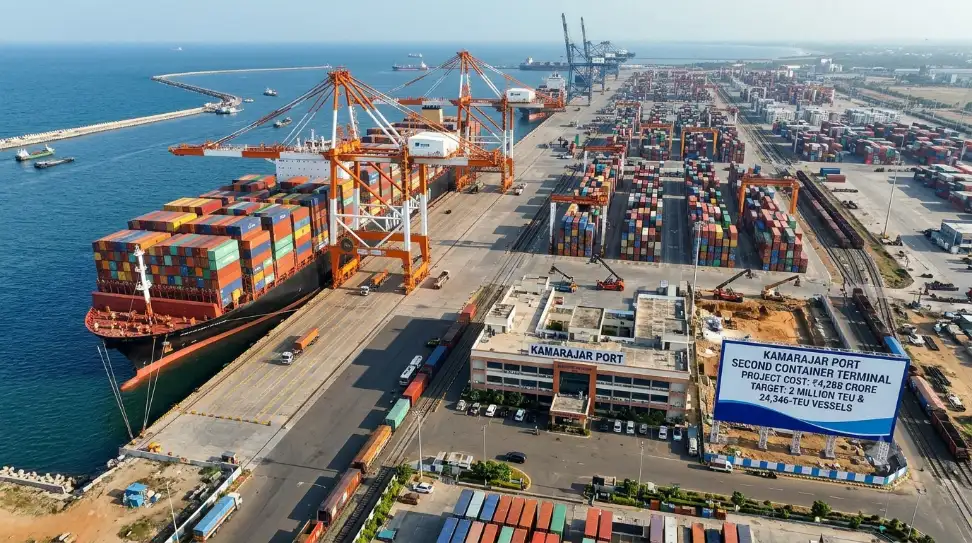
The Union Cabinet has approved a ₹4,288.26 crore second container terminal at Kamarajar Port Limited in Tamil Nadu, clearing one of the largest container infrastructure projects on India's eastern coast . The decision, announced by Union Minister Ashwini Vaishnaw on 25 November 2026, was taken by the Cabinet Committee on Economic Affairs chaired by Prime Minister Narendra Modi, and it addresses a capacity constraint at a port that is already operating near its limits.
The existing container terminal at Kamarajar has an installed capacity of 0.8 million TEUs annually and handled approximately 0.7 million TEUs in FY 2025–26, representing utilisation of about 88% . That level of utilisation leaves little headroom for growth, and the feasibility study projects continued growth in container traffic across the south-eastern region, supporting the need for additional capacity. India's container traffic has grown at a compound annual growth rate of about 7% over the past five years, while Kamarajar's container traffic grew at approximately 9.9% during the same period.
The new terminal's specifications are designed for the next generation of container vessels. The 900-metre terminal with a design draft of 18 metres will be capable of handling vessels of up to 24,346 TEUs and 400 metres in length overall . This capability is significant because it will allow Kamarajar to accommodate larger mainline ships directly, reducing dependence on foreign deep-water transshipment hubs and the feedering costs associated with routing cargo through Colombo or other regional ports . The terminal will be developed in two phases: Phase I with 1.1 million TEUs capacity at ₹2,429.32 crore, and Phase II with 0.9 million TEUs capacity at ₹1,858.94 crore.
The project's financing structure places the investment burden on the private concessionaire. The ₹4,288.26 crore PPP component is to be financed entirely by the selected concessionaire through the DBFOT framework, with Kamarajar Port separately bearing the ₹450 crore dredging cost . The concession period is 40 years, including a 48-month construction period. The government stated that the project would have no financial implication for the Centre, as the investment in the PPP component would be mobilised entirely by the selected concessionaire.
The timeline is defined and phased. Phase I is scheduled for completion within 24 months from the Date of Award of Concession, with commercial operations commencing in the 25th month. Construction of Phase II will take place between the 25th and 48th months, with full commercial operations commencing in the 49th month . The concessionaire will be selected through an open global bidding process and will recover its investment through user charges under the applicable tariff framework.
For the Chennai–Ennore industrial region, the terminal addresses a growing gap between container demand and port capacity. Key cargo-generating sectors include automobiles and auto components, engineering goods, electronics, chemicals, and other manufactured products . The project is expected to provide an additional gateway for EXIM cargo from industrial clusters in Tamil Nadu and neighbouring regions, supporting manufacturing and trade across Tamil Nadu, Karnataka, Andhra Pradesh, Telangana, and the adjoining hinterland.
The timing of the approval aligns with the broader expansion of India's east coast port infrastructure. The project is aligned with Maritime India Vision 2030 and Maritime Amrit Kaal Vision 2047, and it is expected to strengthen Kamarajar's position as a container gateway on the eastern coast while improving the efficiency of the maritime logistics chain . The port handled 49.08 million tonnes of cargo and 1,008 vessels during FY 2025–26, including more than 7 lakh TEUs of container traffic, and it recorded revenue of ₹1,280 crore and profit before tax of ₹924 crore last financial year.
Looking ahead, the key milestones are the completion of the global bidding process, the award of the concession, and the commencement of Phase I construction. The project is expected to generate around 750 direct and indirect jobs during construction, with approximately 800 additional operational jobs . For now, the Cabinet approval marks the transition from planning to procurement, and the selected concessionaire will determine how quickly the terminal moves from approval to operational capacity.