
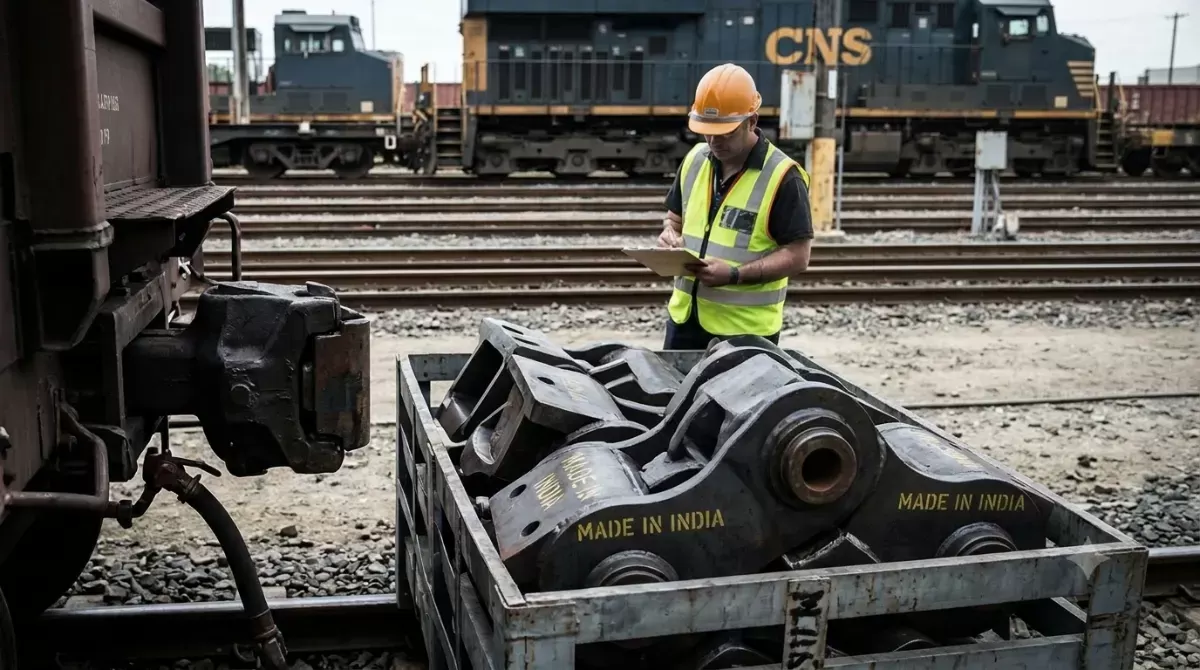
The US Commerce Department has imposed anti-dumping and countervailing duties on freight rail couplers from India, adding a new layer of tariff burden on a specific Indian engineering export category . The determination, reported by MLex on 19 November 2026, sets a dumping rate of 9.02% for Indian exporters and a countervailing duty rate of 9.71% to offset alleged subsidies, with separate rates assigned to four individual Indian producers.
The Czech Republic, the other country covered by the investigation, faces a far higher dumping rate of 73.56%, indicating that the Commerce Department found significantly different pricing behaviour across the two sources . The disparity in rates suggests that the investigation was not a blanket action against all imports of the product but a case-specific determination based on the pricing and subsidy evidence presented for each country and each producer.
The product at issue—freight rail couplers—is a specialised component used in the assembly and maintenance of freight trains. India has a domestic rail equipment manufacturing sector that supplies both Indian Railways and export markets, and the US is one of the destinations for Indian-produced rail components. The duties will raise the landed cost of Indian couplers in the US market, potentially making them less competitive against domestic US production or imports from other countries that are not subject to the duties.
The timing of the determination is significant because it coincides with the broader escalation of US trade measures against Indian exports. Washington has proposed a 17% tariff on Indian goods following a Section 301 investigation into excess manufacturing capacity, with public consultation underway and implementation possible as early as January 2027 . The coupler duties are a product-specific action under a different legal framework, but they contribute to the same overall trend of increasing tariff barriers for Indian exporters in the US market.
For India's engineering export sector, the coupler duties illustrate the vulnerability of specific product categories to trade remedy actions even as the broader trade relationship is being negotiated. The Indian government has been pursuing a bilateral trade deal with the US and has argued that its exporters need tariff certainty and comparative advantage over competitors. The coupler determination adds a data point to the complexity of that negotiation, showing that product-level trade remedies can proceed independently of the broader deal.
The affected Indian producers have not been publicly identified beyond the four companies that received separate rates. The duties will apply to future shipments, and importers in the US will be responsible for paying them at the time of customs clearance. Indian exporters may attempt to absorb the duties through price reductions, pass them through to US buyers, or redirect their couplers to other markets, depending on the elasticity of demand and the availability of alternative suppliers.
Looking ahead, the key question is whether the coupler duties will be challenged by India at the WTO or addressed through bilateral negotiations. The US has argued that the duties are a legitimate response to dumped and subsidised imports, while India has consistently contested the methodology and findings of US trade remedy investigations. For now, the determination adds a specific, product-level cost to Indian exports at a time when the broader tariff environment is already uncertain, and it reinforces the case for Indian exporters to diversify their market exposure beyond the US.