
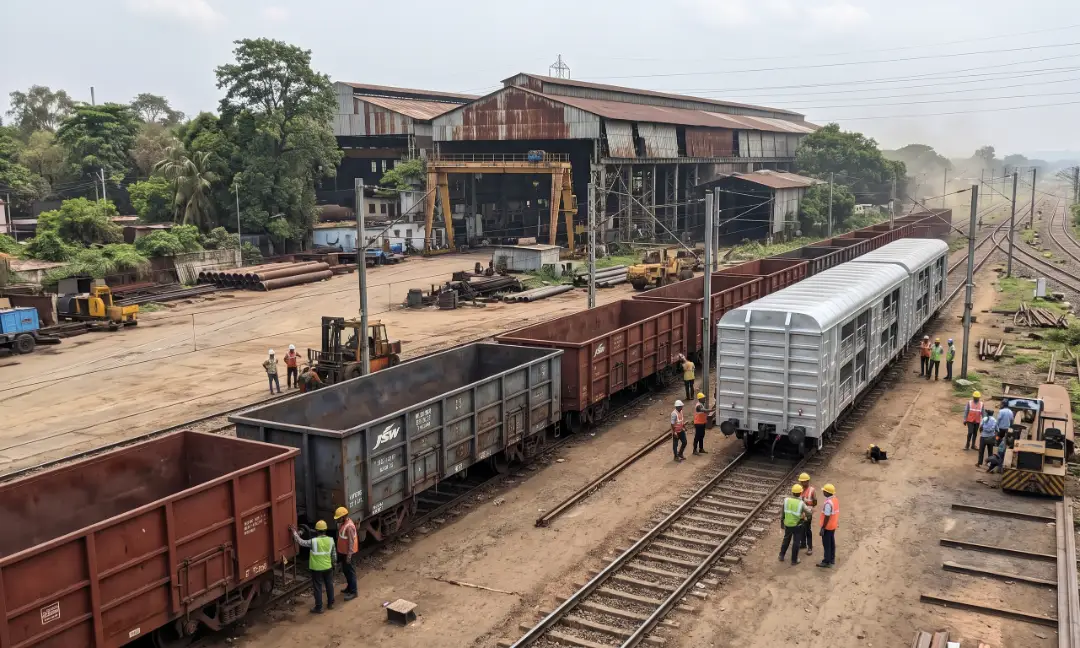
Titagarh Rail Systems Limited announced on 23 November 2026 that it has secured a new order worth ₹77.09 crore from JSW (South) Rail Logistics Pvt Ltd for the supply of 184 freight wagons . The contract comprises 181 BFNSM1 model wagons and 3 BVCM model wagons, adding to the Kolkata-based manufacturer’s freight rolling stock order book . The company did not disclose the delivery timeline for the order . The order value is equivalent to approximately 2.4 per cent of Titagarh’s consolidated revenue of ₹3,185.82 crore in FY26, positioning it as an incremental addition to the company’s revenue base rather than a transformative contract .
In a separate but strategically significant development, Titagarh received route clearance from Indian Railways to manufacture and dispatch specialised automobile carrier (ACT) wagons from its Bharatpur Manufacturing Unit . This approval connects the Bharatpur facility to the Dedicated Freight Corridor Corporation of India Limited (DFCCIL) network, enabling the company to move newly manufactured auto carrier wagons onto the dedicated freight corridor for delivery to customers . Without this clearance, Titagarh had been unable to address the growing automobile-on-rail segment despite the market’s buoyancy in recent months .
The approval makes Titagarh one of a small number of wagon manufacturers capable of producing the full spectrum of freight wagons, from pressurised tank wagons used for transporting gas and petroleum products to automobile carriers . Umesh Chowdhary, Vice Chairman and Managing Director of Titagarh Rail Systems, described the development as “another significant step towards broadening our product offerings and strengthening our capabilities in specialised freight solutions” . He added that with the approval for movement from the Bharatpur unit to the DFCCIL network now in place, the company is “better positioned to enhance our manufacturing and delivery capabilities and contribute more meaningfully to the DFC network” .
Titagarh has already initiated steps to manufacture a prototype auto carrier wagon, aiming to offer shorter delivery timelines to potential customers . The company noted that automobile movement by rail has gained momentum recently and that the auto carrier market has remained buoyant over the past few months . The prototype development represents a proactive approach to market entry, allowing Titagarh to demonstrate its capabilities to automobile manufacturers and logistics providers before securing firm orders. The company plans to actively pursue opportunities in this segment now that the regulatory barrier has been removed .
The timing of the auto carrier approval aligns with broader trends in India’s freight rail ecosystem. The government has set a target of achieving 3,000 million tonnes of freight loading by 2027, and the Dedicated Freight Corridor network is expected to play a central role in achieving this objective . Chowdhary explicitly linked the development to this national target, stating that the expansion would “support greater efficiency in freight movement and contribute towards the national target of achieving 3,000 MT freight loading by 2027” . The auto carrier segment represents a high-value niche within the freight market, as automobile manufacturers increasingly seek rail-based logistics solutions to reduce costs and carbon emissions compared with road transport.
The order and approval come amid a mixed operating environment for Titagarh’s freight business. The company dispatched 1,155 wagons in Q2 FY27, compared with 1,872 wagons in the same quarter a year earlier, reflecting softer execution despite fresh ordering . Its freight order book stood at approximately ₹4,119 crore as of 30 September 2026 . Management has indicated that Indian Railways’ option orders improved near-term visibility after production was deliberately slowed due to order uncertainty . The JSW order and auto carrier clearance together provide additional momentum as the company works to ramp up wagon production toward its target of approximately 1,000 wagons per month by Q4 FY27 .
From a strategic perspective, the auto carrier clearance represents more than an incremental product addition. It positions Titagarh to participate in a segment that has historically been underserved by domestic manufacturers, potentially reducing dependence on imports for specialised auto carrier wagons. The company’s ability to manufacture the full range of freight wagons—from tank wagons to auto carriers—strengthens its competitive position in both public and private sector procurement. The development also aligns with the government’s Make in India and Aatmanirbhar Bharat initiatives, reinforcing Titagarh’s focus on indigenous railway rolling stock and supporting India’s freight infrastructure modernisation . For cargo operators and automobile manufacturers, the emergence of a domestic auto carrier manufacturing capability could eventually improve availability and reduce lead times for specialised rolling stock, though the immediate impact will depend on the company’s ability to convert the prototype into firm orders and deliveries.