
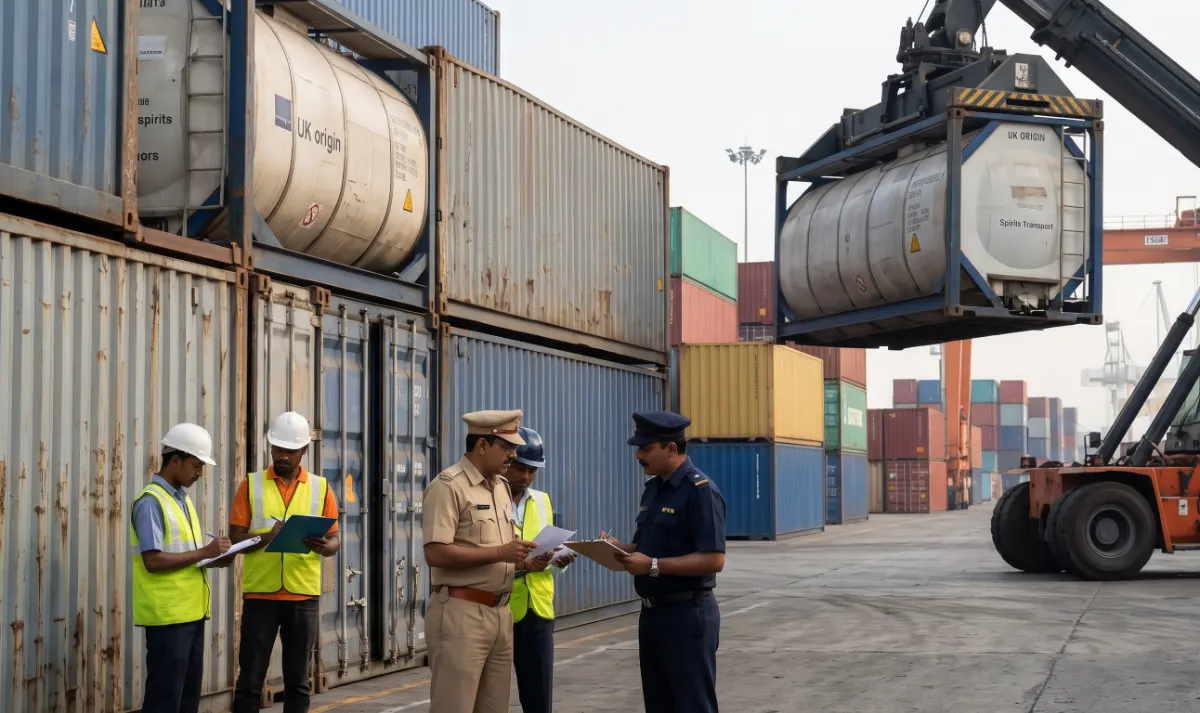
India's Commerce Secretary Rajesh Agarwal on Monday, 23 November 2026, moved to contain a growing trade dispute with the United Kingdom by reaffirming that New Delhi has not retreated from its tariff commitments under the Comprehensive Economic and Trade Agreement (CETA). Speaking to reporters in New Delhi, Agarwal stated that "the commitment is as given under CETA," adding that there was "no pull back, push back" on the concessions extended under the agreement. The clarification came after more than 80 shipping containers of bulk Scotch whisky belonging to major liquor companies were held at Indian ports, with importers facing an effective duty burden of 162.5%—higher than the pre-CETA rate of 150% .
The dispute centres on the customs classification of bulk Scotch whisky imported into India as a raw material for blending and manufacturing Indian-Made Foreign Liquor (IMFL). Under CETA, which entered into force on 15 July 2026, India reduced the basic customs duty on eligible Scotch whisky from 150% to 75%. However, the concession was negotiated on the understanding that bulk Scotch would be classified under HSN code 220830, the longstanding tariff line for whisky in containers holding more than two litres. It subsequently emerged that a significant volume of bulk Scotch was also being imported under HSN code 220890, a residual "others" category, following court rulings dating back to the early 1990s .
The legal complexity stems from judgments by the Bombay and Delhi High Courts in the early 1990s that supported importers' position in classification disputes involving bulk Scotch whisky. Agarwal acknowledged that trade negotiators were unaware that bulk Scotch was being imported under the residual category, which covers hundreds of products and was not individually tracked during negotiations. The UK side, he noted, had also not flagged the issue during talks. British industry representations recorded in a UK House of Commons committee report published after the agreement was signed suggested the matter only came to light subsequently .
The dispute escalated in November 2026 when customs investigators began reclassifying bulk Scotch concentrates—imported at alcohol strengths of 58% to 63% ABV—as "compound alcoholic preparations of a kind used for the manufacture of beverages" under a new eight-digit code (21069051) introduced through the Finance Act 2026. This classification attracts a 150% basic customs duty, and with a 5% consumption levy applied to the import value plus duty, the combined burden reaches 162.5%. Importers seeking provisional release were reportedly required to pay 75% of the goods' value upfront and furnish bank guarantees for the remaining amount .
The impact on the liquor industry has been immediate. Around 80% of Scotch whisky imported from Britain by volume arrives in bulk, with most used as raw material in IMFL production. Pernod Ricard, Diageo, and Bacardi were among the companies affected, with thousands of litres stranded at ports. Industry executives warned that the provisional release requirements could strain working capital and disrupt production schedules. The government has since instructed revenue authorities, including the Directorate of Revenue Intelligence, to release the consignments following due procedure. Agarwal confirmed that "to my knowledge, the cargo has been released," with duties to be adjusted once the classification issue is resolved .
The UK government has raised the matter with India, prompting discussions between officials from both sides. Agarwal said he had met UK importers approximately 15 days prior and found them satisfied with the discussions and the proposed way forward. The Commerce Ministry is working closely with the Finance Ministry to find a technical solution that honours India's CETA commitments while ensuring existing court orders are not violated. A final decision on whether bulk Scotch qualifies for the concession remains pending, though Agarwal indicated a resolution could come "in days rather than months" .
The dispute carries broader implications for India's trade policy credibility. The classification issue has surfaced just months after CETA took effect, raising concerns among UK exporters about the predictability of India's tariff commitments. However, Agarwal's framing of the matter as a technical classification problem rather than a policy reversal suggests New Delhi is seeking to preserve the agreement's political and economic value while navigating domestic legal constraints. The Commerce Ministry has also pointed to the Scotch Whisky Association's own submissions to the UK Parliament acknowledging that HS 220890 was being used for bulk exports for regulatory reasons but had not received the same tariff liberalisation .
For cargo operators and freight forwarders handling UK-origin alcohol shipments, the immediate operational environment remains uncertain. While the stranded containers have been released, the underlying classification question is unresolved, meaning future consignments could face similar scrutiny. Importers will need to monitor the Commerce and Finance Ministries' technical solution closely, as it will determine whether bulk Scotch shipments can clear customs at the 75% CETA rate or face the higher 162.5% burden. The outcome will also set a precedent for how India handles classification disputes under other trade agreements, particularly where legacy court rulings intersect with newly negotiated tariff schedules .