
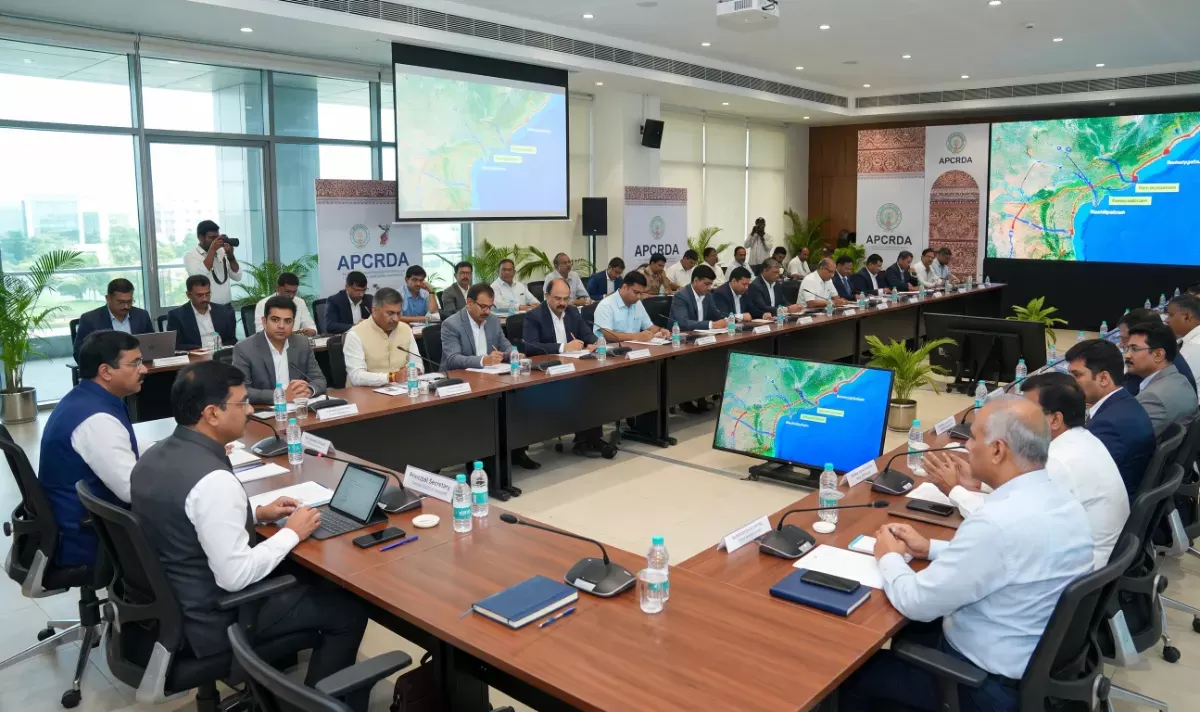
The Andhra Pradesh Capital Region Development Authority (APCRDA) has initiated a structured consultation process to define the logistics and port infrastructure requirements of the proposed Amaravati Economic Region (AER). The first of eight sectoral roundtable meetings was held at the APCRDA headquarters in Rayapudi, Amaravati, focusing specifically on ports, logistics, transport, and airports. The sessions are designed to identify infrastructure gaps, establish development priorities, and surface investment opportunities across the economic region, with recommendations to be incorporated into the AER Economic Plan .
The roundtable brought together a broad coalition of public and private stakeholders. Participants included representatives from the Andhra Pradesh Economic Development Board, APIIC, the AP Maritime Board, the Central Warehousing Corporation, APIDCL, the AP Inland Waterways Authority, and CII Andhra Pradesh, alongside private sector representatives from shipping, logistics, real estate, and urban planning . This mix reflects an intent to align public infrastructure planning with private sector commercial realities, rather than developing facilities in isolation.
The infrastructure agenda covered several interconnected proposals. Discussions focused on the development of the Machilipatnam and Ramayapatnam greenfield ports, dedicated connectivity corridors linking ports to hinterland production and consumption centres, multimodal logistics parks, and container rail terminals . The proposed international cargo terminal at Vijayawada airport was also on the table, alongside growing demand for modern Grade A warehousing facilities across the Vijayawada–Guntur–Amaravati corridor .
Principal Secretary for Municipal Administration and Urban Development, Suresh Kumar, articulated a clear strategic vision for Machilipatnam. He called for the port to be developed as a major gateway for the entire eastern coast, positioning Andhra Pradesh as a significant maritime player beyond its existing Visakhapatnam-centric cargo base . Kumar also stressed the need for technology-driven logistics systems and micro-level logistics plans tailored to the specific requirements of port areas and major cities, rather than relying solely on region-wide infrastructure blueprints .
A notable emphasis was placed on connecting the region's agricultural and aquaculture strengths to export markets. Kumar called for improved air cargo and cold-chain facilities to facilitate the export of aquaculture and horticulture products, addressing a longstanding gap in the region's ability to move perishable goods efficiently to international buyers . He also advocated for the revival of inland waterways as an alternative transport network, which could reduce road congestion and provide a cost-effective mode for bulk cargo movement .
Despite the ambitious scope, stakeholders identified several bottlenecks that could temper investor enthusiasm. Land availability emerged as a recurring concern, alongside uncertainty over the recovery of customs-related costs for air cargo services . Perhaps most critically, private sector participants highlighted the need for clearer projections of future cargo volumes, without which prospective investors would struggle to assess the commercial viability of proposed terminals, warehouses, and logistics parks . These concerns suggest that the planning process must move beyond infrastructure wish-lists to provide the data and certainty that private capital requires.
The APCRDA roundtable is part of a broader push by Andhra Pradesh to establish itself as India's eastern maritime gateway. The state has four greenfield ports under construction at Ramayapatnam, Mulapeta, Machilipatnam, and Kakinada, and recently secured investment commitments worth ₹7,532 crore for port and logistics projects at the CII Partnership Summit . Visakhapatnam Port handled a record 91.17 million tonnes of cargo in the last financial year, providing a foundation of existing throughput upon which the new port infrastructure can build . The Amaravati consultations represent an attempt to ensure that these port investments are matched by the inland logistics networks—warehousing, rail terminals, road corridors, and cold chains—needed to make them commercially viable.
The outcome of these consultations will have implications beyond Andhra Pradesh. If the state can successfully integrate its new greenfield ports with multimodal logistics infrastructure and attract private investment in warehousing and cargo terminals, it could offer a replicable model for other Indian coastal states seeking to develop port-led economic regions. Conversely, if the identified bottlenecks—land, customs costs, and cargo volume uncertainty—remain unresolved, the gap between infrastructure announcement and operational reality may persist. The remaining seven sectoral consultations will determine whether the Amaravati Economic Region becomes a genuinely integrated logistics ecosystem or remains a collection of disconnected infrastructure proposals .