
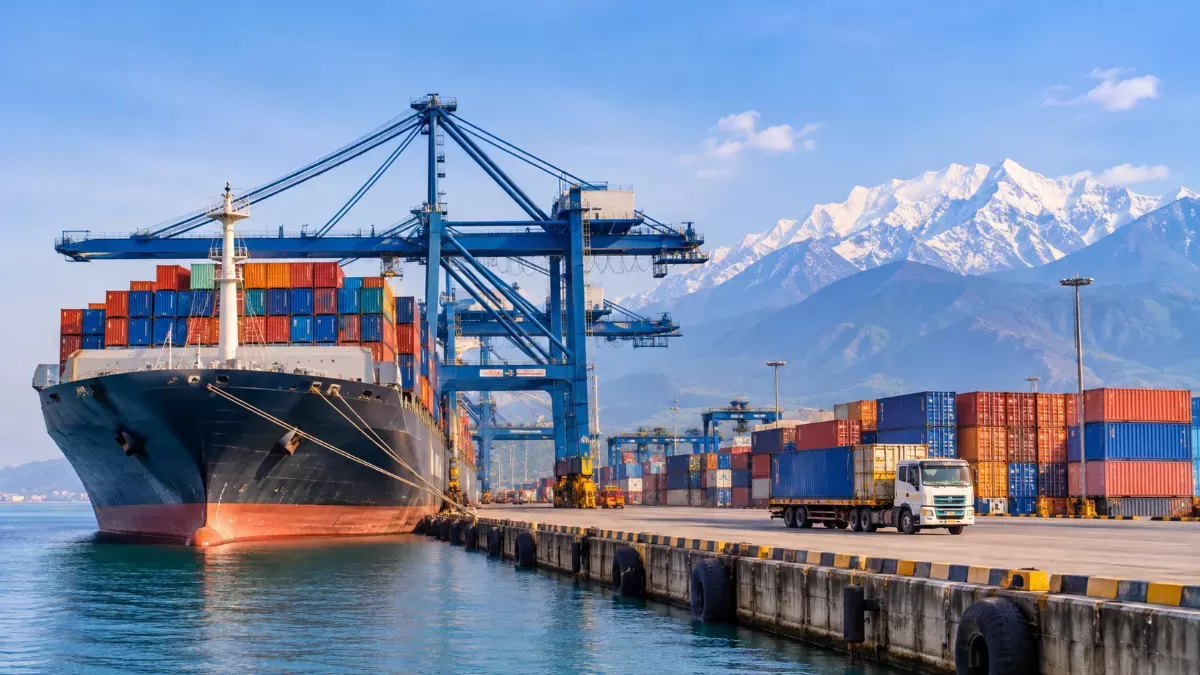
India has agreed to extend Nepal’s transit trade access to Deendayal Port at Kandla in Gujarat, marking a significant expansion of the landlocked country’s maritime connectivity options. The announcement was made during the state visit of Nepalese Prime Minister Balendra Shah to India on 22–23 November 2026, following delegation-level talks with Prime Minister Narendra Modi . Under the arrangement, Nepal will also gain access to Paradip Port in Odisha once the requisite infrastructure is developed, though no timeline has been specified for either gateway . The move is expected to provide Nepal with additional options for international trade and transit through third countries, reducing its dependence on a limited set of Indian seaports .
For Nepal, a landlocked nation that relies almost entirely on Indian territory for access to the sea, the addition of Kandla represents a strategic diversification of its transit routes. Its established transit arrangements currently cover Kolkata and Haldia in West Bengal and Visakhapatnam in Andhra Pradesh, supported by road and rail connections through India . Visakhapatnam was added following an exchange of letters in February 2016, establishing an additional route serving Nepal’s Inland Container Depot at Birgunj . The inclusion of Kandla introduces a western Indian gateway that could serve trade flows originating from or destined for markets in the Middle East, Africa, and Europe, potentially reducing reliance on the eastern ports that have historically handled the bulk of Nepal’s third-country trade.
The announcement comes amid a broader strengthening of India-Nepal bilateral relations. During the same visit, India announced a development assistance package worth ₹15,000 crore for Nepal, comprising ₹3,500 crore in grants for post-disaster reconstruction and infrastructure projects and an ₹11,500 crore rupee-denominated line of credit for energy sector projects . The two leaders also dedicated Phase II of the Motihari-Amlekhgunj petroleum pipeline, laid the foundation stone for a petroleum terminal at Jhapa, and called for work to begin promptly on the Siliguri-Jhapa pipeline . On connectivity, they announced completion of the field location survey for the proposed Raxaul–Kathmandu electrified broad-gauge railway and laid the foundation stone for a new Integrated Check Post at Banbasa .
The operational framework for Nepal’s transit trade through India is governed by the revised India–Nepal Treaty of Transit, signed on 1 June 2023, which provides for merchandise movement through India’s roads, railways, inland waterways, and ports . Existing transit rights operate through mutually agreed routes and procedures, and the addition of new ports would require corresponding amendments to the treaty and the railway service agreement, according to Nepalese trade representatives . Hari Gautam, president of the Birgunj Chamber of Commerce and Industry, noted that using the additional ports would require clear arrangements on entry and exit points, rail routes, customs checks, and transit documentation .
From the perspective of Nepalese businesses, the practical value of the new port access remains contingent on cost and efficiency factors that have yet to be detailed. Ganesh Lath, a former president of the Madhesh Federation of Industry and Commerce, observed that even if sea freight is cheaper from a particular port, the savings could be limited if rail or road transport from there to Birgunj is more expensive . He emphasised that the frequency of vessel calls, container availability, cargo-handling charges, and port clearance times will determine the overall cost of imports . The road distance from Birgunj to Paradip is approximately 1,045 kilometres, while the estimated rail distance via Raxaul and various Indian railway junctions is around 2,263 kilometres—a route that is not currently a regular direct freight service or an approved transit route for Nepal .
The development builds on earlier progress in India-Nepal rail freight connectivity. In July 2026, Indian Railways operated the first direct commercial container freight train from Kolkata Port to Biratnagar Customs Yard, carrying 40 wagons of canola under the revised bilateral rail transit protocol . The service enabled containerised cargo to travel directly to Biratnagar without transshipment at the border, building on the Jogbani–Biratnagar broad-gauge connection inaugurated in June 2023 and a revised exchange of letters signed in November 2025 . This operational milestone demonstrated that direct rail freight between Indian ports and Nepalese inland destinations is feasible, providing a potential template for extending similar services to the new gateways at Kandla and Paradip.
For cargo operators and freight forwarders, the immediate distinction remains between operating connections and newly announced access that requires implementation details. The Biratnagar freight service is operational, while Paradip’s availability will specifically depend on completion of the requisite infrastructure, and Kandla’s operating arrangements have yet to be specified . Nepalese officials and business representatives have indicated that the country would benefit directly only if regular freight train services from Paradip and Kandla to the Sirsiya dry port in Birgunj are arranged, with competitive freight rates and simplified transit procedures . The announcement thus represents a diplomatic and strategic milestone rather than an immediate operational change, with the realisation of tangible benefits dependent on the bilateral consultations and infrastructure development that must follow.
The timing of the announcement reflects the broader trajectory of India-Nepal economic relations. Bilateral merchandise trade reached approximately US$9.38 billion in financial year 2025–26, with India accounting for over 60 per cent of Nepal’s external goods trade and receiving more than 80 per cent of Nepal’s total goods exports . India is also Nepal’s largest source of foreign investment, with Indian investments estimated at around US$800 million across approximately 150 ventures . The port access arrangement, coupled with the development assistance package and energy infrastructure commitments, signals a comprehensive effort to deepen economic integration while addressing Nepal’s longstanding concerns about transit dependence and connectivity constraints.