
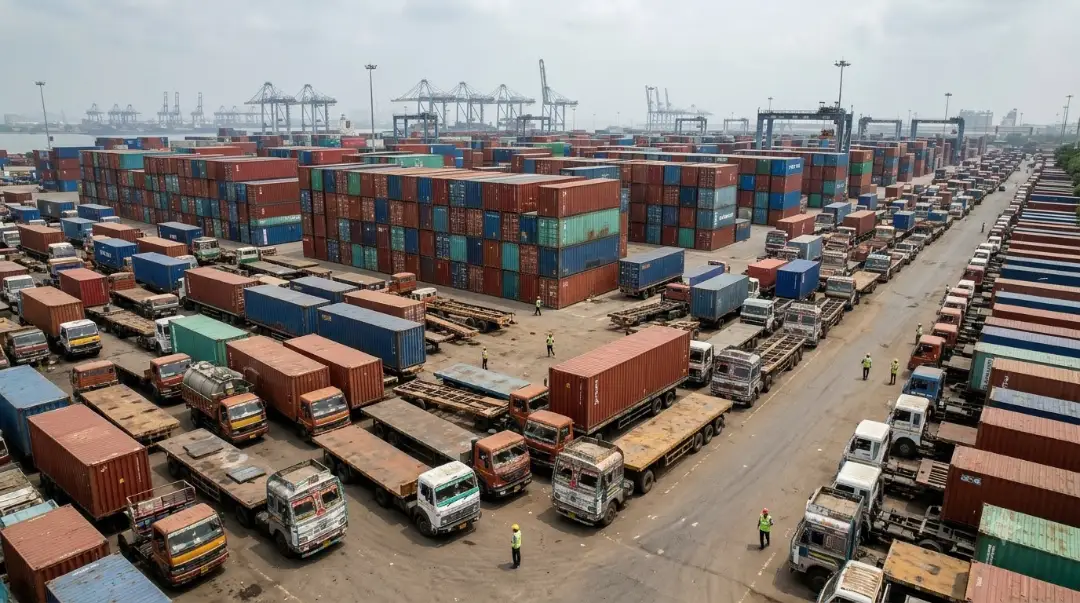
Jawaharlal Nehru Port Authority experienced a severe traffic disruption on 23 November 2026, with a 10-hour gridlock leaving more than 3,000 containers stranded near India's largest container gateway . The immediate cause, according to the Maharashtra Heavy Vehicle and Interstate Container Operators Association, was a shortage of trailer drivers: an estimated 40% of drivers who had travelled to their hometowns for Diwali and Chhath Puja did not return, leaving the port's road transport network short of the manpower needed to move containers in and out of the terminals .
The operational impact was substantial. Over 3,000 containers were stuck near the port, including export cargo worth crores of rupees destined for overseas markets . The congestion persisted for 10 hours, creating a backlog that would take time to clear even after the immediate gridlock eased. Praveen Paithankar, president of the operators' association, attributed the problem to a combination of narrow approach roads and the driver shortage, arguing that JNPA's target of handling 10 million containers is not achievable with the current infrastructure .
The disruption illustrates the vulnerability of India's largest port to labour availability in the road transport segment that connects it to the hinterland. Unlike the port's rail and terminal operations, which are managed by professional operators with scheduled workforces, the trailer fleet that moves containers between terminals, CFSs, and inland destinations depends on drivers who are mobile and can be absent for extended periods during festival seasons. When a significant share of that workforce is unavailable, the entire port ecosystem can seize up, regardless of the efficiency of the terminals themselves.
The response has been limited so far. A meeting of Navi Mumbai traffic police and related officials was scheduled for the following Tuesday to address the congestion . However, the meeting was called to discuss traffic management, not to resolve the underlying driver shortage, which is a structural issue that will persist beyond the immediate crisis. The operators' association has flagged the narrow road infrastructure as a compounding factor, suggesting that even with full driver availability, the port's road connectivity is inadequate for the volumes it is handling.
For India's export sector, the JNPA gridlock comes at a sensitive time. October merchandise exports reached an all-time high, and the government has set a $1 trillion annual target. Any disruption at JNPA, which handles a significant share of India's containerised exports, directly affects the ability of exporters to meet shipment deadlines. The 3,000+ stranded containers represent cargo that may miss vessel cut-offs, incur detention and demurrage charges, and damage India's reputation for reliability among international buyers.
The timing aligns with the broader pattern of labour-related disruptions that we have documented in recent weeks. The SIDCUL industrial area in Uttarakhand saw freight movement halve after Diwali as drivers returned home for Chhath, and the Vallarpadam terminal in Cochin experienced a 13-day boycott by trailer crews over scanning safety concerns. The common thread is that India's logistics sector depends heavily on migrant labour that is mobile, festival-sensitive, and difficult to replace at short notice. The JNPA disruption is the most visible manifestation of this vulnerability because of the port's scale and its centrality to India's export trade.
Looking ahead, the immediate priority is clearing the 3,000-container backlog and restoring normal traffic flow at JNPA. The longer-term question is whether the port and the state government will address the structural issues that made the disruption possible: the driver shortage, the narrow approach roads, and the lack of redundancy in the road transport network. For now, the gridlock serves as a reminder that port efficiency depends not only on terminal productivity but on the entire logistics chain that connects the port to its hinterland, and that chain is only as reliable as the workforce that operates it.