
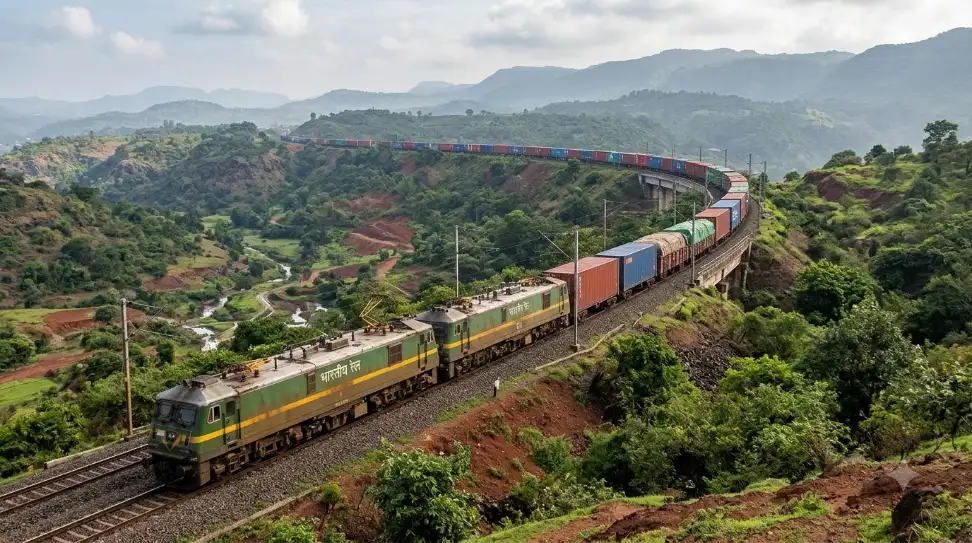
Indian Railways is expanding its commodity-specific freight reforms to 400 additional commodities after the initial phase of the programme generated ₹1,078 crore in additional revenue during calendar year 2026 . The expansion, announced by Railway Minister Ashwini Vaishnaw on 23 November 2026, extends an approach that adapts transport and handling arrangements to the specific requirements of individual cargo types, rather than applying a uniform freight model across all commodities.
The reforms currently cover 120 commodities, including bulk cement, fly ash, salt, automobiles, foodgrains, fertilisers, and petroleum products . The next phase will add limestone, sand, dolomite, gypsum, and clay, broadening the programme into construction materials and industrial minerals that move in large volumes but have historically been handled through less specialised arrangements. The Railway Minister said the changes to cement, fertiliser, and foodgrain movement had already reduced spoilage and transit losses, and he identified containerisation as a further mechanism for limiting losses in foodgrain and fertiliser shipments.
The programme is part of a broader effort to reduce Indian Railways' dependence on coal, which has historically dominated its freight mix. By tailoring services to the needs of diverse cargo categories, the railway is seeking to attract volumes that have gravitated to road transport or that have not moved by rail because of handling and transit concerns. The commodity-specific approach involves adjustments to wagon types, loading and unloading procedures, and transit scheduling that are calibrated to the characteristics of each cargo.
The revenue impact of the reforms provides a measure of their commercial traction. The ₹1,078 crore in additional revenue during 2026 is modest relative to Indian Railways' total freight earnings, but it represents incremental business generated by the reforms rather than a redistribution of existing volumes. For the railway, which has been investing heavily in dedicated freight corridors and terminal infrastructure, the ability to attract new commodity categories is a test of whether those investments can translate into a broader freight base.
The expansion builds on existing private investment in specialised wagons and cargo terminals. In an August reply to the Rajya Sabha, the Ministry of Railways said around 275 special-purpose rakes were operational under its wagon investment schemes, and 142 Gati Shakti Cargo Terminals had been commissioned with a combined handling capacity of 224 million tonnes a year . The terminals handled 146 million tonnes in FY2025–26. Indian Railways loaded 1,670 million tonnes of freight in FY2025–26, up from 1,617 million tonnes the previous year.
For shippers of construction materials and industrial minerals, the expansion of the reforms is significant because these commodities have historically been underserved by rail relative to their volume. Limestone, sand, dolomite, gypsum, and clay are bulky, low-value materials where transport cost represents a substantial share of delivered cost, and where rail's cost advantage over road should be most pronounced if the handling and scheduling arrangements are appropriate. The commodity-specific approach is intended to address the friction that has kept some of this cargo on road despite rail's theoretical advantages.
Looking ahead, the key question is whether the railway can translate the reforms into sustained volume growth in the newly covered commodities. The ₹1,078 crore in additional revenue is an encouraging indicator, but the 400-commodity expansion will require further adjustments to wagon availability, terminal access, and door-to-door cost structures. For now, the programme represents a deliberate effort to diversify Indian Railways' freight base and to compete for cargo that has historically moved by other modes.