
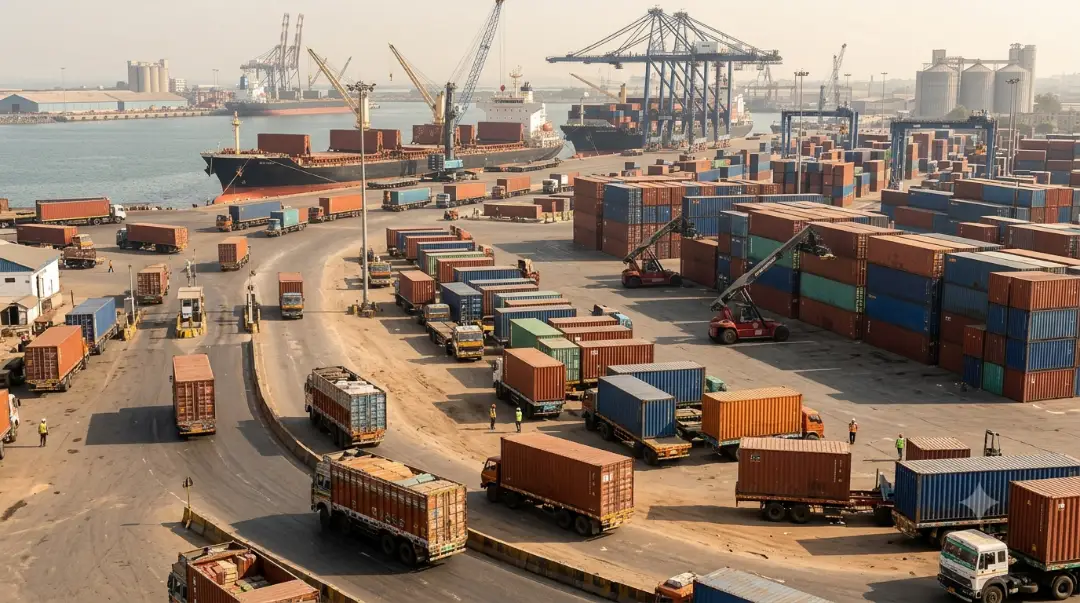
India has announced access to Deendayal Port at Kandla in Gujarat for Nepal's transit trade, adding a western Indian gateway to the landlocked country's network of seaports serving overseas trade . The announcement was made during Nepalese Prime Minister Balendra Shah's state visit to India on 22–23 November 2026, alongside measures to strengthen cross-border transport and energy connectivity.
For Nepal, the addition of Kandla represents a significant expansion of its maritime access options. Its established transit arrangements currently cover Kolkata, Haldia, and Visakhapatnam, supported by road and rail connections through India . Kandla introduces a western gateway that could serve trade flows to and from markets in Europe, Africa, and the Americas more efficiently than the eastern ports, depending on the specific cargo and destination. Paradip Port in Odisha has also been announced as a future option, though access remains conditional on infrastructure readiness, with no commencement date or detailed operating arrangements specified .
The announcement is part of a broader package of connectivity measures that the two leaders agreed upon. They announced completion of the field location survey for the proposed Raxaul–Kathmandu electrified broad-gauge railway and agreed to collaborate on Nepal's East–West Railway . They also laid the foundation stone for a new Integrated Check Post at Banbasa and inaugurated a motorable bridge connecting Dharchula in India with Darchula in Nepal. These projects are intended to strengthen the physical infrastructure that supports bilateral trade and people-to-people movement.
The rail dimension of the relationship has already seen operational progress. In July 2026, Indian Railways reported the first direct commercial container freight train from Kolkata Port to Biratnagar Customs Yard, carrying canola under the revised bilateral rail transit protocol . The service enabled containerised cargo to travel directly to Biratnagar without transshipment at the border, building on the Jogbani–Biratnagar broad-gauge connection inaugurated in June 2023 and a revised exchange of letters signed in November 2025. The Kandla and planned Paradip access extend this framework to maritime gateways on both coasts.
The commercial foundation for the relationship is substantial. Bilateral merchandise trade reached approximately US$9.38 billion in financial year 2025–26, with major Indian exports to Nepal including petroleum products, iron and steel, automobiles, machinery, and cereals . The energy dimension was also addressed during the visit, with the leaders dedicating phase two of the Motihari–Amlekhgunj petroleum pipeline and laying the foundation stone for a petroleum terminal at Jhapa. India separately announced a ₹15,000-crore development package comprising ₹3,500 crore in grants and an ₹11,500-crore rupee-denominated credit line for energy projects.
For India's logistics sector, the Kandla announcement reflects the broader pattern of regional connectivity that the government has been pursuing through its Neighbourhood First policy. Nepal is a significant trading partner, and the ability to route its cargo through Indian ports generates revenue for Indian port operators, freight forwarders, and transport companies. The addition of a western gateway also spreads the logistics burden across India's port network, reducing the concentration of Nepal-bound transit cargo at Kolkata and Haldia.
Looking ahead, the key milestones are the operationalisation of Kandla access and the development of the infrastructure required for Paradip. The joint statement did not specify when Kandla would begin handling Nepal-bound transit cargo or what procedures would govern the movement. For now, the announcement signals that India is willing to expand Nepal's maritime access as part of a broader package of connectivity and energy cooperation, and that the two countries are treating trade facilitation as a priority in their bilateral relationship.