
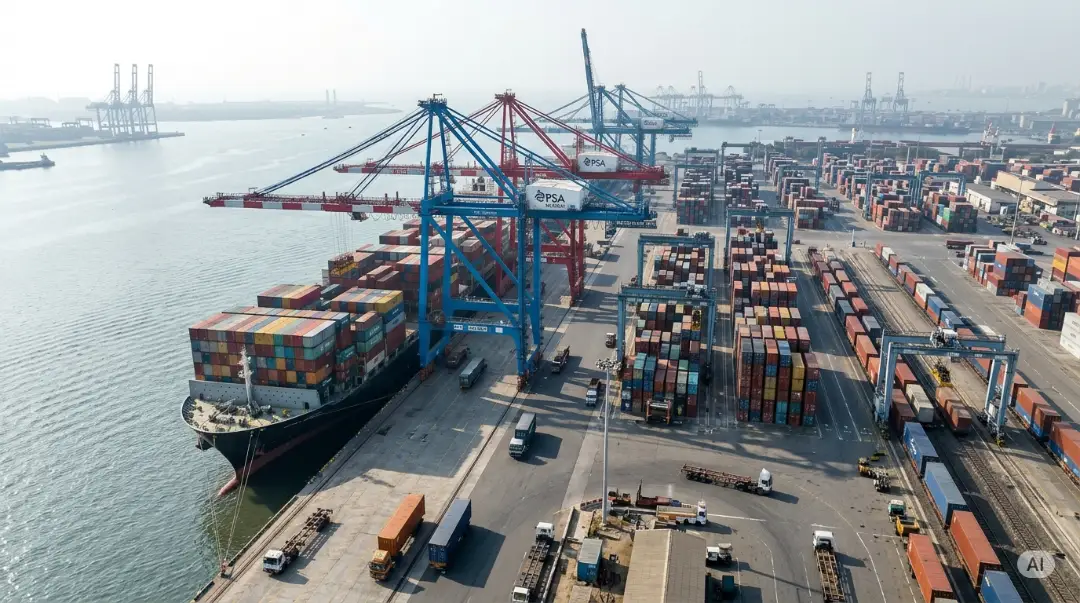
PSA Mumbai has expanded its equipment fleet at the Bharat Mumbai Container Terminals facility at Jawaharlal Nehru Port with the inauguration of two new quay cranes and six electric rubber-tyred gantry cranes, adding capacity at India's largest container terminal . The investment, reported by World Ports Organization on 22 November 2026, supports the growth of direct traffic and rail intermodality at a facility that handled 2.6 million TEU in 2025, its highest level since operations began.
The new ship-to-shore cranes are intended to increase productivity in vessel operations and reduce berth turnaround times, which is a critical metric for container terminals competing for carrier calls . Faster vessel handling allows carriers to maintain tighter schedules and reduces the port time that ships spend idle, which in turn lowers operating costs and improves schedule reliability. The six eRTGs will be used for handling and storage in the yards, ensuring lower local emissions than diesel-powered equipment, aligning with the broader push toward green port operations.
PSA Mumbai's physical footprint provides the context for the equipment investment. The terminal has 2,000 metres of quay and a nominal capacity of 4.8 million TEU per year, and it is connected to 63 inland container depots and 34 international maritime services . On the intermodal front, the port has six tracks suitable for double-stack trains up to 1,500 metres, connected to the Dedicated Freight Corridor. This rail integration is a key factor in extending the terminal's landside catchment area and easing road congestion in the Mumbai port area.
The timing of the equipment inauguration aligns with the terminal's recent performance. PSA Mumbai handled 312,179 TEUs in October 2026, its highest monthly container throughput, surpassing the previous record of 303,032 TEUs set in August . The October volume represented approximately 36% of JNPA's total container traffic for the month . The new equipment will support the terminal's ability to handle sustained volumes at these levels and potentially grow beyond them.
PSA did not disclose the amount of the investment or any increase in nominal capacity directly linked to the new equipment, but the project fits into India's strategy to improve the efficiency of national gateways and retain a larger share of international flows by avoiding foreign transshipment hubs . For JNPA, the enhanced capacity at BMCTPL supports its position as India's premier container gateway and its ability to compete for transshipment cargo that might otherwise route through Colombo or other regional hubs.
For India's logistics sector, the equipment addition is a small but meaningful increment to the country's container handling capacity. The quay cranes and eRTGs are the physical assets that determine how quickly ships can be worked and how efficiently containers can be stacked and retrieved. As JNPA handles record volumes and as carriers return to Suez routings that will bring more cargo through Indian ports, the terminal's ability to maintain productivity at higher throughput levels becomes increasingly important.
Looking ahead, the key question is whether the new equipment translates into measurable improvements in berth productivity and yard efficiency. PSA Mumbai has not disclosed the expected productivity gains or the timeline for commissioning the new cranes. For now, the inauguration signals that PSA is continuing to invest in its Indian terminal despite the global shipping disruptions of 2026, and that it sees JNPA as a gateway with durable growth prospects.