
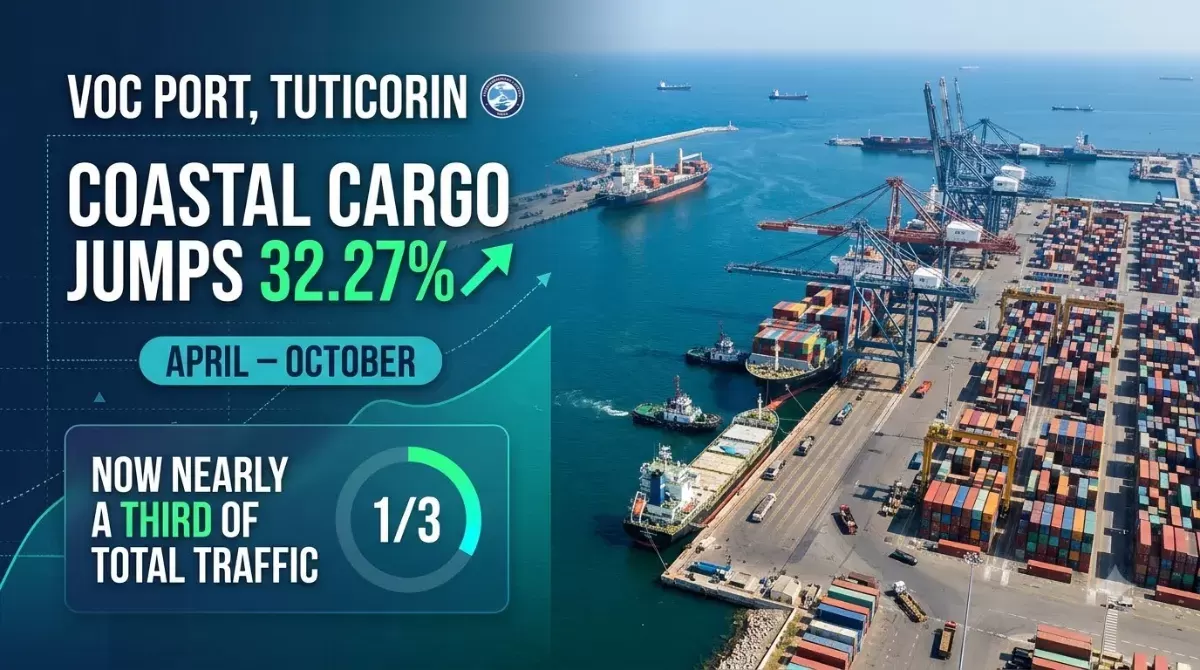
V.O. Chidambaranar Port has recorded a 32.27% increase in coastal cargo handling during April–October 2026, with coastal freight now contributing nearly one-third of its total traffic . The port handled 83.53 lakh tonnes of coastal cargo during the seven-month period, compared with 63.15 lakh tonnes in the corresponding period of the previous financial year. Coastal cargo's share of overall throughput rose from 25.03% to 32.06%, reflecting the growing importance of domestic maritime freight in the port's cargo mix.
The growth was concentrated in industrial commodities that are well-suited to coastal movement. Coastal coal handling increased by 50.58%, from 44.52 lakh tonnes to 67.04 lakh tonnes, while slag traffic rose 67.74% to 2.11 lakh tonnes. Higher movement of phosphoric acid, furnace oil, and iron and steel materials also contributed. The port's coastal coal volumes reflect its role in serving thermal power plants and industrial users along the eastern coast, where coastal shipping offers an alternative to long-distance rail and road transport.
Vessel activity expanded alongside cargo volumes. The port handled 170 coastal vessels during April–October 2026, compared with 123 in the same period last year, an increase of 38.21%. This growth in vessel calls indicates that shipping lines are deploying more capacity on coastal routes serving the port, responding to the cargo demand that the industrial commodities have generated.
The coastal cargo growth substantially outpaced the port's overall cargo growth of 3.27%, which rose from 252.3 lakh tonnes to 260.5 lakh tonnes. Container handling also grew 2.56%, from 5.03 lakh TEUs to 5.16 lakh TEUs. This divergence suggests that while the port's total throughput is expanding modestly, the coastal segment is growing at a much faster rate, shifting the composition of the port's cargo mix toward domestic maritime freight.
Susanta Kumar Purohit, Chairperson of V.O. Chidambaranar Port Authority, framed the performance in terms of the port's role in India's domestic logistics network. "The strong growth in coastal cargo reflects the increasing relevance of maritime transport to India's domestic logistics network," he said. "Coastal shipping offers considerable potential to make freight movement more economical and efficient, particularly for industrial commodities transported over long distances. At V.O. Chidambaranar Port, we are committed to strengthening coastal connectivity and supporting the competitiveness of Indian industry and EXIM trade. This is aligned with the vision of Hon'ble Prime Minister Shri Narendra Modi for Viksit Bharat 2047" .
For India's logistics sector, VOC Port's coastal cargo performance illustrates the potential of coastal shipping to absorb freight that would otherwise move by road or rail. The port's ability to grow coastal volumes at 32% while overall cargo grows at just 3% suggests that coastal shipping is becoming a more viable option for industrial shippers, driven by cost and efficiency considerations. The growth in coal and slag, in particular, reflects the suitability of these commodities for waterborne movement, where volume and distance justify the use of coastal vessels.
The timing of the data aligns with the government's broader push to promote coastal shipping as a means of reducing logistics costs and easing congestion on land-based transport networks. The Coastal Cargo Promotion Scheme, announced in the Union Budget 2026-27, is intended to incentivise shippers to shift cargo to coastal routes, and VOC Port's performance provides an early indication that the policy direction is aligned with commercial reality.
Looking ahead, the sustainability of VOC Port's coastal cargo growth will depend on whether the industrial demand that drove the increase in coal and slag persists, and whether the port can continue to attract coastal vessel capacity. The port's infrastructure investments, including the ongoing development of its container and bulk terminals, will determine whether it can handle further growth in coastal volumes. For now, the 32.27% increase provides a concrete benchmark: coastal cargo has become a significant and growing component of VOC Port's business, and its contribution to India's domestic freight network is expanding.