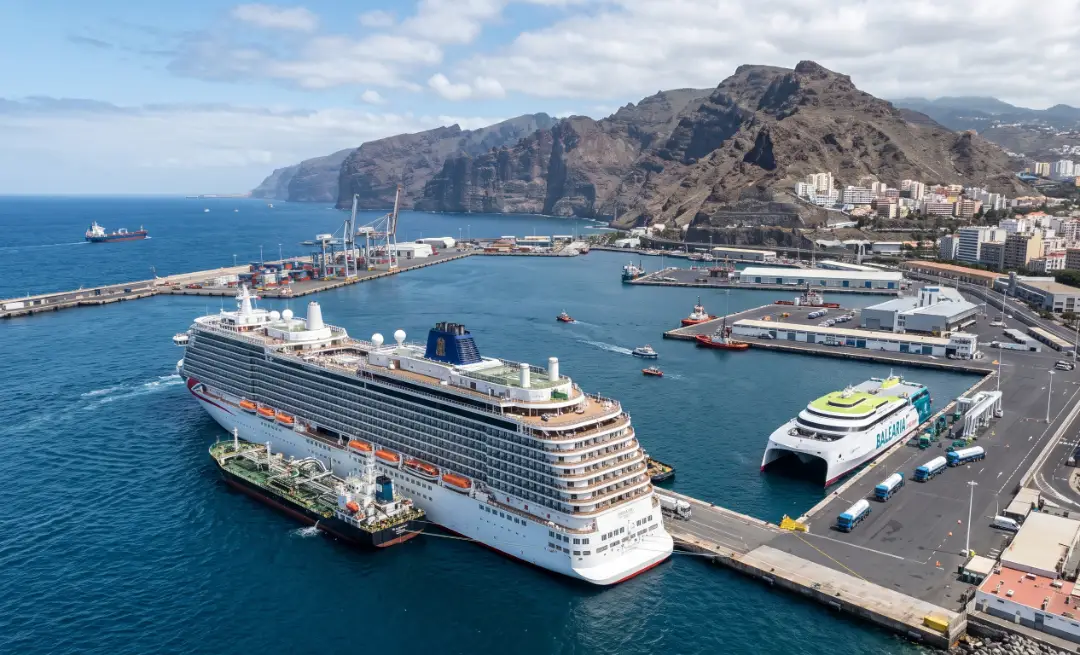
The Port Authority of Santa Cruz de Tenerife has officially joined the global marine fuel coalition SEA-LNG, becoming the organization's first member based in the Mid-Atlantic. Overseeing six ports across Spain's Canary Islands, the authority is rapidly scaling its liquefied natural gas (LNG) bunkering operations. The port expects 33 LNG cruise bunkering operations during the 2026–2027 season—an 83.3 percent jump over the prior season—alongside newly launched multi-truck-to-ship refueling services for dual-fuel ferries.
The Port Authority of Santa Cruz de Tenerife has formally entered the global multi-sector industry coalition SEA-LNG, marking a strategic expansion for the alternative marine fuel body into the Mid-Atlantic region. Managing six commercial ports across Spain’s Canary Islands archipelago, the authority's membership connects SEA-LNG directly with a vital maritime crossroads linking major transatlantic and north-south shipping corridors between Europe, Africa, and the Americas.
By bringing Santa Cruz de Tenerife into its network, SEA-LNG strengthens its collaboration with an established port operator that has actively championed LNG bunkering for nearly a decade. SEA-LNG Chief Operating Officer Steve Esau welcomed the addition, emphasizing that Tenerife’s operational track record and strategic geographic position make it an essential hub for vessels transiting the Atlantic Ocean.
Tenerife’s credentials in alternative marine fuels date back to December 2018, when the Port of Santa Cruz de Tenerife conducted what was recognized as the world’s first commercial ship-to-ship LNG bunkering operation for a cruise vessel, servicing AIDA Cruises’ AIDAnova via the bunker barge Cardissa. Since that milestone, the port has steadily broadened its refueling footprint across multiple berths, supplying more than 12,200 tonnes of LNG in 2024 alone to major vessels including AIDAcosma, Arvia, Costa Toscana, Iona, and Sun Princess.
Demand for LNG bunkering in the Canary Islands is accelerating sharply during the current 2026–2027 cruise season. The port authority projects a total of 33 LNG cruise bunkering operations over the season, representing an 83.3 percent increase compared to the 18 operations completed during the previous cycle. Leading global cruise operators—including Carnival Corporation, Royal Caribbean International, and TUI Cruises—are utilizing the port’s facilities, with the season kicking off on October 27 when P&O Cruises’ Arvia received 1,000 tonnes of LNG from the bunker vessel New Frontier 1 in a Shell-supplied operation en route to the Caribbean.
Alongside its established ship-to-ship cruise operations, the port has diversified its shore-based refueling capabilities to support regional passenger and vehicle transport. On September 10, 2026, Santa Cruz de Tenerife inaugurated a simultaneous multi-truck-to-ship (MTTS) LNG bunkering service at the Anaga basin jetty to supply Baleària’s 123-meter dual-fuel fast ferry Mercedes Pinto. Operated by ESK, the coordinated system enables multiple cryogenic road tankers to pump fuel simultaneously at a combined rate of 700 liters per minute, delivering energy equivalents of 600 megawatt-hours per operation.
Airam Díaz Pastor, Deputy Director of the Port Authority of Santa Cruz de Tenerife, stated that joining SEA-LNG will deepen technical cooperation with international maritime stakeholders and accelerate the adoption of cleaner marine energy solutions. He underscored that while fossil LNG currently delivers immediate reductions in greenhouse gases and local air pollutants, it serves primarily as a practical transitional fuel.
Looking toward long-term maritime decarbonization, both the port authority and SEA-LNG highlighted the scalability of Tenerife's existing bunkering infrastructure. Because liquefied biomethane (bio-LNG) and synthetic e-methane are chemically identical to conventional LNG, they can be stored, transported, and bunkered using the exact same cryogenic equipment and dual-fuel vessel engines without requiring costly retrofits.
To accommodate future growth in both conventional LNG and renewable methane fuels, the port authority pointed to the Port of Granadilla as a prime hub for upcoming infrastructure expansion. Located on the southern coast of Tenerife, Granadilla offers substantial capacity for future storage terminals and expanded bunkering berths, positioning the Canary Islands to remain a premier clean-fuel refueling gateway across the Atlantic.