
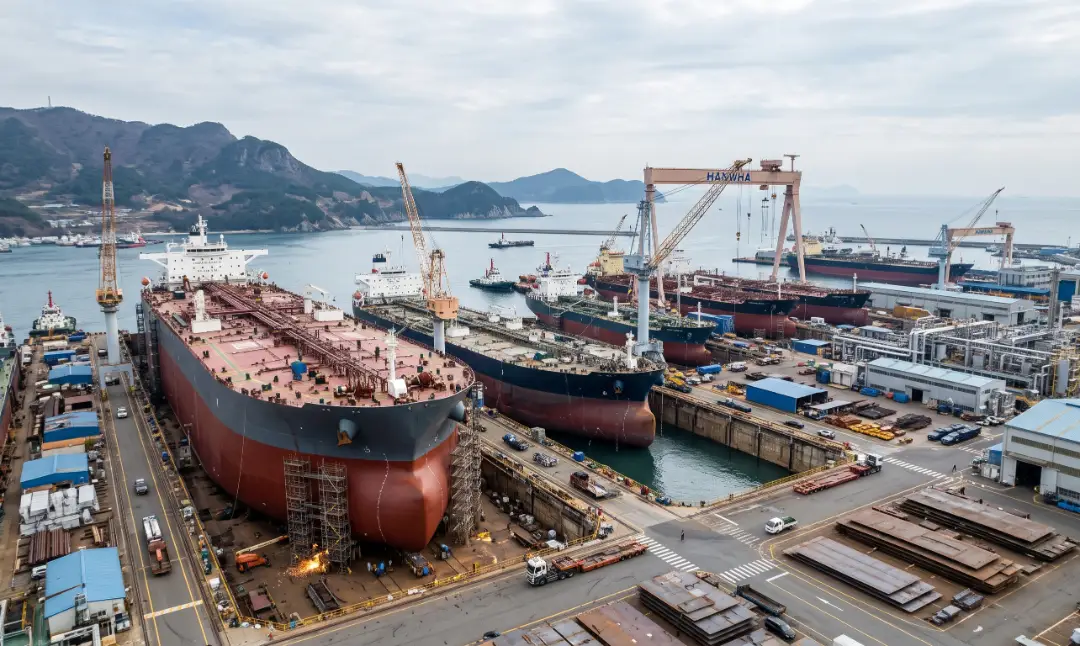
Hanwha Ocean announced on November 19, 2026, that it had signed a shipbuilding contract worth KRW 364.2 billion (approximately $272 million) for two Very Large Crude Carriers, each with a capacity of 320,000 deadweight tons. The vessels will be constructed at the company's Geoje shipyard in South Gyeongsang Province, South Korea's primary production base for large commercial ships, with deliveries scheduled sequentially through the second half of 2029 and the contract period running until September 30, 2029.
While Hanwha Ocean's regulatory filing identified the buyer only as an "Oceania-based shipowner," multiple shipbroking and market sources identified the customer as Switzerland-based Advantage Tankers. Advantage Tankers has an active fleet of 28 vessels and an orderbook of 24 ships, including eight VLCCs, eight Suezmaxes, two Aframax/LR2 tankers and six MR product tankers. The company already had six VLCCs under construction at Hanwha Ocean prior to this latest order.
The contract price of $136 million per vessel represents the highest nominal dollar price for a VLCC newbuilding since the 2008 global financial crisis. Before the crisis, new VLCC contracts reached $150 million to $160 million per vessel. Hanwha Ocean secured this deal at approximately $6.3 million more per vessel than it received in April last year for two VLCCs of the same size ordered by the same operator, when the price was $129.7 million per vessel. The pricing trajectory has climbed steadily through 2026, rising from $130.96 million per vessel in July to $133.5 million by late October, before reaching $136 million in November.
Including this contract, Hanwha Ocean has recorded orders for 47 vessels and one onshore plant project so far in 2026, with a cumulative value of approximately $8.54 billion. This tally reaches roughly 85% of the $10.05 billion in total orders the yard logged during the full year 2025. The vessel mix comprises 24 VLCCs, eight LNG carriers, six container ships, three very large ammonia carriers, three very large gas carriers, one wind turbine installation vessel and one special-purpose ship.
The dominance of VLCCs in Hanwha Ocean's 2026 orderbook reflects a broader surge in crude tanker demand. In the first half of 2026 alone, global VLCC orders reached 54.5 million deadweight tons, surpassing the previous annual record of 32.6 million DWT set in 2006. This surge is attributed to worsening Middle East tensions, increased oil transportation distances and times, and a shortage of available vessels, which have driven VLCC freight rates to historic highs. With nearly 40% of the active crude tanker fleet at least 16 years old, replacement demand has added further momentum.
Industry analysts note that Hanwha Ocean is pursuing a strategy of selective order-taking centered on high-value vessel types rather than simple volume expansion. With rising raw material prices and labor costs remaining a burden, contracts focused on high-value-added ships are expected to support future operating profit improvement. Yard forward cover across major South Korean shipbuilders now averages 3.6 years of advance production, leaving few open construction slots before 2029 and allowing domestic yards to enforce pricing discipline on tanker operators seeking replacement tonnage.
The VLCC market's strength in 2026 has been underpinned by geopolitical disruption in the Strait of Hormuz, which has lengthened voyage distances and tightened vessel availability. VLCC construction typically takes three to four years, meaning vessels ordered now will not be delivered until around the end of 2029. For Hanwha Ocean, the latest contract consolidates its leadership in the high-specification crude tanker segment, where South Korean yards have maintained dominance over Chinese competitors in pricing and technological complexity, even as Chinese builders absorb larger volumes of standard tonnage.