
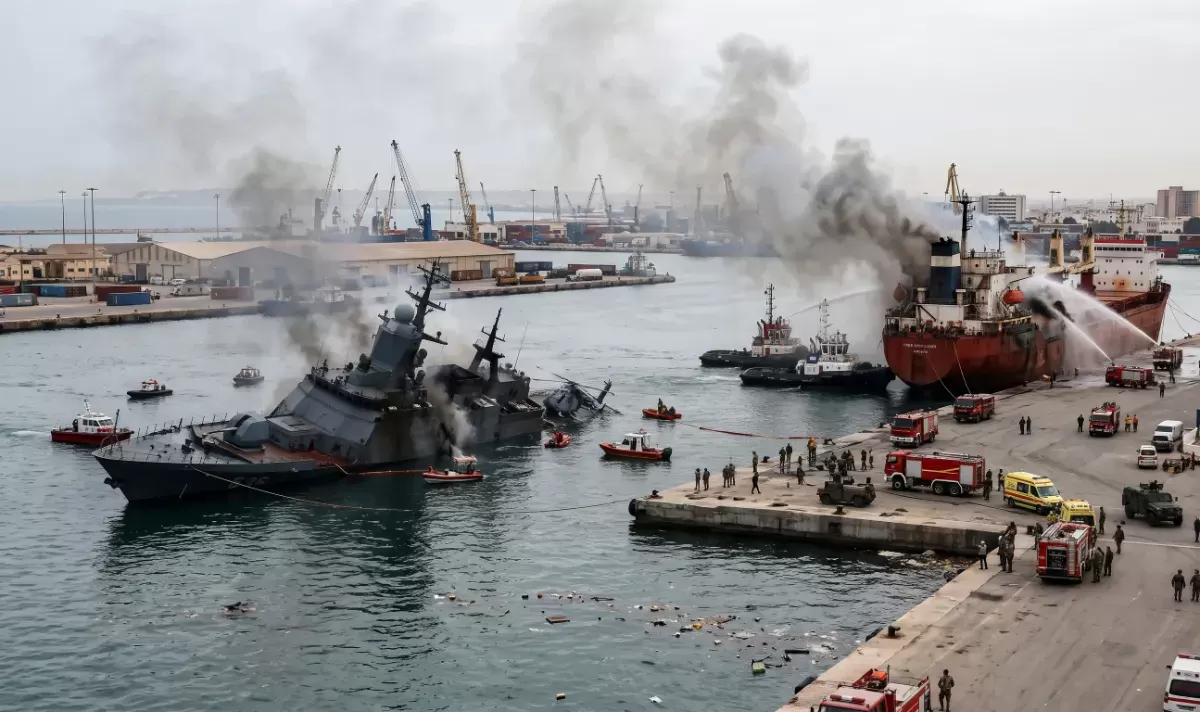
Ukrainian President Volodymyr Zelenskyy announced on November 23 that Ukrainian forces had successfully struck two Russian vessels off the coast of Libya, sinking the corvette Merkury and damaging the dry cargo ship MV Angara . In a post on X, Zelenskyy stated that seven Ukrainian-made naval drones were deployed in the operation, which he described as "an exemplary Ukrainian operation in response to Russia's war" . The strikes occurred near the port of Benghazi in eastern Libya, a region controlled by forces loyal to General Khalifa Haftar and allied with Moscow .
The Merkury, a Project 20380 Steregushchiy-class corvette commissioned in 2023, was one of Russia's newest warships and had been docked at Benghazi for refueling and resupply during its return voyage to Russia . Satellite imagery confirmed that the vessel capsized and partially sank at its mooring, with only its bow remaining above water . A Ka-27 anti-submarine helicopter stationed on the corvette's flight deck was also destroyed in the attack . At least ten Russian and Libyan personnel were reported wounded .
The second target, MV Angara, is a Russian dry cargo vessel sanctioned by Ukraine and identified by the Security Service of Ukraine (SBU) as having been used to transport military equipment for Russia . The SBU stated that both vessels were legitimate military targets because they directly supported Russia's military logistics, including operations linked to the so-called "Syrian Express" and its newer extension, the "Libyan Express" . The Merkury had regularly escorted Russian naval convoys in the Mediterranean, including providing protection for the Angara .
According to Ukrainian and Western assessments, the naval drones were transported to the operation area aboard a "mother ship" and launched from waters near the Libyan coast . Some reports suggested the drones may have been launched from a base in western Libya where Ukrainian military personnel operate, though this has not been independently confirmed . The operation demonstrated Ukraine's capacity to project power at significant distance from its own territory, with Benghazi located roughly 2,200 kilometers from Kyiv .
The attack drew immediate diplomatic responses. The United Nations Support Mission in Libya (UNSMIL) expressed "serious concern" over the strikes and called for an "immediate, independent and transparent investigation," warning that "Libya cannot afford, and must not become a battleground for foreign conflicts" . Libya's eastern-based Government of National Stability condemned the attack as a violation of Libyan sovereignty and said it was coordinating with Russia on an investigation . Russian Ambassador to Libya Aydar Aganin accused Ukraine of attempting to expand the geographical scope of the conflict and said Moscow was weighing its response .
The Kremlin responded through spokesman Dmitry Peskov, who described the operation as a "very dangerous trend" but offered no specifics on retaliation . The Russian Defense Ministry did not immediately comment on the sinking . Meanwhile, the Security Service of Ukraine stated that the operation proved "there is no safe shipping route even far from the Black Sea" for Russian military logistics .
For the shipping industry, the strike raises uncomfortable questions about the Mediterranean's emerging status as a conflict zone. Benghazi had been considered a relatively secure logistics hub for Russian operations following the loss of Russia's naval base at Tartus, Syria, after the fall of Bashar al-Assad . With that hub now penetrated, Russian naval escorts in the Mediterranean are likely to be reinforced or rerouted, potentially increasing military traffic and security risks in waters already traversed by commercial vessels. The attack also underscores a broader trend: the Russia-Ukraine conflict's maritime dimension is no longer confined to the Black Sea, and merchant shipping in the central Mediterranean may face heightened insurance and security costs as a result.