
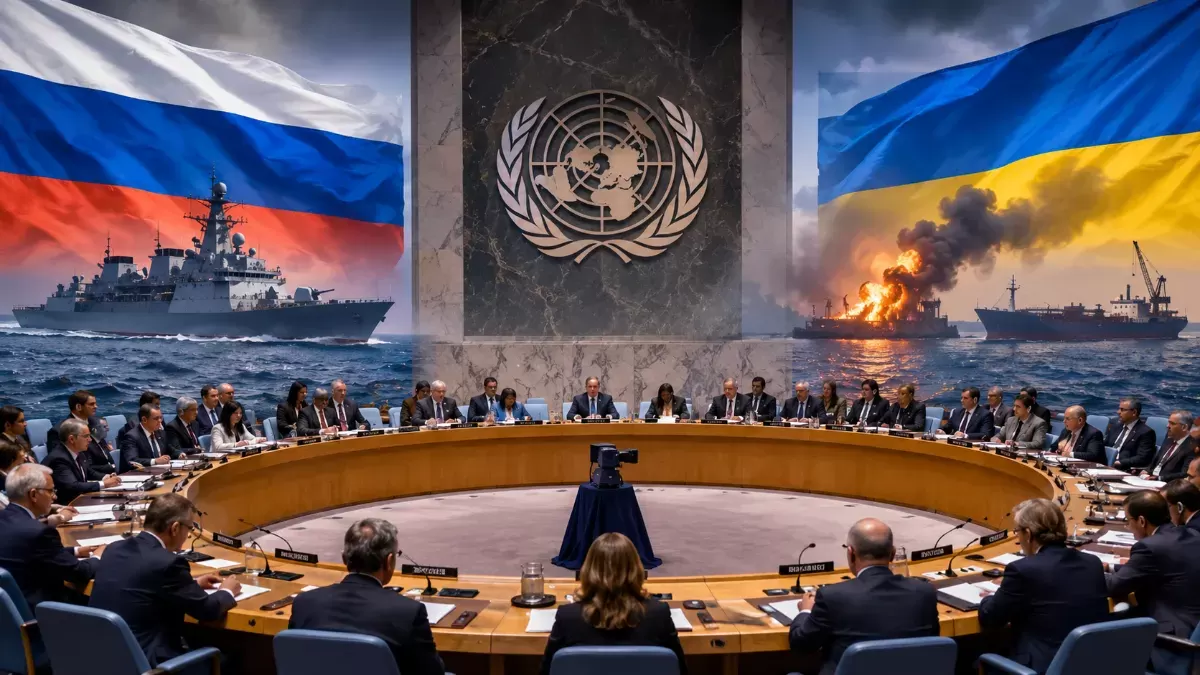
The UN Security Council convened a high-level briefing on November 23, 2026, chaired by Latvian President Edgars Rinkēvičs, with support from Liberia and Panama, to address the protection of critical energy infrastructure and Black Sea shipping lifelines essential to global food supply . The session quickly devolved into a direct confrontation between Russian and Ukrainian representatives, each blaming the other for endangering civilian maritime traffic and disrupting global food and energy markets .
Russia's Deputy Permanent Representative Anna Evstigneeva rejected any possibility of a new grain agreement, declaring that Moscow "will not accept any new grain deal, which in practice is nothing other than a scheme of Ukrainian food in exchange for Western weapons" . She claimed that under the previous Black Sea Grain Initiative, countries in need received only 3 percent of exported grain while up to 70 percent of Ukrainian agricultural products flowed to EU and Western markets. Evstigneeva accused Ukrainian President Volodymyr Zelenskyy of "opening Pandora's box" by ordering systematic attacks on Russian export infrastructure and civilian vessels in June 2026 .
Citing Russian Defense Ministry data, Evstigneeva asserted that since July 2026, Ukrainian forces had targeted more than 200 commercial vessels across the Black, Azov, Caspian, Baltic, and Mediterranean seas, killing or wounding 12 seafarers . She specifically referenced the November 21 attack on the Russian dry cargo vessel Sparta II in the Gulf of Finland, which caused a fire and left the ship unable to operate under its own power, describing it as evidence of "terrorist activity" expanding into the Baltic region . Russia maintained that its own strikes target only military-logistical vessels and dual-purpose facilities, dismissing Western calls for a maritime truce as a pretext to arm Ukraine while restricting Russian exports .
Ukraine's representative countered that Russia had targeted civilian power infrastructure relentlessly since mid-July 2026, damaging virtually every power plant in the country and over 800 units of energy equipment . He stated that November barrages shut down three thermal plants and plunged more than 850,000 people into darkness, while the Zaporizhzhia Nuclear Power Plant had lost off-site power for the 28th time. Kyiv reported 89 attacks on civilian vessels between June and August 2026, a dramatic escalation from 25 attacks in all of 2025, and accused Moscow of looting grain through a "shadow grain fleet," insisting that "grain stolen from Ukrainian land must be seized, not bought" .
The human and humanitarian dimensions of the maritime crisis were underscored by other Council members. The European Union stated that the Black Sea is now "the deadliest maritime route in the world," with 40 seafarers dead or missing, and noted that nine ships were attacked in October alone, four of which sank . The EU also announced a proposed allocation of EUR 50 million to establish a Black Sea Maritime Security Hub in Romania and Bulgaria to strengthen maritime security and protect critical infrastructure. Latvia's President Rinkēvičs warned that Russia's objective was "obvious—to block the sea routes through which millions of tons of Ukrainian food are delivered annually to various parts of the world" .
The United States representative urged both Russia and Ukraine to immediately cease strikes on energy grids, civilian ports, food distribution sites, and commercial shipping. "Food distribution sites must not be hit. Colleagues, the best way to protect food supplies on the Black Sea is for the war to end," the US envoy said, warning that ongoing attacks are sinking grain and fertilizer while endangering merchant sailors . Washington also outlined four pillars of a potential settlement being discussed with Kyiv and European partners: security guarantees, an EU membership path, a post-war prosperity plan, and post-settlement security arrangements, building on recent talks in Abu Dhabi .
China's representative, Ambassador Fu Cong, called for protecting the safety of civilian merchant vessels and port facilities, ensuring the normal flow of grain, oil, and other essential livelihood supplies from both sides. Beijing expressed concern over recent attacks on Russian vessels in different waters and reiterated its position that dialogue and negotiation are the only path to a political settlement . The session concluded with Russia's envoy accusing Kyiv of "criminally expanding the scope and geography" of maritime attacks, citing weekend strikes on two logistics vessels and a military boat off Libya's coast, while Ukraine's representative dismissed Moscow's allegations as "distortion and finger pointing," declaring that "Russia chose to invade Ukraine" and bears full responsibility for the war .