
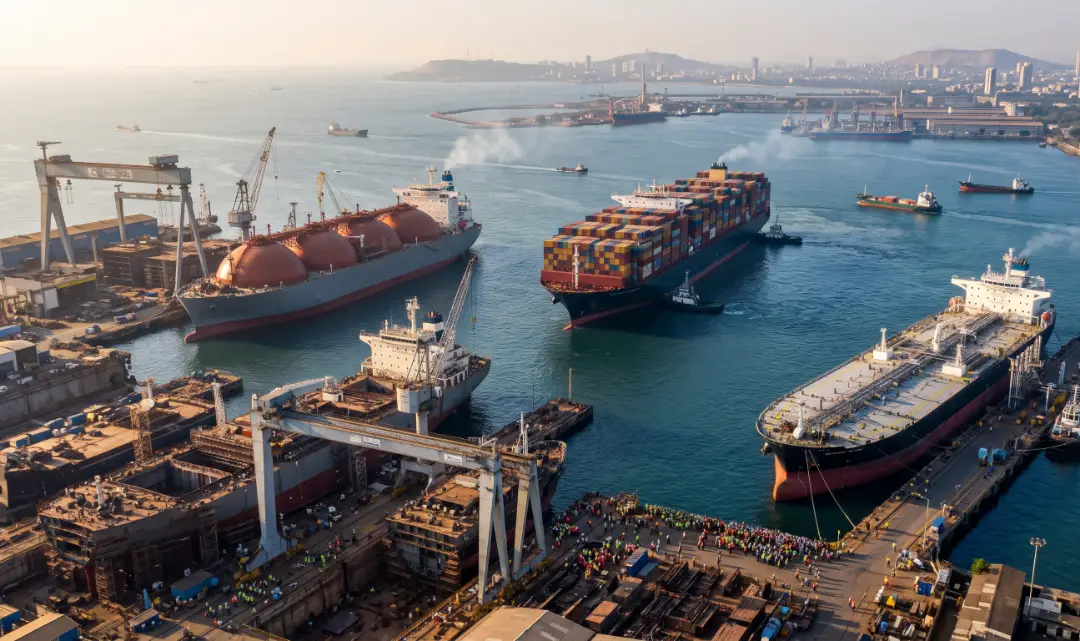
Shipping Corporation of India has formally opened a multi-billion-dollar fleet expansion drive, issuing tenders covering up to 22 newbuildings valued at an estimated $3.2 billion. The state-owned carrier is seeking eight 88,000 cubic metre very large gas carriers, six 18,000-TEU containerships, up to six 8,000-TEU LNG-ready container vessels and two 155,000-dwt Suezmax crude tankers, with a separate tender for secondhand feeder tonnage . The headline figure remains an industry estimate of the proposed programme, as none of the packages has yet been confirmed as a firm shipbuilding contract .
The largest single package centres on the eight VLGCs, with an estimated combined value of $950 million and bids due by January 27, 2027 . These vessels are intended for a proposed joint venture involving Indian Oil Corporation, Bharat Petroleum and Hindustan Petroleum, with four ships earmarked for IOC and two each for BPCL and HPCL . The gas carriers are designed to transport LPG, butane, propane and ammonia .
A central objective of the tender structure is the development of India's domestic shipbuilding capability. For the VLGC programme, two vessels are to be constructed at an established overseas yard while the remaining six must be built in India . International shipyards seeking to participate must either establish a majority-owned facility in India or enter a technical collaboration with an Indian yard, providing basic and detailed design support through to delivery . Similar domestic-content conditions apply to the large container ship tender, under which four of six 18,000-TEU vessels are to be built in India .
The container programme itself is split between SCI's own fleet and the proposed Bharat Container Shipping Line (BCSL). Of the six 18,000-TEU ships, two are intended for SCI while four are earmarked for BCSL, a venture involving SCI, Container Corporation of India and Sagarmala Finance Corporation . Bids for this package are due by December 22, 2026, following a revision of the earlier timetable . A separate tender covers six 8,000-TEU LNG-ready containerships comprising two firm vessels and four options, previously valued at around $720 million, with bids due December 7 .
In the tanker segment, SCI has invited bids for two 155,000-dwt Suezmax crude carriers, with submissions closing on December 21, 2026 . For both the Suezmax tankers and the 8,000-TEU container ships, qualified Indian yards have been granted a right of first refusal, allowing them to match the lowest evaluated foreign bid and secure the contract . This mechanism is intended to balance competitive pricing with the strategic goal of localising complex vessel construction.
SCI is also moving to strengthen its container feeder capacity through the secondhand market. A separate tender, announced on November 18, seeks two firm and two optional boxships of 1,500 to 2,500 TEU, with vessels up to 20 years old eligible and offers due December 17 . This acquisition route addresses a smaller vessel category than the newbuilding programmes and would supplement SCI's existing fleet independently of the larger tenders.
The expansion drive comes as SCI operates a fleet of 58 vessels across tanker, dry bulk, container and offshore sectors, of which only two are owned containerships . The carrier recently reported strong quarterly results, with revenues up more than 70 percent and consolidated net profit more than tripling, largely driven by tanker operations . The tender programme represents a significant shift in SCI's container position, potentially adding twelve large containerships alongside the feeder acquisitions.
The procurement framework aligns with India's broader maritime ambitions, including targets to rank among the world's top ten shipbuilders by 2030 and top five by 2047 . South Korea's three major shipbuilders—HD Hyundai, Samsung Heavy Industries and Hanwha Ocean—are reportedly weighing participation, with HD Hyundai pursuing a joint venture shipyard project in Thoothukudi, Tamil Nadu . Contract awards, final prices, shipyard selection and delivery schedules will determine the programme's eventual scale, with the December and January bid deadlines set to provide clarity on how the planned expansion translates into contracted tonnage .