
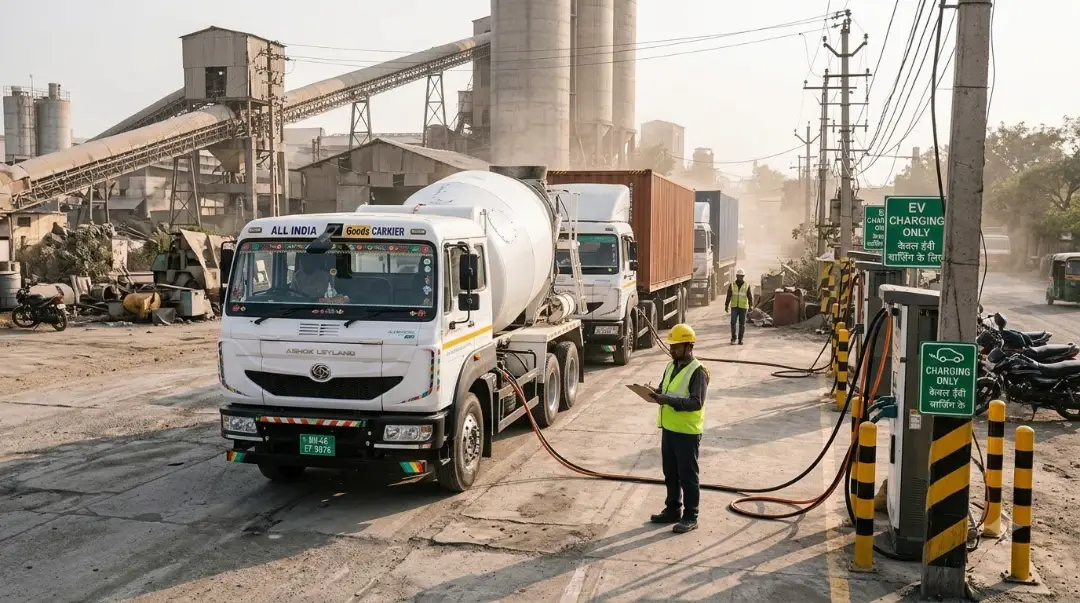
Ashok Leyland is pushing deeper into electric commercial vehicles through its OHM Mobility arm, which has won an order to deploy over 200 electric trucks for cement transport . The deal, reported by ET Supplychain on 23 November 2026, nudges OHM beyond its existing electric bus business and into the freight segment, which the company sees as the next significant EV opportunity.
The cement transport order is strategically significant because it targets a segment where electric trucks can deliver favourable economics. Cement is a dense, heavy commodity that moves on predictable routes between plants, distribution centres, and construction sites. These fixed, high-utilisation duty cycles are well-suited to electrification, provided that charging infrastructure can be arranged at loading and unloading points. The order suggests that Ashok Leyland has found a customer willing to commit to electric traction at fleet scale, rather than testing a handful of vehicles.
The financial commitment behind the EV push is substantial. Ashok Leyland has infused ₹150 crore into OHM and used ₹324 crore to repay a Switch Mobility UK loan . These investments reflect a company that is spending heavily now in anticipation of stronger LCV sales and EV revenue later. The decision to widen its market reach to 80–85% from 55–60% indicates that Ashok Leyland is also expanding its addressable customer base, rather than relying solely on existing relationships.
The timing of the order aligns with a broader wave of electric truck deployments in India's industrial logistics sector. EIM and Sorigin have announced plans for 500 electric trucks around JNPA, GreenLine Mobility has partnered with Kirloskar Ferrous at Taloja, and Tata Motors and Amazon have committed to 3,000 electric trucks. The common thread is that the deployments are concentrated in captive or semi-captive operations where routes are predictable and charging can be planned, rather than in the open road freight market where range anxiety and infrastructure gaps remain barriers.
For India's cement logistics sector, the order represents a meaningful test of whether electric trucks can handle the payloads and duty cycles that the industry requires. Cement trucks operate at high gross vehicle weights, and the battery capacity needed to move those loads over meaningful distances is substantial. If the Ashok Leyland deployment proves operationally viable, it could encourage other cement manufacturers and logistics providers to follow, creating a demand signal that supports further investment in charging infrastructure and vehicle manufacturing capacity.
Looking ahead, the key milestones are the actual deployment of the 200+ trucks and the operational data that emerges from their first year of service. Ashok Leyland has not disclosed the customer, the specific routes, or the charging arrangements, and the commercial success of the order will depend on whether the vehicles deliver the reliability and cost profile that cement transport requires. For now, the win signals that Ashok Leyland's EV strategy is extending from buses into freight, and that the cement sector is emerging as an early adopter of electric trucking in India.