
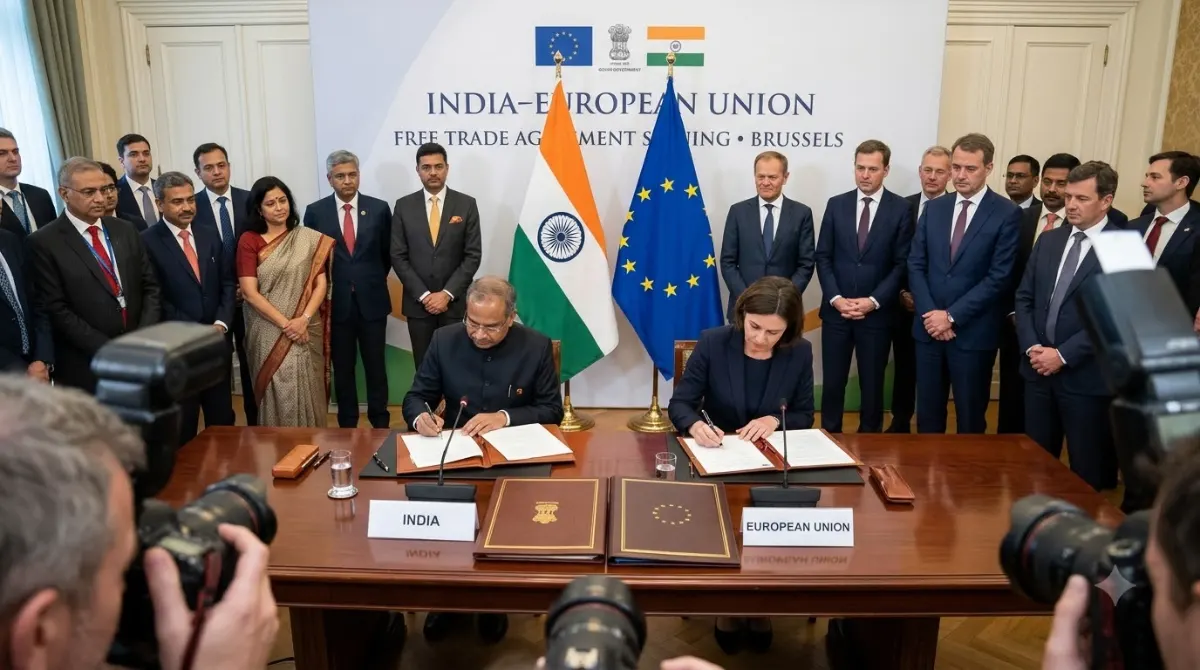
India and the European Union are set to sign their long-negotiated Free Trade Agreement on 16 December 2026 during Prime Minister Narendra Modi's visit to Brussels, according to statements from the EU Ambassador to India and Indian commerce officials . The signing would mark the conclusion of a process that began with negotiations in 2007, was suspended in 2013, and was relaunched in 2022 before negotiations formally concluded on 27 January 2026.
The timeline for implementation is now clearer. Commerce Secretary Rajesh Agrawal said India is aiming to operationalise the agreement in the first quarter of 2027, adding that "it depends on a lot of things moving in time, but we will be there" . After signing, the pact will require the European Parliament's consent and a final decision by the Council, while India must complete its own ratification procedures before the agreement can enter into force.
The market access provisions are substantial for Indian exporters. The agreement will provide preferential access for 99.5% of India's export value into the EU market, with approximately 90.7% of export value receiving zero-duty treatment immediately upon implementation . The remaining tariff lines will be phased in or subject to reduced rates. The Commerce Ministry has identified labour-intensive sectors as the primary beneficiaries, including textiles, apparel, leather, footwear, marine products, gems and jewellery, handicrafts, engineering goods, and automobiles . Tariffs on nearly $33 billion worth of Indian exports in these sectors are expected to fall to zero upon entry into force.
For India's logistics sector, the FTA's implementation will reshape the trade corridors that connect Indian production centres to European markets. The agreement covers not only goods but also services, digital trade, customs and trade facilitation, intellectual property rights, and mobility of professionals . The customs facilitation provisions are particularly relevant to logistics operators, as they are intended to reduce clearance times and transaction costs at both ends of the India–Europe supply chain. The agreement also provides a framework for the movement of skilled Indian professionals to European countries, which could affect the services component of bilateral trade.
The timing of the signing aligns with the broader pattern of trade policy momentum that has characterised the final quarter of 2026. India has implemented the CETA with the UK, is finalising a trade deal with the United States, and has been engaged in negotiations with Egypt and other partners. The EU agreement is the largest of these in terms of market size, and its conclusion would give Indian exporters preferential access to a bloc that accounts for roughly 25% of global GDP when combined with India's economy.
For Indian exporters and logistics providers, the practical implications will unfold over the coming months. The zero-duty treatment for the majority of export value will improve the competitiveness of Indian goods in European markets, potentially increasing volumes on the India–Europe container and air cargo corridors. The customs facilitation provisions could reduce the administrative friction that has historically added cost and delay to India–Europe trade. However, the full benefits will only materialise after ratification and implementation, and the phased nature of some tariff reductions means that the impact will be gradual rather than immediate.
Looking ahead, the key milestones are the 16 December signing, the European Parliament's consent process, and India's ratification. If the agreement enters into force in the first quarter of 2027 as targeted, it would give Indian exporters a durable advantage in the EU market at a time when global trade policy is becoming more fragmented. For now, the announcement of the signing date provides a concrete timeline for businesses to plan around, and it signals that the India–EU trade relationship is about to enter a new phase.