
DFCCIL was conferred the "Global Green Freight & Sustainable Transport Excellence of the Year 2026" at the GEEF Global Sustainability Awards 2026, according to an announcement reported on November 22, 2026. The award, organized by the Global Energy & Environment Foundation, recognizes the organization's work in promoting sustainable freight transportation, strengthening environmentally responsible logistics infrastructure, and advancing green initiatives.
The award was received by Sh. Manish Awasthy, ED/Infrastructure/DFCCIL, Shri Sandeep Kumar Ravivanshi, GGM/LA&SEMU, and Shri Ajay Gupta, Expert/Environment/NKC. DFCCIL stated that the recognition reflects the collective commitment of the organization toward building an efficient, greener, and more sustainable transportation ecosystem.
A central element of DFCCIL's sustainability credentials is its 100% electrified rail freight network. The Dedicated Freight Corridors use a 2x25 kV Auto Transformer feeding system designed for heavy haul operations, offering electrical distribution efficiency of 97.6% compared with 92.95% for conventional 25 kV systems. This allows operation of higher tonnage freight trains at increased speeds while minimizing environmental impact.
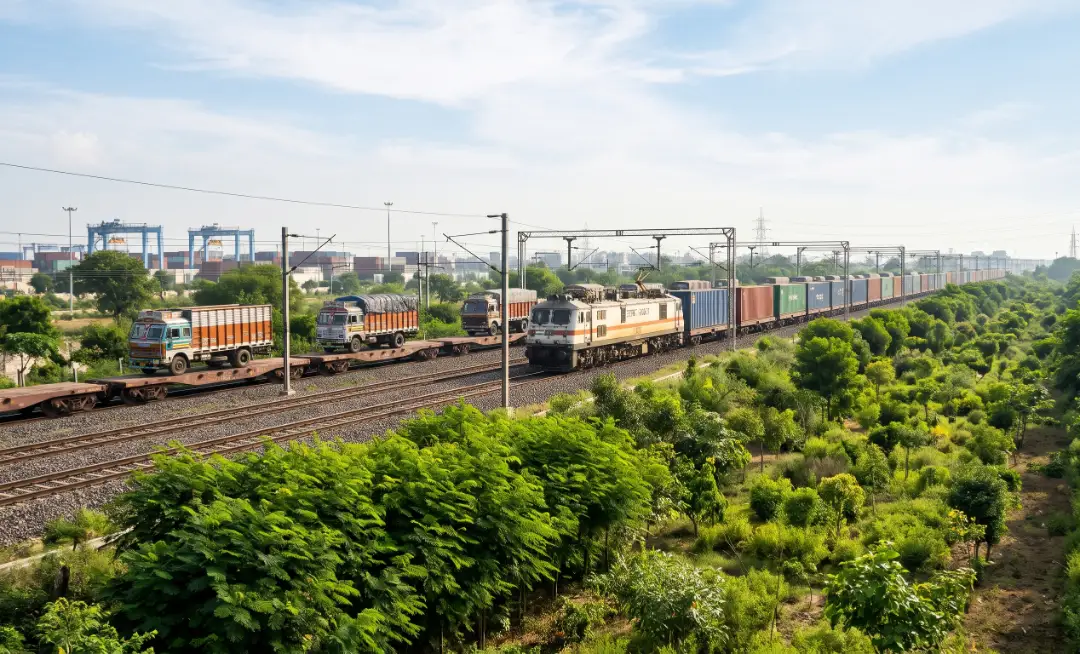
DFCCIL's green belt plantation program and Miyawaki plantations were specifically cited in the award recognition. The organization has undertaken extensive plantation drives along its freight corridors, including a Miyawaki Forest development project in the Meerut unit involving approximately 4,000 saplings planted in a one-hectare area along the Right of Way. These plantations contribute to soil conservation, erosion control, and the creation of green buffers that mitigate noise, dust, and pollution.
The shift from road to rail freight is central to DFCCIL's environmental proposition. Rail transport emits only 28 grams of carbon per Net Ton Kilometre, compared with 64 grams per NTKM by road transport. Over a 30-year period, the Dedicated Freight Corridor is projected to save 457 million tons of CO₂ emissions. DFCCIL's "Track on Green" mission is centered on achieving net-zero carbon emissions.
DFCCIL's eco-friendly business innovations include the Trucks on Train (ToT) service, which carries loaded and empty trucks on flat rail wagons to enable door-to-door service piggybacking on rail movement. In FY 2023-24, a total of 442 rakes transported 11,259 trucks through this service, generating earnings of approximately 31.18 crore rupees. The service saved over 1 lakh litres of diesel and reduced 270 tons of CO₂ emissions.
The recognition comes as DFCCIL continues to position dedicated freight corridors as a key component of India's efforts to modernize freight transportation and encourage a greater shift of cargo from road to rail. By strengthening rail-based freight infrastructure, DFCCIL contributes to more sustainable logistics operations while supporting the country's broader objectives of reducing the environmental impact of transportation.
For India's logistics sector, DFCCIL's award highlights the growing emphasis on decarbonizing freight movement through rail infrastructure. As the organization continues to develop multimodal logistics parks and Gati Shakti cargo terminals along the corridors, the recognition reinforces the role of dedicated freight infrastructure in supporting sustainable economic growth and a greener logistics ecosystem.