
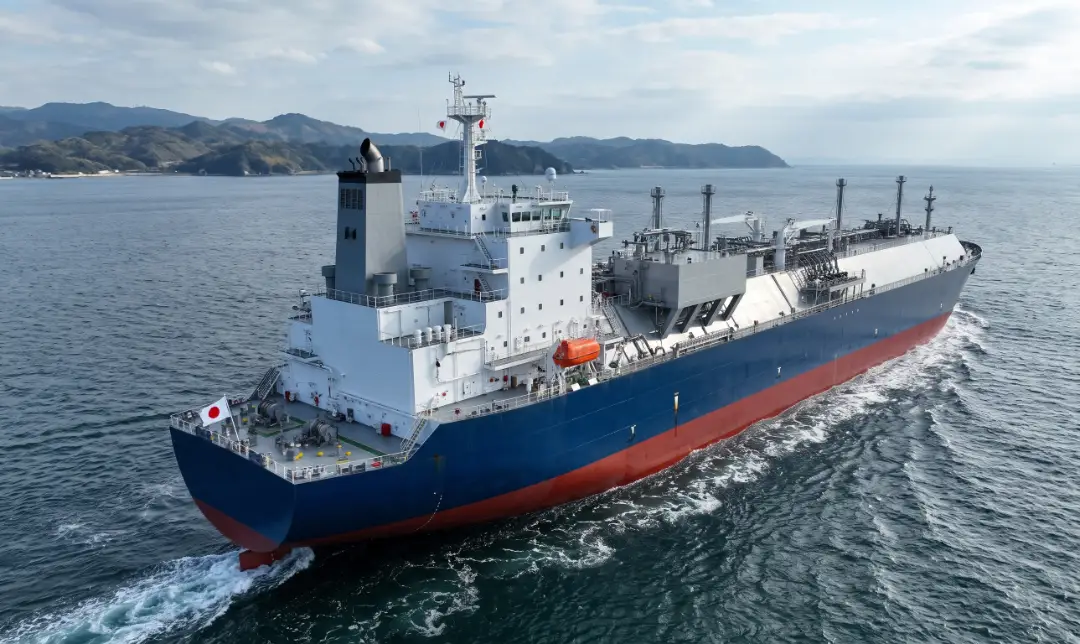
NYK held a naming ceremony on November 6, 2026, at Japan Marine United Corporation’s Ariake Shipyard in Kumamoto Prefecture, where NYK President Takaya Soga named the vessel “Izanami.” The name derives from Izanami-no-Mikoto, a deity in Japanese mythology responsible for forming the islands of Japan, chosen in the hope that the vessel will symbolize the dawn of a new era of next-generation energy beginning in Japan . An unveiling ceremony followed on November 17, attended by approximately 100 project participants, including Kentaro Asahi, vice-minister of Land, Infrastructure, Transport and Tourism, and Yasushi Kaneko, a member of Japan’s House of Representatives .
The vessel is the world’s first to adopt ammonia-fueled engines for both main and auxiliary engines. The main engine is an ammonia-fueled dual-fuel two-stroke engine manufactured by Japan Engine Corporation, which drives the propeller for propulsion. The auxiliary engines are ammonia-fueled dual-fuel four-stroke engines manufactured by IHI Power Systems, which drive generators supplying the ship’s electricity . This configuration allows ammonia to be used across both propulsion and onboard power generation, extending the application of the fuel beyond the main engine alone .
Ammonia emits no carbon dioxide when burned and can be stored and transported as a liquid, making it a candidate next-generation fuel for decarbonizing international shipping . However, its use as a marine fuel presents technical challenges involving toxicity, fuel handling, and emissions management, including nitrogen oxides and nitrous oxide unless controlled . The demonstration voyages under the Yara charter will provide data on these issues as the industry assesses ammonia as a viable alternative to conventional marine fuels.
The project brings together NYK, Japan Engine Corporation, IHI Power Systems, and Nihon Shipyard, with technical cooperation from classification society ClassNK. The consortium was selected in October 2021 for the Green Innovation Fund Project administered by Japan’s New Energy and Industrial Technology Development Organization (NEDO) . The fund is a 2 trillion-yen initiative established by Japan’s Ministry of Economy, Trade and Industry to accelerate technologies supporting carbon neutrality by 2050, providing up to 10 years of continuous support from research and development through demonstration to social implementation .
Following delivery, the vessel will be time-chartered to Yara Clean Ammonia Switzerland SA, a group company of Yara International ASA, a global leader in the ammonia sector . During the charter period, demonstration voyages will be conducted to verify operational performance, safety, and greenhouse gas reduction effects under actual operating conditions. The knowledge gained will be accumulated for the future development and operation of ammonia-fueled vessels . Yara’s involvement provides a commercial setting for the demonstration program, connecting the project to the emerging market for ammonia as both an industrial commodity and marine fuel .
The vessel has a cargo capacity of approximately 40,000 m³, an overall length of 180 meters, a breadth of 32 meters, and a moulded depth of 18.45 meters. It will fly the Japanese flag . According to Jiji Press, the ship is expected to reduce greenhouse gas emissions by more than 90 percent compared with a vessel powered by fuel oil . The specifications position Izanami as a substantially larger ocean-going gas carrier compared with NYK’s earlier ammonia-fueled tugboat, introducing different operating requirements associated with longer voyages, greater fuel consumption, and international shipping regulations .
Izanami builds on NYK’s previous development of the ammonia-fueled tugboat Sakigake, which entered commercial operation in August 2024 and is described by NYK as the world’s first commercially operated ammonia-fueled vessel . The tugboat project provided experience with ammonia propulsion in a smaller vessel operating in a domestic maritime environment. Izanami extends the technology to a larger gas carrier, moving the program from engineering development into commercial operating conditions .
With the vessel’s completion, the NEDO-backed project transitions from the development phase to the operational phase . NYK President Takaya Soga said at the unveiling ceremony that the ship “pursues both high environmental performance and safety” and that the company “will work on advancing decarbonization and realizing a sustainable society” . NYK intends to leverage the results obtained through the vessel’s actual operation to promote wider adoption of ammonia-fueled vessels and advance decarbonization toward achieving net-zero emissions in international shipping .