
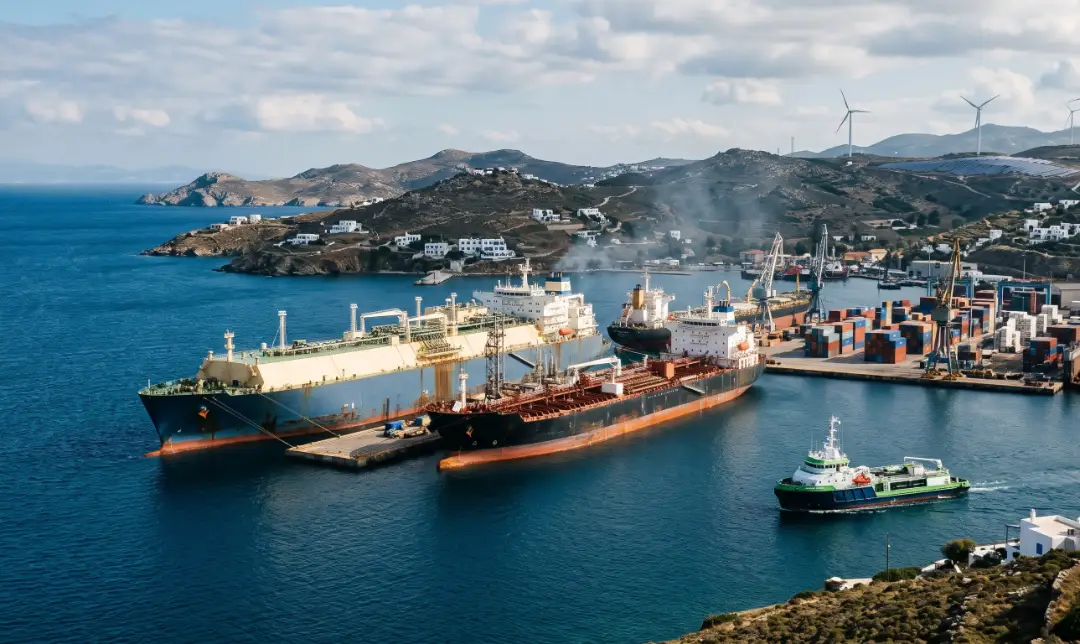
The report, published by the UCL Energy Institute's Shipping and Oceans Research Group in partnership with WWF Greece, quantifies for the first time the scale of Greece's exposure to the global energy transition. Greek shipowners hold approximately $78 billion in oil tanker and LNG carrier assets vulnerable to declining fossil fuel demand, compared with $37.67 billion for Japan and $34.08 billion for China . Greece controls about one-fifth of the world fleet—roughly 5,800 ships and 460 million deadweight tonnes—with leading market shares in oil tankers (26% of global tonnage), LNG carriers (23%), and bulk carriers (22%) .
The report distinguishes between two transitions facing Greek shipowners. The first is the demand-side transition they cannot control: as the world shifts away from fossil fuels, demand for the cargoes their ships carry may decline, potentially reducing the need for specialized vessels such as LNG carriers. The second is the regulatory transition in how shipping's own energy use is governed. Dr Tristan Smith, Professor of Energy and Transport at UCL and co-director of the Shipping and Oceans Research Group, said supporting the NZF is a chance to make the second transition "predictable, lower burden, less complicated and more supportive of a mix of decarbonisation strategies and pathways" .
LNG carriers face particularly acute risk due to their high capital costs, specialized cargo requirements, and limited ability to transport alternative commodities. The report identifies a managed exit from LNG exposure as a key benefit of the NZF, which would provide a predictable timetable and more compliance options, reducing the risk of stranded assets . However, the analysis also notes that depending on fuel prices and regulatory details, LNG could remain among the most cost-effective compliance options until the mid-to-late 2030s .
The report warns that a weaker, technical-only outcome at the IMO would leave the EU Emissions Trading System (ETS) operating alongside the IMO fuel standard, while also incentivizing additional unilateral carbon pricing measures such as those already initiated in Africa. This is the regional patchwork that the Union of Greek Shipowners (UGS) has warned against . The European Commission's commitment to avoid double payment depends on a global carbon price being adopted; without one, the EU ETS would remain in force on top of the IMO standard .
Smaller Greek shipowners are particularly vulnerable to regulatory fragmentation. Of approximately 700 Greek shipping companies, only 19 operate more than 50 vessels . Smaller operators have fewer resources to manage overlapping regulations, varying compliance requirements, and the administrative burden of navigating multiple regional regimes. The report argues that a single global framework would reduce this complexity and provide greater investment certainty across the fleet .
The timing of the report is significant. It was published ahead of ISWG-GHG 23 (November 23–27, 2026) and MEPC 85, which opens on November 30 . At MEPC 84, NZF-like options drew more than twice the support of technical-only alternatives . The report concludes that there is no alternative architecture to the NZF with anywhere close to the level of support for adoption, and that efforts not supporting it only increase the risk of stalemate and fragmentation .
Demetres Karavellas, CEO of WWF Greece, said: "As climate impacts intensify, shipping must play its part in the transition to net-zero. The IMO Net-Zero Framework is the only credible global pathway to decarbonise the sector while providing the certainty businesses need to invest. This report shows that Greece, as the world's leading shipping nation, has more to lose from delay than almost anyone else. Opposing the NZF will not stop the transition. It will only increase uncertainty and expose Greek shipping to greater risk" . The report concludes that failure to adopt the NZF, or a delay of more than a year, would weaken the IMO as global regulator, accelerate regional regulation, and force a steeper decarbonisation pathway later .