
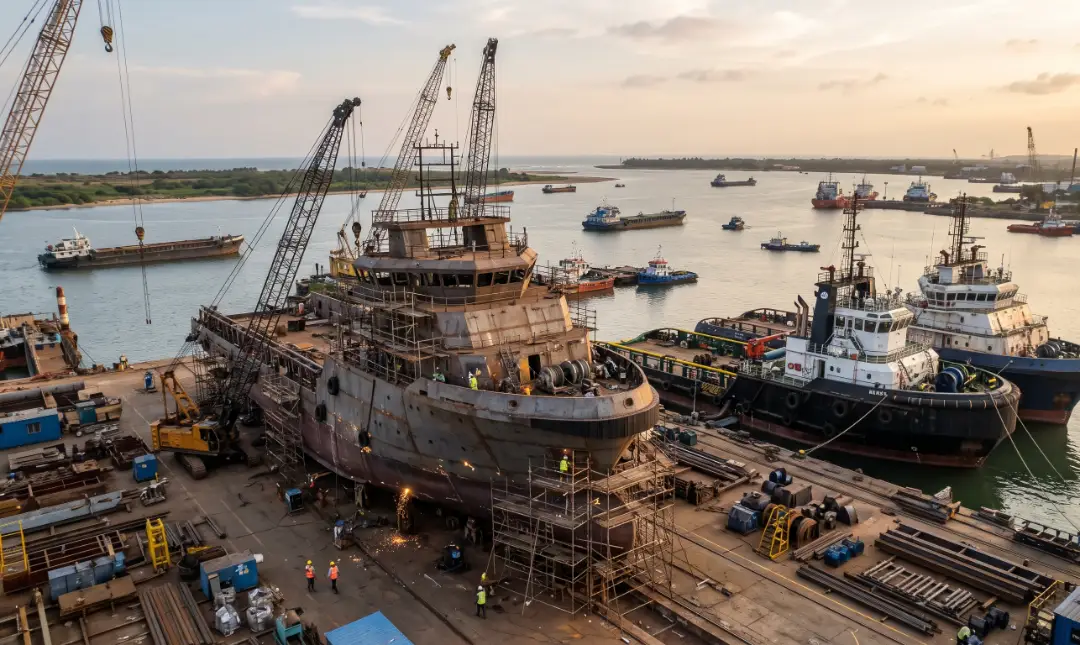
J M Baxi Marine Services has acquired a 51% controlling stake in San Maritime India Pvt Ltd, a Kakinada-based shipbuilding and offshore support company, the group confirmed on November 23, 2026. The deal marks the Mumbai-headquartered logistics conglomerate's formal entry into shipbuilding and represents the first such move by an Indian corporate house since the Union Cabinet approved a ₹69,725 crore package last year to revitalize domestic shipbuilding .
San Maritime operates a fleet of more than 40 vessels, including offshore supply vessels, tugs, utility vessels, crew boats, chase boats, bunker barges, freshwater barges, crane barges, cargo barges, jack-up barges, spud barges, and pontoons. Its shipyard in Kakinada features two waterfront areas with the capability to construct vessels up to 80 metres in length and 20 metres in breadth, with a launching draft of 4.5 metres. Up to four vessels can be constructed simultaneously in each area, and the facilities are equipped to build vessels of up to 7,500 Deadweight Tonnage .
The acquisition aligns with J M Baxi Group's strategy of building a marine services platform focused on segments where India lacks strategic depth. According to sources, the group is concentrating on "critical" areas including cable laying, cable repairs, Single Buoy Mooring services, harbour towage, and energy logistics for LNG and LPG transportation. A few months prior to this deal, the group acquired two very large gas carriers in a 50-50 partnership with Dubai-based SPM Shipping, an affiliate of Priya Blue Industries, India's largest green ship recycler .
J M Baxi Group is already the largest single build-operate-transfer (BOT) operator at major Indian ports by number of concessions, running 12 port concessions across state-owned major ports with approximately $1 billion invested over the past decade. The group's marine services vertical also encompasses ship management and technology services. In January 2026, J M Baxi Group, Japan's Kawasaki Kisen Kaisha (K Line), and GAIL (India) Limited signed an agreement to jointly own a 174,000 cubic metre LNG carrier under construction at South Korea's Samsung Heavy Industries, scheduled for delivery in 2027 on a long-term time charter with GAIL .
The group's rationale for entering shipbuilding rests on a perceived capacity gap in India's maritime infrastructure. Sources indicated that India is short of drydocking capacity and needs more facilities for shipbuilding, ship repairs, and ship recycling. "India needs a lot more dry-docking capability like how we did in the ports space," a source said. "They don't have to be very large. Shipbuilding is a manufacturing process where, like in automobiles, a shipbuilder also needs to create a very large, extensive ecosystem to support ship construction" .
Ship repairs have become an acute concern for Indian operators due to disruptions in the Gulf region over recent months, reinforcing the case for domestic capability. The group's marine services strategy is framed around securing and protecting India's maritime sovereignty, port security, refinery and energy security, digital security, and the shipbuilding, repair, and recycling value chain. The source added: "Ship repairs have become a problem over the past few months due to the conflict in the Gulf region. So, India needs independence and long-term security in this segment" .
Shipbuilding in India has historically been dominated by government-owned companies, with private sector participation limited by the industry's cyclical nature and perceived high risk. J M Baxi Group has signaled its willingness to commit capital to the segment, with plans to bring in expertise through global tie-ups and technical collaborations. The group also has ambitions to enter cruise shipping, which it views as commercial real estate on water .
The acquisition of San Maritime positions J M Baxi Group as an integrated maritime services player spanning port concessions, offshore vessel operations, LNG and LPG shipping, ship management, and now shipbuilding and repair. For the Indian shipbuilding sector, the entry of a established private logistics group represents a test case for whether domestic corporate capital can be deployed successfully in a capital-intensive, cyclical industry that the government has identified as strategically important .