
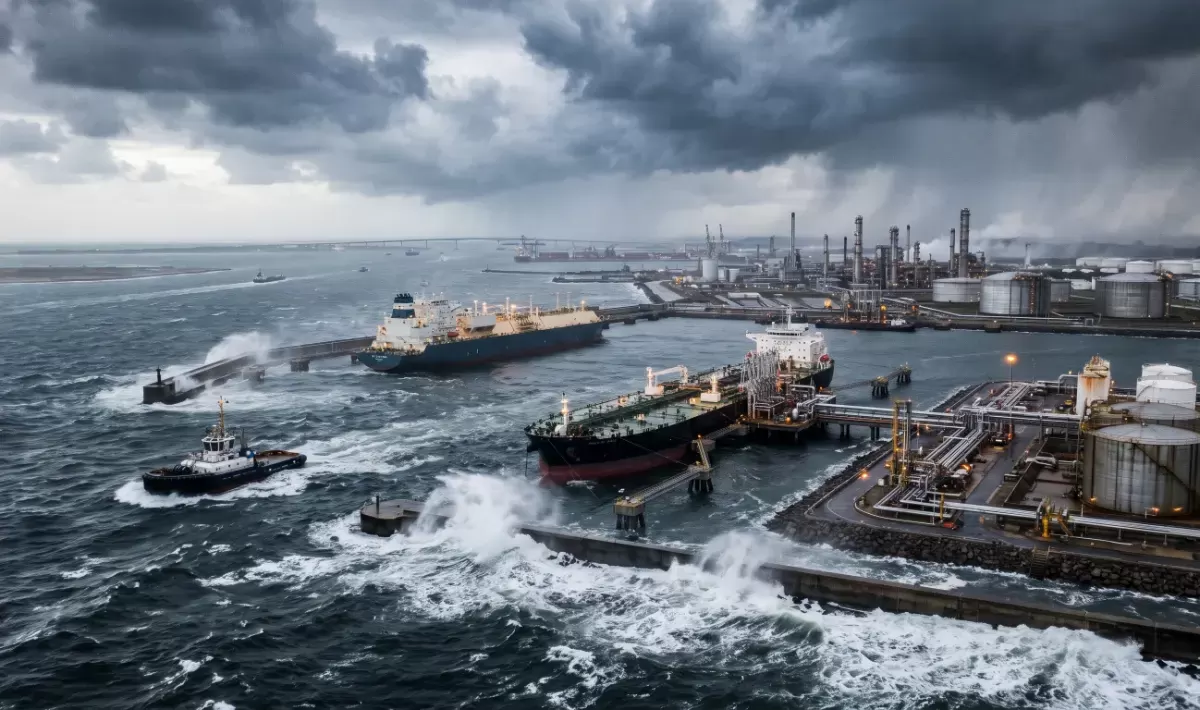
The International Energy Agency released its report “Extreme Weather Risks to International Oil and Natural Gas Shipping” on November 18, 2026, at the request of the French government during its G7 presidency. The report assesses how extreme weather disrupts the international shipping of oil and natural gas and how associated risks could evolve in coming decades. Maritime shipping is a central pillar of global energy trade: in 2024, around 40% of crude oil, 30% of petroleum products, and 15% of natural gas produced made at least part of their journey to market by ship .
Port infrastructure is directly exposed to extreme weather hazards including flooding, high winds, and extreme heat. Virtually all ports with regular tanker activity in Japan, Korea, and China are exposed to a tropical cyclone at least once in 500 years on average, while the US Gulf Coast, home to nearly half of American refining capacity, faces similar cyclone and flooding risks. Tanker-handling ports currently experience an average of 1.5 days of weather-related downtime annually, though individual high-impact events can shut ports for weeks or even months. Current annual weather-related physical damage to these ports is estimated at around USD 5 billion, with Europe and North America accounting for nearly half due to the value of exposed assets .
The report warns that these costs could escalate significantly. By 2050, under the IPCC scenario associated with around 3°C warming by the end of the century, annual damage to tanker-handling ports could nearly double. River flooding accounts for roughly half of current estimated damage, but coastal flooding is expected to become a larger driver in the future as sea-level rise compounds with storm surge risks from tropical cyclones .
Shipping routes face distinct vulnerabilities, particularly where they pass through chokepoints with limited alternatives. Tropical cyclones can disrupt the Luzon Strait between the South China and Philippine seas; fog can temporarily close the Turkish Straits connecting the Mediterranean and Black seas; and drought can constrain Panama Canal transits for months. Where rerouting is possible, disruptions raise voyage times, fuel use, freight costs, and emissions. Where practical alternatives are limited, disruptions can halt flows entirely. A tanker voyage from the US Gulf Coast to Japan routed around the Cape of Good Hope instead of through the Panama or Suez canals would add approximately 13,000 kilometers and 26 days, increasing fuel consumption by 75% at unchanged speed .
Inland waterways face parallel risks from drought. At Kaub on Germany’s River Rhine, navigation was economically unviable for around one month per year on average between 2015 and 2026. Under a high-warming scenario, this period could nearly double to almost two months by the end of the century. Ships may need to reduce draught by shedding load, reducing capacity and increasing costs, or shippers may need to find alternative overland routes by road or rail .
The strategic implications are amplified by projected growth in seaborne energy trade. Maritime crude oil trade volumes have risen by around 15% since 2000 as refinery capacity and import demand shifted toward Asia, while LNG volumes have quadrupled over the same period. In the IEA’s Stated Policies Scenario, international oil and natural gas shipping activity rises by over 15% by 2035, with LNG growing faster than oil. Growth is stronger in the Current Policies Scenario, where the global oil tanker fleet could expand by 45% and the LNG carrier fleet by 80% by 2050 .
Small island economies face particularly acute risks. IEA analysis of selected fuel-importing small island economies finds that over 85% rely on imported fossil fuels for at least three-quarters of power generation. More than 15% of the islands assessed hold less than 90 days of fuel supply, with some holding as little as three weeks. Many depend on just one or two import terminals, leaving them highly vulnerable if flows are interrupted .
The IEA recommends that extreme-weather resilience become part of national energy-security planning. Proposed measures include stronger port infrastructure, better early-warning systems, diversified supply chains, disaster management frameworks, flood defenses, and stockpiling of critical spares. The report also emphasizes closer international information sharing and cooperation across stakeholders. For the shipping industry, the findings place fleet investment and infrastructure resilience within the same planning challenge: additional ships need dependable terminals and navigable routes to deliver their intended transport capacity .