
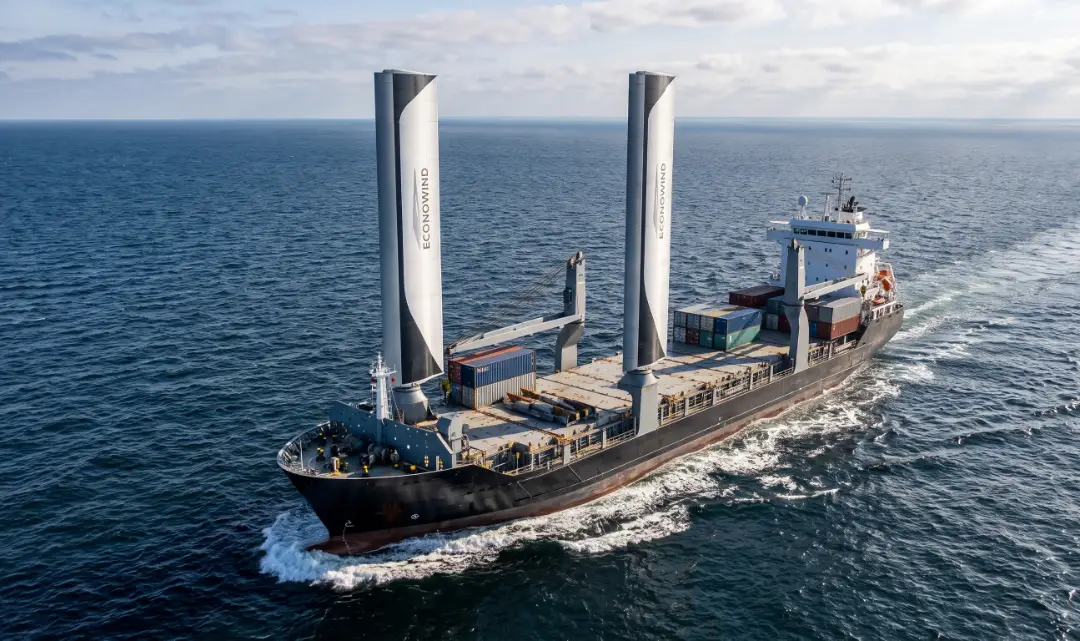
Econowind, the Dutch wind-assisted propulsion company, marked its tenth anniversary on November 19, 2026, with a tally of more than 170 VentoFoil units sold globally since its founding in 2016. The company was established by Frank Nieuwenhuis in partnership with ship design firm Conoship International, at a time when much of the maritime sector remained skeptical about whether wind could play a meaningful role in modern commercial shipping.
The company’s early development was decidedly hands-on. Nieuwenhuis bolted wooden prototypes to the roof of his car and used a vacuum cleaner to simulate the suction principle that improves airflow over the vertical aerodynamic wings. Later prototypes were tested on a car trailer before progressing to sea trials. Early installations revealed practical challenges: systems required manual operation by an onboard technician, and smaller wings delivered limited fuel savings on larger vessels.
Econowind responded by developing automated bridge controls that respond to changing wind conditions, along with tilting designs that allow crews to lower the wings during cargo operations or heavy weather. This engineering work laid the foundation for the 3-series VentoFoil, now the company’s best-selling unit. The VentoFoil system uses vertical wings with suction technology to generate additional thrust from wind, reducing the load on a vessel’s main engine.
The commercial case for wind-assisted propulsion has strengthened considerably over the past decade. Fuel accounts for approximately half of a ship’s operating expenses, and shipowners face both high, unpredictable bunker prices and the costly long-term transition to alternative fuels such as green methanol and ammonia, which remain expensive and lack established supply infrastructure. Wind propulsion offers a complementary solution: it reduces engine demand without requiring new fuel supply chains.
Regulatory developments have reinforced the financial rationale. The EU Emissions Trading System and FuelEU Maritime, which grants a reward factor for qualifying wind propulsion systems and allows operators to pool compliance surpluses, are turning emissions reduction into a direct commercial case. According to the International Windship Association (IWSA), more than 100 ships are now either equipped with wind propulsion systems or classified as wind-ready.
Gavin Allwright, Secretary General of IWSA, identified Econowind as one of the industry’s frontrunners by number of vessels equipped. “What has changed most over the past decade is perception: shipping now sees wind not as a romantic throwback, but as a 21st-century toolbox of commercial solutions,” Allwright said. He added that the WASP market has evolved from a handful of trial installations into a recognized commercial segment, with installations roughly doubling every twelve months.
Looking ahead, Econowind is expanding its manufacturing capacity and preparing to introduce a 30-metre steel version of its 5-series VentoFoil, targeting larger deep-sea vessels that require greater propulsion assistance than earlier systems could provide. The company is also releasing a series of ten anniversary stories featuring shipowners, shipyards, and other stakeholders. “This journey has been full of trials and learning by doing,” Nieuwenhuis said. “It would not have been possible without the people behind Econowind and everyone who supported us along the way”.
The broader wind propulsion sector is also approaching a regulatory inflection point. The International Maritime Organization’s Sub-Committee on Ship Design and Construction finalized a work plan in January 2026 to develop safety guidelines for wind propulsion and wind-assisted power, with interim guidelines targeted for approval by the Maritime Safety Committee in 2029. For Econowind and its peers, clearer international safety standards are expected to reduce project-by-project uncertainty and accelerate adoption beyond early adopters. As Allwright put it: “Wind propulsion is approaching an inflection point. The groundwork has been laid by technology providers such as Econowind, and the sector is now absolutely ready to ride the wave”.