
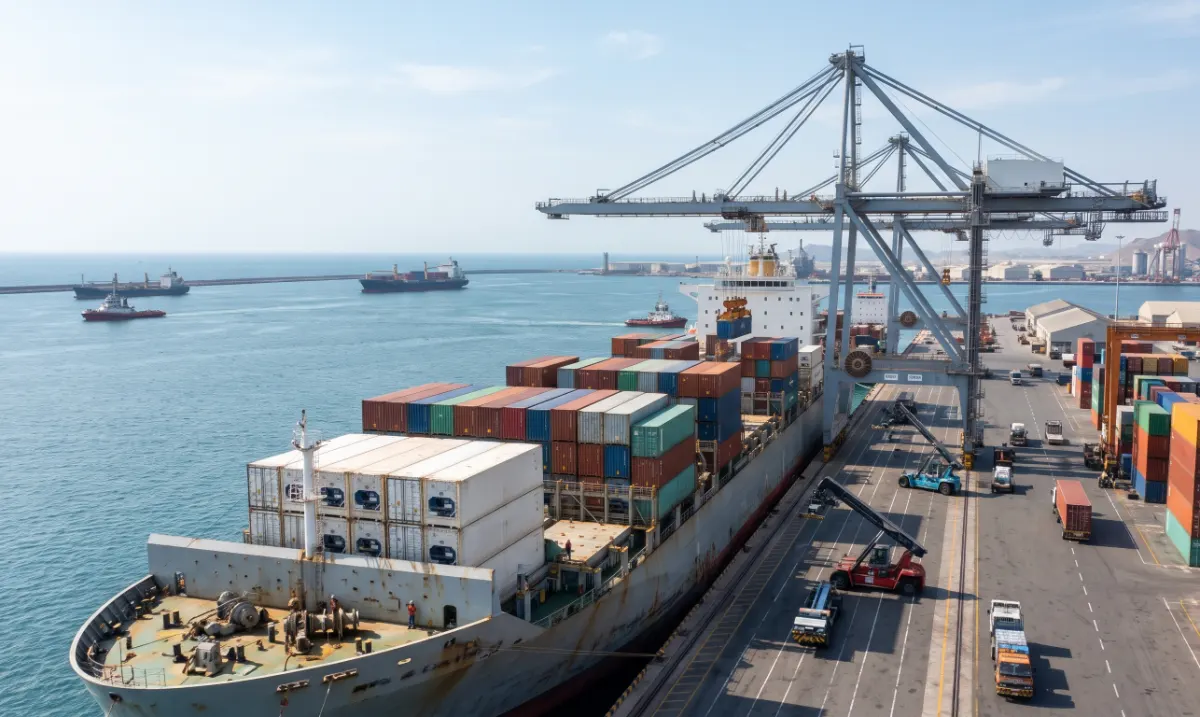
Caerus Shipping has formally launched the Arab Sea Express (AXS), a direct container service that establishes a scheduled maritime link between Sohar Port in Oman and the Indian west coast ports of Nhava Sheva and Mundra. The service operates every 14 days, providing exporters, importers, freight forwarders, and non-vessel-operating common carriers (NVOCCs) with a direct connection that eliminates the need for transshipment at intermediate hubs. The announcement was made in mid-November 2026, with the carrier outlining the service details in a formal statement dated November 16 .
The AXS port rotation follows a straightforward sequence: Sohar → Nhava Sheva → Mundra → Sohar. Caerus Shipping has published port-to-port transit times indicating that eastbound cargo moves from Sohar to Nhava Sheva in three days and from Sohar to Mundra in seven days. Westbound, the carrier lists six days from Nhava Sheva to Sohar and two days from Mundra to Sohar. These timings represent the carrier's published port-to-port schedules and are distinct from the fortnightly sailing frequency, with additional time required for inland transport, customs clearance, and final cargo delivery .
A central commercial objective for the service is the development of refrigerated cargo volumes, particularly fresh fruit and vegetable exports moving from India to Oman. Caerus Shipping has indicated it is exploring opportunities in this segment, recognizing the potential for temperature-sensitive agricultural products that benefit from direct routing. However, reefer acceptance remains conditional on operational approval, equipment availability, and the number of vessel reefer-plug connections. The carrier has presented refrigerated cargo as a development area rather than confirming a dedicated allocation or guaranteed capacity on every sailing .
The service is open to a broad range of trade participants, including exporters, importers, freight forwarders, and NVOCCs. Caerus Shipping has also confirmed support for shipper-owned containers (SOC), allowing customers who manage their own equipment to utilize the route, subject to booking and space confirmation. This flexibility is particularly relevant for freight forwarders and NVOCCs operating in markets where equipment availability can influence cargo movement decisions .
Operationally, Caerus Shipping is providing integrated logistics support through local representatives at both ends of the route. In Oman, the carrier's representatives assist with port operations, documentation, container handling, customs clearance, and inland transportation arrangements. Teams at Mundra and Nhava Sheva support bookings, cargo coordination, and operational enquiries. This approach positions the carrier as more than a pure port-to-port operator, offering service depth that extends into landside coordination at both origin and destination .
The launch comes against a backdrop of substantial bilateral trade between India and Oman. According to data from the Embassy of India in Muscat, two-way trade reached approximately US$11.19 billion in the 2025–26 financial year, with India exporting around US$4.02 billion in goods to Oman and importing approximately US$7.17 billion. Oman ranked as India's 27th-largest trading partner during that period, while India stood as the third-largest source of Omani imports. Indian imports from Oman include petroleum products, crude oil, fertilisers, inorganic chemicals, and plastic raw materials, alongside cargo suitable for containerized transport .
Sohar Port, the Omani gateway for the AXS service, combines a deep-sea port with an adjoining free zone and is managed by Sohar Industrial Port Company, a joint venture between the Port of Rotterdam and the Sultanate of Oman. This port-industrial configuration provides the Omani maritime and logistics infrastructure supporting the service. On the Indian side, Nhava Sheva and Mundra are established west coast container gateways with extensive hinterland connectivity and feeder networks serving the broader Indian market .
The commercial viability of the AXS service will depend on confirmed bookings and the cargo flows developed around its fortnightly schedule. The 14-day frequency presents a consideration for shippers of highly perishable goods, who typically require more frequent departures to manage inventory and shelf life effectively. For the service to become a primary routing option for time-sensitive produce, market observers suggest that a move toward weekly frequency would be a key development to watch, alongside the confirmation of reefer plug availability and equipment stocks at both Indian ports .