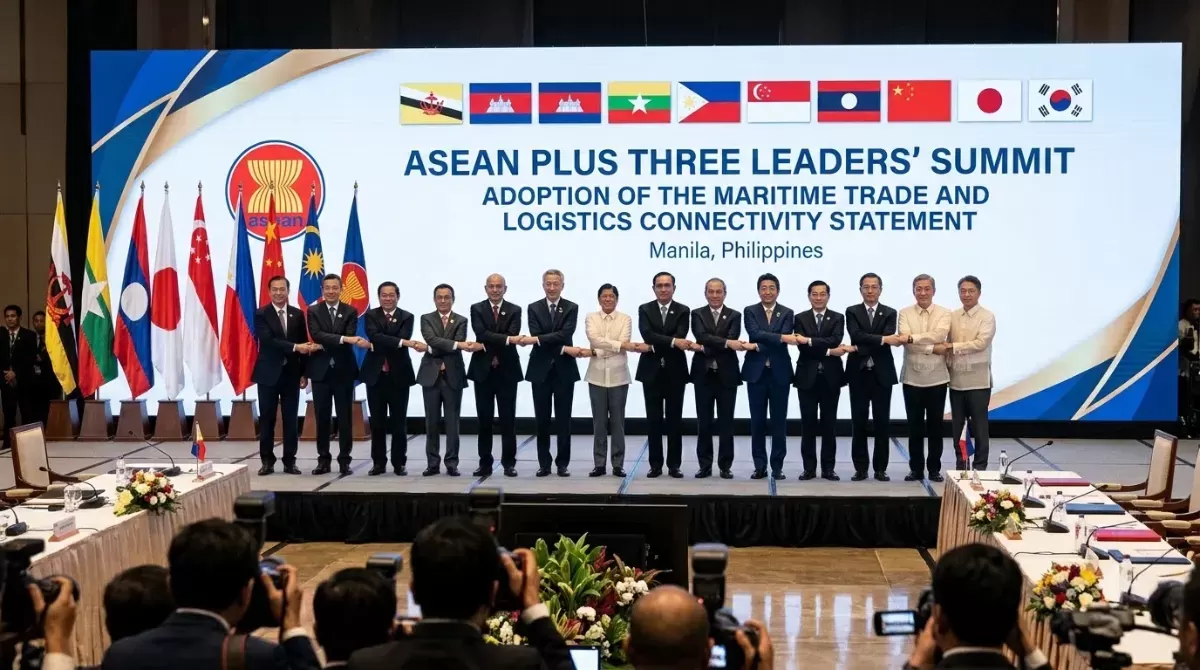
<p class="ds-markdown-paragraph" style="margin: 16px 0px; color: rgb(15, 17, 21); font-family: quote-cjk-patch, Inter, system-ui, -apple-system, BlinkMacSystemFont, "Segoe UI", Roboto, Oxygen, Ubuntu, Cantarell, "Open Sans", "Helvetica Neue", sans-serif; font-size: 16px;"><span class="">The 29th ASEAN Plus Three Summit, held in Manila on November 17, concluded with the adoption of the APT Leaders’ Statement on Maritime Trade and Logistics Connectivity, a political declaration intended to strengthen regional cooperation across ports, shipping, and supply chains </span><span class="">. The statement was adopted alongside a second declaration on strengthening energy and food security resilience amid external shocks and supply chain disruptions </span><span class="">. The dual declarations reflect a recognition among regional leaders that maritime logistics and resource security are deeply interconnected concerns requiring coordinated responses.</span><span class="_5f9bba8" data-citation-group="18" style="margin-left: 2px; margin-right: 2px;"><a href="https://asean.org/secretary-general-of-asean-participates-in-the-29th-asean-plus-three-summit/" target="_blank" rel="noreferrer" aria-label="11" style="color: rgb(57, 100, 254); transition: box-shadow 0.2s cubic-bezier(0.4, 0, 0.2, 1); border-color: rgba(255, 255, 255, 0); border-width: 2px 3px; margin-left: -3px; margin-right: -3px; text-decoration: none; position: relative;"></a></span></p><p class="ds-markdown-paragraph" style="margin: 16px 0px; color: rgb(15, 17, 21); font-family: quote-cjk-patch, Inter, system-ui, -apple-system, BlinkMacSystemFont, "Segoe UI", Roboto, Oxygen, Ubuntu, Cantarell, "Open Sans", "Helvetica Neue", sans-serif; font-size: 16px;"><span class="">The maritime connectivity statement encompasses a range of commitments, including port cooperation, supply chain resilience, paperless trade facilitation, cold chain management, and green shipping practices. These areas address longstanding inefficiencies in regional logistics, where documentary requirements, incompatible standards, and inadequate cold chain infrastructure have historically added costs and delays to intra-Asian trade. The inclusion of green shipping in the statement signals an awareness that environmental sustainability is becoming a defining issue for the maritime sector and that regional cooperation will be necessary to manage the transition to lower-emission fuels and technologies.</span></p><p class="ds-markdown-paragraph" style="margin: 16px 0px; color: rgb(15, 17, 21); font-family: quote-cjk-patch, Inter, system-ui, -apple-system, BlinkMacSystemFont, "Segoe UI", Roboto, Oxygen, Ubuntu, Cantarell, "Open Sans", "Helvetica Neue", sans-serif; font-size: 16px;"><span class="">The statement’s most notable feature may be what it does not contain: mandatory deadlines. The declaration acknowledges that geopolitical events and route disruptions have exposed the vulnerability of regional supply chains, but it leaves follow-up and implementation to existing ASEAN sectoral bodies rather than establishing new institutions or binding timetables </span><span class="">. This approach is consistent with ASEAN’s preference for non-binding, consensus-based cooperation, but it raises questions about whether the statement will produce concrete improvements in regional logistics performance or remain primarily a statement of intent.</span><span class="_5f9bba8" data-citation-group="20" style="margin-left: 2px; margin-right: 2px;"><a href="http://vov.vn/zh-CN/xinwen/limingxingzonglidongmengyuzhongrihanxujiaqiangjingjimaoyihulianhutong-2481150.vov" target="_blank" rel="noreferrer" aria-label="4" style="color: rgb(57, 100, 254); transition: box-shadow 0.2s cubic-bezier(0.4, 0, 0.2, 1); border-color: rgba(255, 255, 255, 0); border-width: 2px 3px; margin-left: -3px; margin-right: -3px; text-decoration: none; position: relative;"></a></span></p><p class="ds-markdown-paragraph" style="margin: 16px 0px; color: rgb(15, 17, 21); font-family: quote-cjk-patch, Inter, system-ui, -apple-system, BlinkMacSystemFont, "Segoe UI", Roboto, Oxygen, Ubuntu, Cantarell, "Open Sans", "Helvetica Neue", sans-serif; font-size: 16px;"><span class="">For the Indian subcontinent, the ASEAN Plus Three connectivity framework has indirect but significant implications. India is not a member of the APT process, but its trade with Southeast Asia—much of which moves by sea—stands to benefit from improvements in port efficiency, paperless trade, and supply chain coordination among APT countries. Indian exporters of rice, textiles, and other commodities destined for ASEAN markets depend on efficient transshipment through regional hubs, and any reduction in documentary friction or port delays would lower their costs and improve reliability.</span></p><p class="ds-markdown-paragraph" style="margin: 16px 0px; color: rgb(15, 17, 21); font-family: quote-cjk-patch, Inter, system-ui, -apple-system, BlinkMacSystemFont, "Segoe UI", Roboto, Oxygen, Ubuntu, Cantarell, "Open Sans", "Helvetica Neue", sans-serif; font-size: 16px;"><span class="">The timing of the statement is also relevant to the broader geopolitical context. The Hormuz crisis has disrupted shipping routes between South Asia, the Middle East, and Europe, making the resilience of intra-Asian trade routes more important. If the APT countries can implement even partial improvements in maritime connectivity, they may be able to absorb some of the trade that has been disrupted by instability in the Middle East and the Red Sea. The statement’s emphasis on supply chain resilience suggests that this consideration was on the minds of the leaders who adopted it.</span></p><p class="ds-markdown-paragraph" style="margin: 16px 0px; color: rgb(15, 17, 21); font-family: quote-cjk-patch, Inter, system-ui, -apple-system, BlinkMacSystemFont, "Segoe UI", Roboto, Oxygen, Ubuntu, Cantarell, "Open Sans", "Helvetica Neue", sans-serif; font-size: 16px;"><span class="">The Manila summit also provided an opportunity for bilateral discussions on maritime issues among the participating countries. While the public declarations focus on cooperative frameworks, the margins of the summit likely hosted conversations about the security situation in the South China Sea, the Strait of Malacca, and other regional waterways. These discussions, though not reflected in the formal statement, are an important part of how regional maritime cooperation actually functions in practice.</span></p><p class="ds-markdown-paragraph" style="margin: 16px 0px; color: rgb(15, 17, 21); font-family: quote-cjk-patch, Inter, system-ui, -apple-system, BlinkMacSystemFont, "Segoe UI", Roboto, Oxygen, Ubuntu, Cantarell, "Open Sans", "Helvetica Neue", sans-serif; font-size: 16px;"><span class="">Implementation of the connectivity commitments will depend on the capacity and willingness of ASEAN sectoral bodies to translate the declaration into actionable programs. ASEAN has a mixed record in this regard: some initiatives, such as the ASEAN Single Window for customs documentation, have made meaningful progress, while others have languished due to funding constraints, capacity limitations, or lack of political prioritization. Whether the maritime connectivity statement follows the more successful or less successful path will become clear only over the coming years.</span></p>
ASEAN Plus Three Leaders Adopt Maritime Trade and Logistics Connectivity Statement in Manila
Leaders of ASEAN and the Plus Three countries—China, Japan, and South Korea—have adopted a statement on maritime trade and logistics connectivity at their 29th summit in Manila. The statement covers port cooperation, supply chain resilience, paperless trade, and green shipping, but sets no mandatory deadlines, leaving follow-up to existing ASEAN sectoral bodies.