
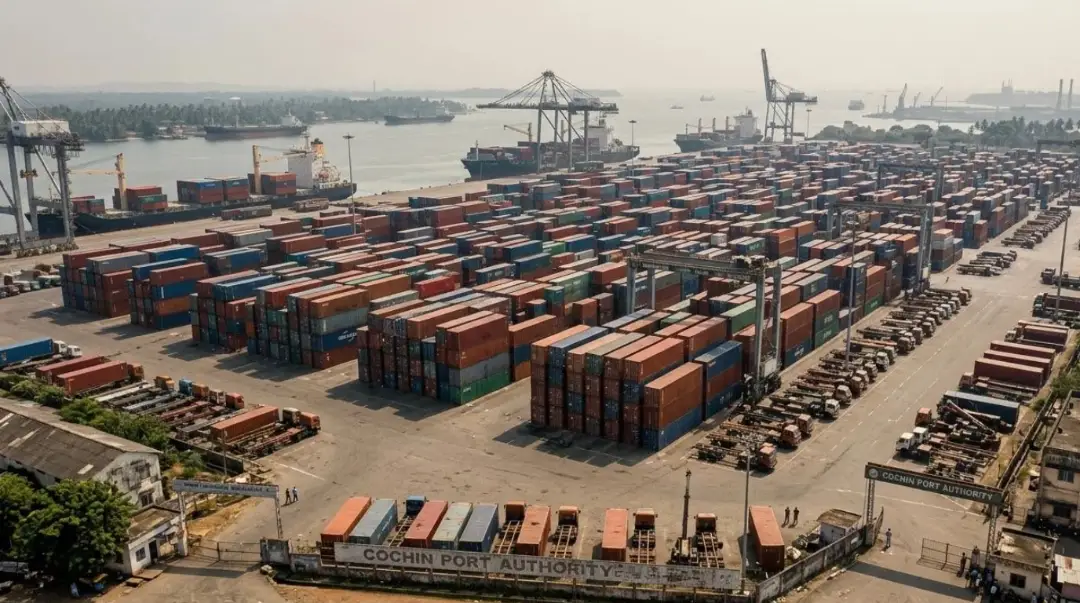
The indefinite strike by container truck drivers at the Vallarpadam International Container Transshipment Terminal (ICTT) in Cochin Port has now entered its twelfth consecutive day, with no resolution in sight between protesting workers and customs authorities. The dispute centres on a mandatory 100 percent container scanning requirement that drivers say forces them to pass through drive-through scanners six or seven times daily, causing health complaints including body pain, headache, and nausea . The Cochin Chamber of Commerce and Industry has appealed to both the Central and Kerala governments for urgent intervention, warning that the disruption poses long-term risks to the region's entire logistics ecosystem.
As of November 20, approximately 1,810 containers have accumulated at the Vallarpadam terminal, with a significant proportion consisting of reefer containers holding perishable goods that require continuous refrigeration . The financial burden is mounting rapidly: reefer containers incur charges of ₹588 to ₹886 per four-hour slab, translating to roughly ₹2,352 to ₹3,545 per day per container, with separate demurrage charges applying from the eighth day of storage onwards . Shipping lines and importers are now actively exploring alternative routing options, with the V.O. Chidambaranar Port in Tamil Nadu emerging as the primary beneficiary of diverted cargo flows.
The operational paralysis at Vallarpadam carries significant weight given the terminal's throughput scale. Operator DP World reported handling 834,665 TEUs in the 2024-25 fiscal year, approximately 11 percent higher than the preceding year, including 169,562 TEUs of transshipment cargo across 640 vessel calls . Any sustained disruption to this volume threatens not only immediate commercial interests but also Cochin's competitive positioning among South Indian ports. Prakash Iyer, Vice-President of the Cochin Chamber, explicitly warned that cargo shifting to other ports "will have long-term implications for the region's trade, logistics ecosystem and economy" .
The root cause of the dispute remains contested. Workers allege that repeated daily passage through the drive-through scanning equipment has caused adverse health effects, though the Customs Directorate of Logistics maintains that such systems incorporate safeguards designed to prevent unacceptable radiation exposure . The Cochin Chamber has proposed a compromise involving selective or risk-based scanning while adequate infrastructure is established, and has suggested examining whether designated Container Freight Stations and Inland Container Depots could accommodate scanning operations to relieve pressure at the terminal . These proposals, however, have not yet been accepted by customs authorities or the protesting drivers.
The timing of the disruption is particularly damaging given the terminal's recent growth trajectory. Vallarpadam had been positioning itself as a key transshipment hub for the Indian subcontinent, leveraging its strategic location and modern infrastructure to attract mainline carrier services. The current impasse risks undoing years of investment in building shipper confidence and carrier relationships. Shipping lines that have already diverted vessels to Tamil Nadu may be reluctant to restore services to Cochin once the dispute is resolved, given the uncertainties inherent in the current situation.
For importers, the financial exposure extends beyond demurrage and detention charges to include potential contractual penalties for delayed delivery and spoilage of perishable cargo. The reefer containers currently stranded at Vallarpadam represent particularly acute losses, as temperature-sensitive pharmaceutical products and food items may become unsaleable if power supply or monitoring is interrupted during the standoff. Exporters, meanwhile, face missed shipment windows and the prospect of damaged relationships with international buyers who may turn to alternative suppliers in Southeast Asia or the Middle East.
The strike has also exposed vulnerabilities in India's broader port labour relations framework. The mandatory scanning policy that triggered the dispute was part of a pilot programme at three locations, suggesting that similar conflicts could emerge at other Indian ports if the Cochin experience is not resolved through constructive dialogue. The Customs Directorate's insistence on universal scanning reflects heightened security concerns, but the implementation approach has clearly failed to account for the legitimate concerns of the workers who must operate the equipment on a daily basis.
Resolution will require coordinated action from multiple government stakeholders, including the Ministry of Ports, Shipping and Waterways, the Central Board of Indirect Taxes and Customs, and the Kerala state government. The Cochin Chamber has specifically called for customs intervention to restore cargo movement while a permanent solution is negotiated . Until an agreement is reached, the Indian logistics sector will continue to watch closely, aware that the outcome will set a precedent for how similar conflicts between security requirements and labour rights are managed across the country's port network