
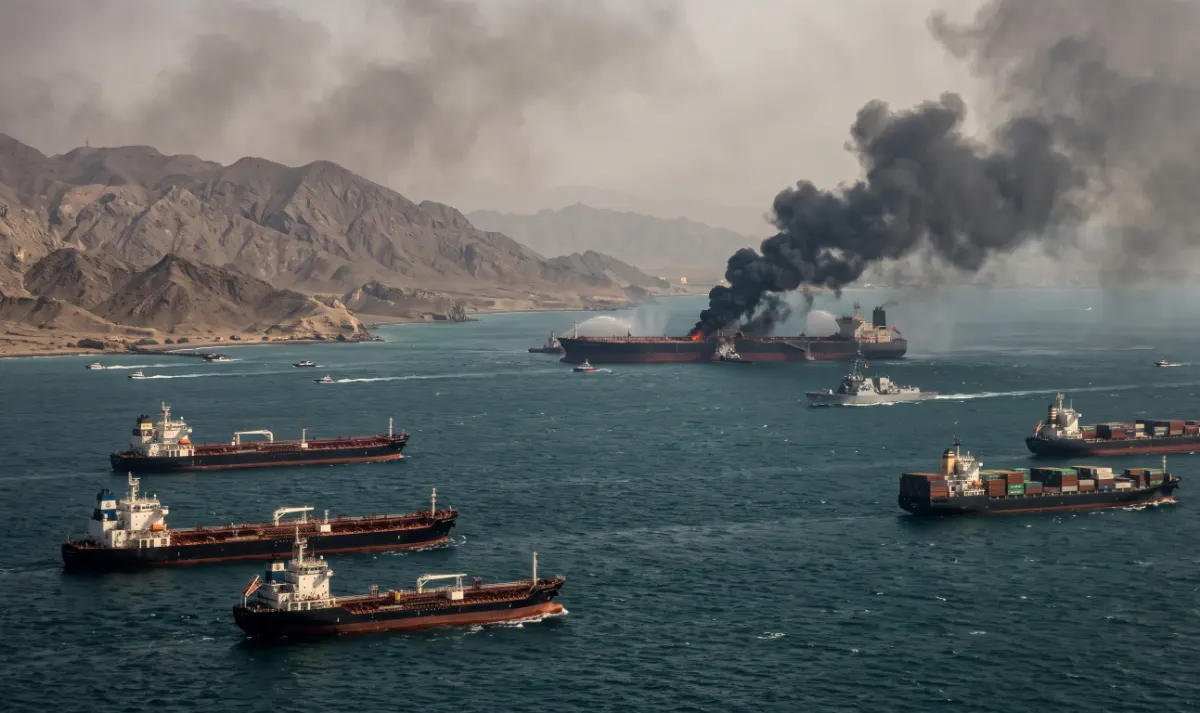
Oil shipments through the Strait of Hormuz have declined significantly as Iranian strikes on commercial vessels escalate, creating a dual crisis of reduced transit volumes and insufficient onward shipping capacity. According to the Hormuz Strait Tracker, the seven-day average of crude oil flows through the strategic waterway fell from roughly 13 million barrels per day in late October to just 8 million barrels per day by November 15, representing approximately 47% of pre-war flows . Including petroleum products, total liquid flows averaged 8.6 million barrels per day over the past week, 57% below the pre-war norm of 20 million barrels per day .
The decline reflects an intensifying campaign of attacks on shipping in and around the strait. Noam Raydan, a maritime tracker at the Washington Institute, reported that at least 16 attacks were carried out by Iranian forces against passing ships in the Strait of Hormuz in November alone . The UK Maritime Trade Operations centre has logged a steady stream of incidents involving tankers struck by unknown projectiles, with vessels reporting fires, engine room damage, and crews forced to evacuate . Iran's Islamic Revolutionary Guard Corps has stated that vessels attempting to transit without coordinating with its maritime traffic control centre risk striking naval mines, and has claimed multiple tankers have been disabled after entering what it describes as unauthorized routes .
The attack pattern has targeted vessels across multiple flags and cargo types. On November 18, the UAE's national oil company ADNOC confirmed one of its vessels came under attack while transiting the strait, injuring 11 crew members and leaving one missing . A day earlier, Iran reported a fourth tanker damaged by a mine near the strait in a 24-hour period, with the vessel left unable to manoeuvre and a fire breaking out in its engine room . These incidents follow earlier attacks in October and early November that established a pattern of projectile strikes on outbound and inbound tankers, container ships, and product carriers .
A separate but equally consequential constraint has emerged in the Gulf of Oman, where the remaining oil transiting Hormuz is being consolidated for onward shipment. The increased reliance on ship-to-ship transfers outside the strait has caused very large crude carriers to wait weeks to complete cargo transfers, drastically reducing the availability of empty tankers for other global routes . Data from Tankertrackers.com shows that combined capacity of supertankers and Suezmax vessels en route to the Gulf of Oman stood at just 71 million barrels as of November 16, down from 130 million barrels in late August—a decline of roughly 40% . "There are simply not enough empty tankers to move the oil out of the region," said co-founder Samir Madani, noting that getting oil through Hormuz to Oman is only half the problem when onward transport capacity is lacking .
The operational environment has forced major shipping companies to adapt under extraordinary circumstances. Saudi Arabia's Bahri Ship Management has been coordinating with the US military to escort tankers through the strait, with president Khalid Alhammad stating the company dispatched four vessels through the waterway on a single day in November . "We have to keep transporting energy," Alhammad said, acknowledging that the company has no alternative but to continue transiting the contested passage . The US Central Command has reported escorting more than 1.7 billion barrels of crude oil out of the Strait of Hormuz since late February, though the pace of attacks has continued to outstrip protective measures .
The volume declines carry significant implications for global energy markets and tanker economics. Kpler data indicates that November flows through Hormuz are at approximately 90% of pre-war levels when alternative pipeline routes are included, but the share of oil actually transiting the strait by tanker has fallen from 80% before the war to 60% . Refined products, which account for roughly 3 million barrels per day, have no alternative pipeline and remain entirely dependent on the contested waterway . For tanker operators, the combination of elevated war risk premiums, longer waiting times for ship-to-ship transfers, and reduced vessel availability creates a complex operating environment where freight rates may remain elevated even as total volumes decline.
The trajectory of Hormuz oil flows remains uncertain. Iran has linked the lifting of maritime restrictions to US guarantees against renewed attacks and the release of frozen funds, conditions that show little prospect of near-term resolution . The US-imposed naval blockade on Iranian southern ports has reduced Iranian crude exports to near zero, while Iran's proxy attacks continue to target vessels associated with US-aligned shipping . For the global economy, the persistent disruption of a waterway that normally carries approximately one-fifth of global oil supply represents a structural risk that has already reshaped trade routes, pipeline utilization, and tanker deployment patterns—and shows no sign of abating as the conflict enters its tenth month.