
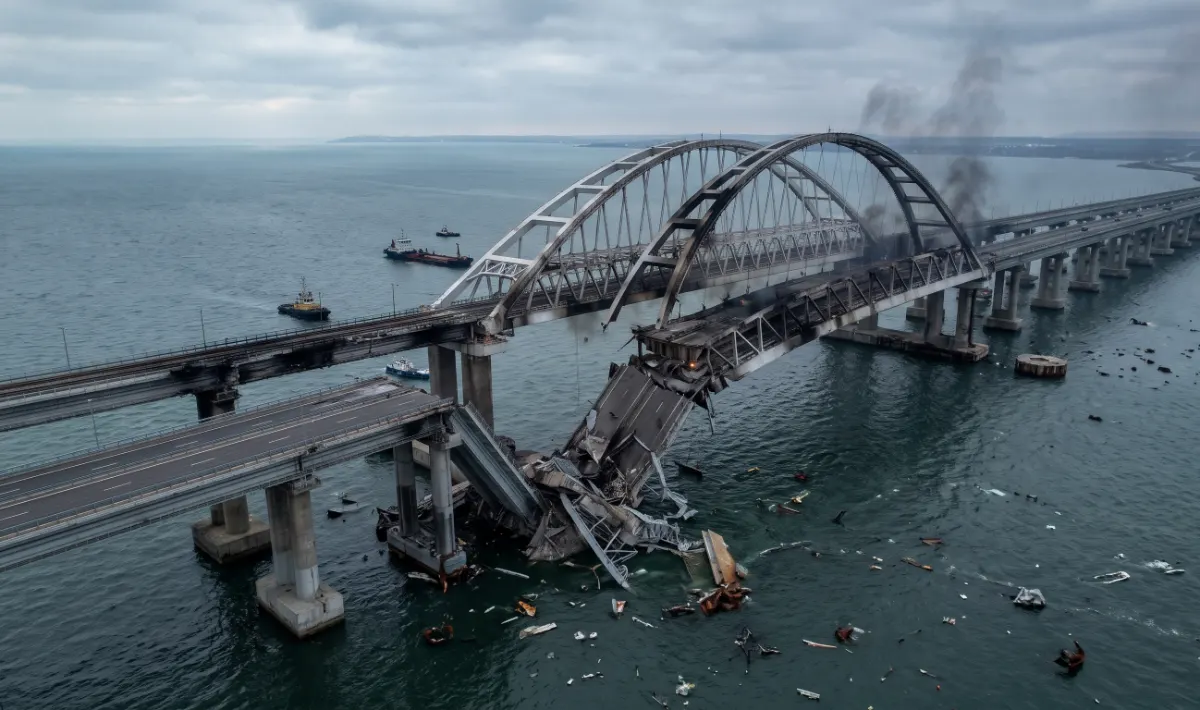
The Kerch Strait Bridge, a 19-kilometer structure linking mainland Russia to the occupied Crimean Peninsula, came under sustained Ukrainian attack over two consecutive nights. On the night of November 16, drone strikes damaged the roadway and shifted the main arch by approximately 15 degrees. A second, combined missile and drone assault on the night of November 17 brought the damaged arch and a road span of roughly 270 meters crashing into the water below. Ukrainian President Volodymyr Zelenskyy confirmed the operation was a multi-stage effort by the Security Service of Ukraine and the General Staff, involving Ukrainian-made weapons including Palianytsia drones, Neptune missiles, and FP-5 Flamingo missiles.
The critical consequence lies beneath the bridge. The Kerch Strait itself is shallow, with depths of only three to five meters, and all significant maritime traffic must pass through the Kerch-Yenikale Canal, a dredged channel just 120 meters wide. This narrow passage ran directly beneath the bridge's central navigation arch. The collapsed steel and concrete structures—estimated at 6,000 tons and standing approximately 45 meters tall—fell precisely into this channel, rendering it impassable for any vessel requiring deep-water access.
The immediate effect has been the complete suspension of shipping between the Black Sea and the Sea of Azov. According to multiple maritime and open-source intelligence reports, no commercial vessels can transit the strait in either direction. This effectively converts the Sea of Azov into a closed body of water, severing maritime access to ports under Russian control, including Mariupol and Berdyansk on the occupied Ukrainian coast, as well as Rostov-on-Don, Azov, and Taganrog on the Russian mainland.
The economic ramifications are substantial. The Sea of Azov normally accounts for approximately 25% of Russian grain exports, according to agricultural consultancy SovEcon. Shipping through the strait had already been suspended since July 2026 following repeated drone attacks, but until the bridge collapse, much of the region's export infrastructure remained intact, offering the prospect of relatively swift resumption if security conditions improved. The collapsed bridge presents a fundamentally different problem: clearing the navigable channel will require substantial engineering work, with no official timetable confirmed.
Beyond grain, the blocked channel disrupts exports of petroleum products, coal, and fertilizers from the affected ports. The Don River navigation system, which stretches far north into the Russian heartland and connects to the Volga-Don Canal, is also severed from seagoing access. This inland waterway network is critical for moving agricultural and industrial cargoes to international markets, and Russian Railways is unlikely to absorb the diverted volume without significant strain.
Military logistics for Russian forces in southern Ukraine have been directly impacted. The bridge had served as the primary artery carrying fuel, ammunition, equipment, and personnel to the Crimean Peninsula and onward to the front lines in Kherson and Zaporizhzhia regions. While Russian authorities reported the resumption of limited rail services by midday on November 17, the road connection remains severed, and the loss of the maritime channel deprives Russian forces of a supplementary supply route. Ukrainian military analysts assess that the damage will constrain Russia's ability to sustain offensive operations and may reduce the tempo of attacks launched from Crimea.
The strategic implications extend beyond immediate logistics. Retired Ukrainian Navy Captain Andriy Ryzhenko estimated that rebuilding the destroyed road span and arch will take more than a year, and the technical complexity is heightened by the need to work around the still-standing but damaged railway arch. Meanwhile, Russia's capacity to conduct repairs is constrained by the threat of further Ukrainian strikes on repair equipment and personnel. For the Kremlin, the visible collapse of a prestige project inaugurated by President Vladimir Putin in 2018 carries significant symbolic weight, undermining the narrative of Crimea's permanent integration into Russia. As one analyst observed, the true significance may lie not in the bridge itself, but in the water beneath it: the interruption of maritime traffic through the Sea of Azov represents a more durable and consequential blow than the physical damage to the roadway.