
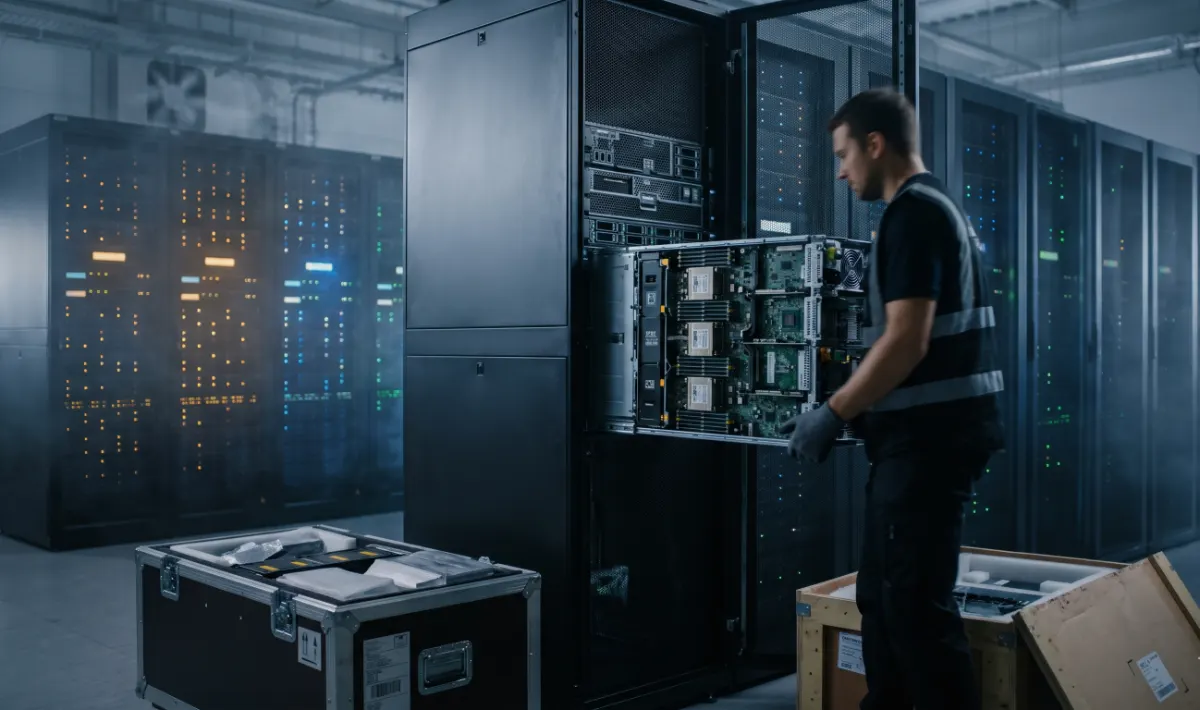
Nvidia's interim Chief Executive Officer Colette Kress confirmed during the company's fiscal third-quarter earnings call on November 17 that the chipmaker has ceased shipments of licensed Hopper-generation data center products to China . "Our guidance does not have any licensed Hopper data center products included, and we are no longer shipping licensed Hopper data center products to China," Kress stated, without providing an explanation for the decision or indicating whether the halt is temporary or permanent . The Hopper family includes the H200, a powerful processor used to train and run advanced AI models .
The $2.4 billion figure represents sales of licensed Hopper-generation products to Chinese customers during the quarter ended October 25, 2026, though Nvidia did not disclose how much of that amount came specifically from H200 processors . This revenue constituted approximately 2.2% of Nvidia's $107.6 billion in total quarterly data center revenue . The halt closes a channel that had been established when the US Department of Commerce eased export restrictions in January 2026, allowing case-by-case review of export applications for the H200 and similar processors .
The decision follows a dramatic leadership upheaval at the company. On November 12, Nvidia's board announced that co-founder and CEO Jensen Huang had stepped down effective immediately, with Chief Financial Officer Kress appointed interim chief executive . Huang had been the strongest advocate for restoring chip exports to China and had personally negotiated the arrangement under which H200 shipments passed through the United States and were subject to a 25% tariff paid to the US Treasury . Reports surrounding Huang's departure referenced allegations of extramarital relationships, including one with a woman suspected of links to Chinese intelligence, though no public evidence of espionage has been published .
The timing of the halt is closely tied to new regulatory measures introduced by the US Commerce Department's Bureau of Industry and Security. On November 16, the agency issued an interim final rule targeting remote computing arrangements, mandating prior export licenses for shipping advanced chips to data centers that provide remote computational capacity to Chinese customers . The rule also imposed destination-based license requirements for shipments to Singapore, Malaysia, Thailand, Indonesia, and Brazil—five transshipment hubs that had handled intermediate server assembly and cloud hosting for Chinese technology enterprises . This measure closed secondary pathways that had permitted Chinese developers to rent advanced processing clusters abroad.
Under the licensing framework established in January 2026, Washington had approved H200 sales to ten Chinese companies, including Alibaba, Tencent, and ByteDance, the owner of TikTok . However, Beijing had also restricted H200 imports as it sought to reduce dependence on American technology and encourage domestic alternatives. Approximately 600,000 H200 chips were being held in Hong Kong awaiting permission to enter mainland China, with several major Chinese internet companies having each obtained about 10,000 chips in recent months . US approval did not guarantee that the chips could enter mainland China, as Beijing withheld approval for large-scale imports .
The financial implications extend beyond the immediate revenue loss. Investment bank Jefferies estimated that the new remote computing rule could cut Nvidia's data center revenue by $44 billion to $62 billion next year . However, Kress stated that ample backlog for next-generation products, such as the Vera Rubin NVL72 rack-scale AI supercomputer, will cushion the near-term blow . Nvidia also announced the establishment of a board-level national security committee to oversee export-control compliance and global trade risks, with the compliance team reporting both to the committee and the interim CEO .
Analysts characterized the move as a strategic pivot from a founder-driven, pragmatic approach toward China to a more cautious, compliance-first posture . Roger Sheng, vice-president at Gartner, noted that Huang was the pivotal figure linking demand-side financing to supply-side execution, and that without him, Asian suppliers and buyers of Nvidia's products will inevitably be affected . The leadership vacuum at Nvidia has emboldened hardline voices in Washington to push for tighter AI curbs, Sheng added. For Chinese cloud platforms, the suspension leaves them without an authorized pathway to acquire high-bandwidth accelerators from American chip designers, forcing a shift toward domestic alternatives such as Huawei's Ascend series .