
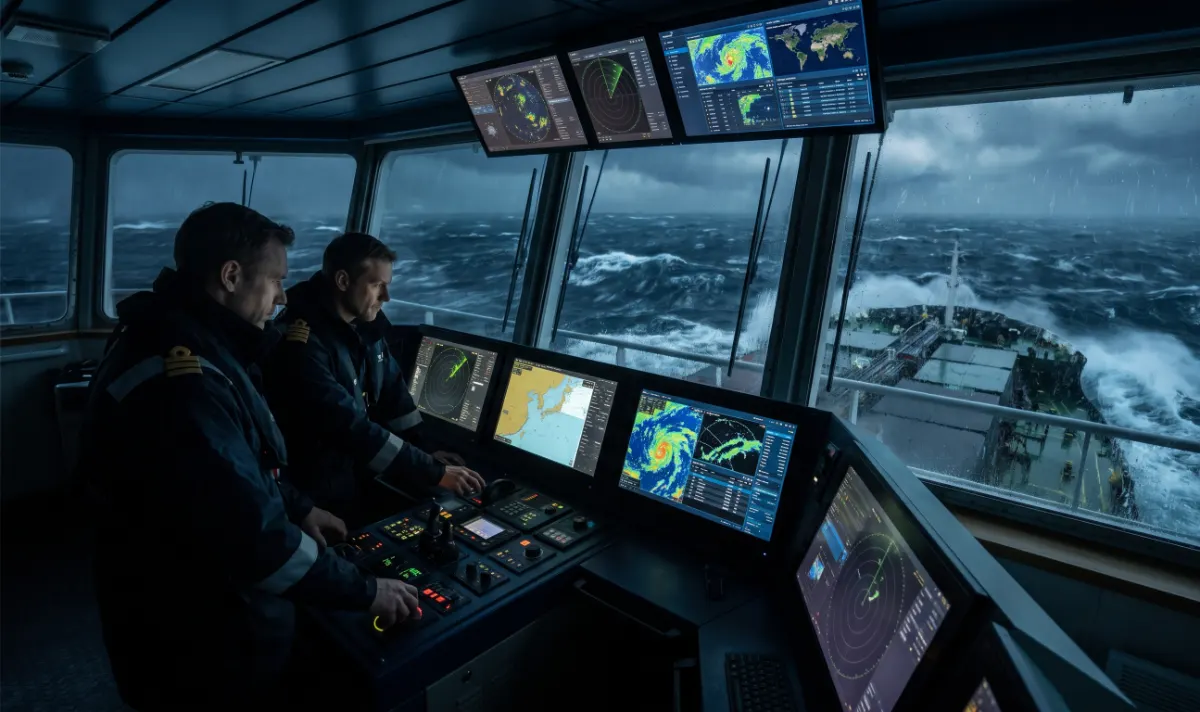
Inmarsat Maritime, now part of Viasat, has developed its Maritime Safety Data Hub in partnership with supply chain consultancy SeaFocus International, creating a platform that moves beyond reporting individual incidents to identifying patterns and trends in maritime risk . The hub integrates GMDSS distress call data with analysis of maritime safety broadcasts and weather information, offering the industry a new layer of intelligence for understanding the conditions that precede emergencies at sea .
The scale of the dataset is substantial. In 2025, Inmarsat transmitted 106,975 maritime safety broadcasts, of which 2.6% were marked as urgent. Among these urgent messages, 84.6% were related to weather, with storms representing 75% of meteorological hazards and gales accounting for 20% . Cyclones, despite constituting just 4% of weather hazards, were responsible for over 99% of urgent weather messages, reflecting their disproportionate impact on vessel safety .
A key finding of the analysis is the temporal relationship between weather warnings and distress events. On average, approximately 10 weather warnings were broadcast in the 12 hours preceding each distress event, establishing a clear correlation between hazardous meteorological conditions and elevated operational risk . John Dodd, Director of Maritime Safety at Inmarsat Maritime, emphasized that the value of maritime safety information lies in giving ships and operators the time to make informed decisions, whether the threat is extreme weather or geopolitical instability .
However, the data also raises uncomfortable questions. If crews were warned in advance, why did distress calls still occur? Dodd has suggested that the resilience of the weather warning system requires review, questioning whether crews fully understood the urgency of messages, whether training was adequate, or whether exposure to jamming and spoofing had eroded faith in the system . Olli Soininen, Head of Programmes at Fintraffic VTS, noted that a storm does not create the same risk for every vessel, and that more granular data on a ship's vulnerability to extreme weather could help masters decide whether to continue, alter course, or delay a voyage .
The broader risk landscape has evolved significantly. Inmarsat received 741 GMDSS calls in 2025, compared with 801 in 2024 and 788 in 2023, a three-year trend that remains broadly consistent with historical averages . Tankers generated the highest number of distress calls at 203, followed by bulk carriers at 105, dry cargo vessels at 83, offshore support vessels at 75, and container ships at 54 . Laurent Parenté, Director General of the International Mobile Satellite Organization, observed that this consistency does not imply a lack of improvement but rather that "the risk is evolving" .
Geopolitical tensions, sanctions, tariffs, and route disruptions have reshaped trade patterns and extended voyages, increasing fuel consumption, crew workloads, and vessel exposure . Electronic interference has emerged as a significant additional threat, with GPS spoofing and signal jamming increasing in strategically important corridors, particularly the Middle East, Black Sea, and Baltic Sea . Simon Osborne, Co-Founder of MarinAI, described these phenomena as creating an "electronic fog" that reduces navigator confidence in onboard systems, and suggested that seafarers may need to relearn traditional navigation techniques as a safeguard .
The Maritime Safety Data Hub is designed as an interactive resource allowing users to explore trends, filter data by vessel type, region, and incident category, and download relevant insights . Inmarsat has drawn its findings to the attention of the World Meteorological Organization and the IMO's Enhanced Group Call coordinating panel, and plans to extend its analysis to correlations between GMDSS calls and navigational warnings, search and rescue alerts, and piracy warnings . For an industry facing increasingly complex and interconnected risks, the hub represents an attempt to shift from reactive incident reporting toward anticipatory risk management.