
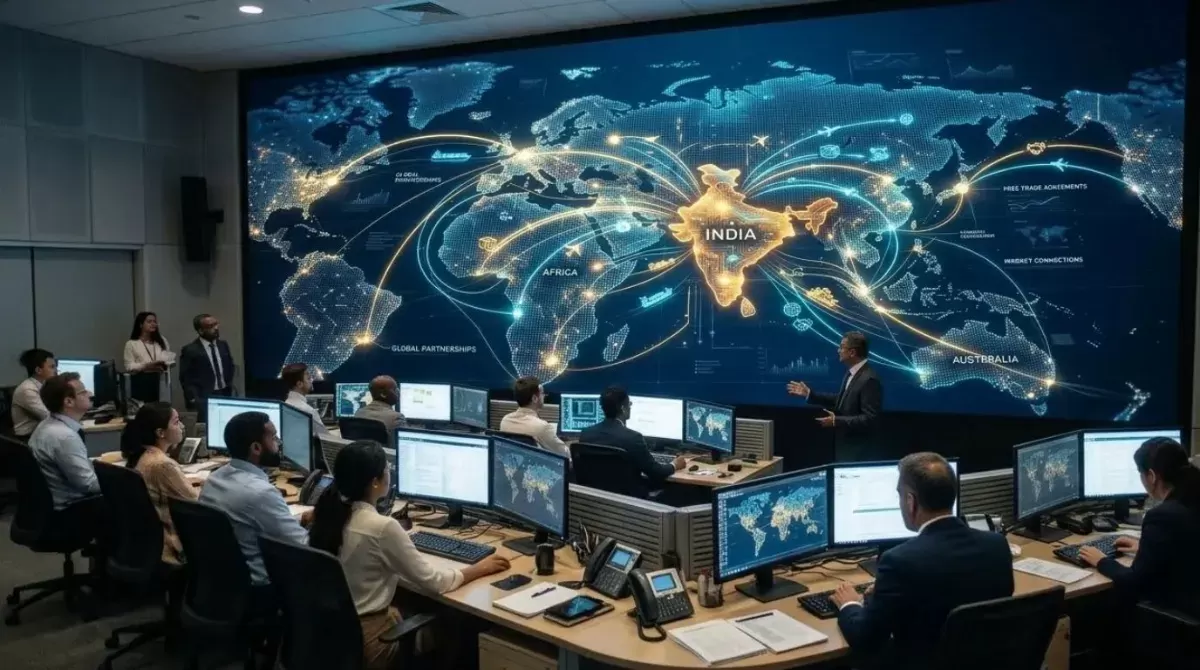
Commerce and Industry Minister Piyush Goyal has said that international partners are increasingly seeking trade agreements with India, reflecting the country's growing economic standing and the attractiveness of its market . Speaking at the valedictory session of the FICCI Annual General Meeting and Annual Convention in New Delhi on 19 November 2026, Goyal framed the shift in stark terms: "Every place I go to, the first demand is, 'We want to do a free trade agreement with you'" .
The expansion of India's preferential market access provides the quantitative backdrop to that statement. Goyal said India's existing trade agreements now cover markets representing around $70 trillion of global GDP, compared with roughly $10 trillion before 2014 . He added that the engagements India has with eight or nine other geographies, bilateral and multilateral, will add another $15 trillion of market access over the next year to year and a half . If those agreements are concluded, India could eventually have preferential access to markets representing $85 trillion, or approximately 76% of global GDP .
The Egypt dimension of the address connects to the broader trade diplomacy that has accelerated in the second half of 2026. Goyal said India and Egypt have decided to ask their officials to examine the possibility of a preferential trade agreement or a free trade agreement and finalise terms of reference . This follows his visit to Egypt in mid-November, where he led a delegation of over 140 CEOs and discussed cooperation in the Suez Canal Economic Zone, ports, and logistics. The Egypt engagement is part of a wider pattern that includes the recently implemented India-UK CETA, the anticipated India-EU FTA, and the ongoing negotiations with the US.
Goyal also framed the strategic objective in terms that go beyond tariff reduction. "Today, I would like to suggest going one step forward. We need to make the world dependent upon us. We need to create leverage in India," he said . He urged FICCI to strengthen its global outreach and help Indian businesses connect with overseas markets, describing the industry body as a bridge between Indian businesses and international opportunities. He also emphasised that the benefits of trade agreements should reach smaller businesses, farmers, artisans, and MSMEs, rather than being limited to large corporations.
For India's export logistics sector, the expansion of preferential market access has direct implications for cargo flows and trade routes. Each new FTA creates new opportunities for Indian exporters, but it also creates demand for the logistics infrastructure that connects production centres to the markets where preferences apply. The India-EU FTA, once implemented, will affect the India-Europe container and air cargo corridors that have been reshaped by the Red Sea disruption. The potential Egypt PTA or FTA could open new channels for trade through the Suez Canal Zone, which Goyal discussed during his November visit.
The timing of Goyal's remarks aligns with the broader pattern of trade policy momentum that has characterised the final quarter of 2026. India has concluded agreements with the UK and New Zealand, is finalising a deal with the US, and is preparing for the EU agreement to enter into force. The FICCI platform provided an opportunity to communicate this momentum to the domestic business community and to urge them to use the agreements that have already been concluded.
Looking ahead, the key milestone will be the conclusion of the eight or nine ongoing engagements that Goyal referenced. If those agreements are finalised and implemented, India's preferential market access will expand to cover a substantial majority of global GDP, giving Indian exporters tariff advantages in most of their major markets. For now, Goyal's remarks signal that the government views trade agreements as a central instrument of economic policy, and that it is actively pursuing a network of preferential access that extends beyond the traditional markets of the US, EU, and Gulf.