
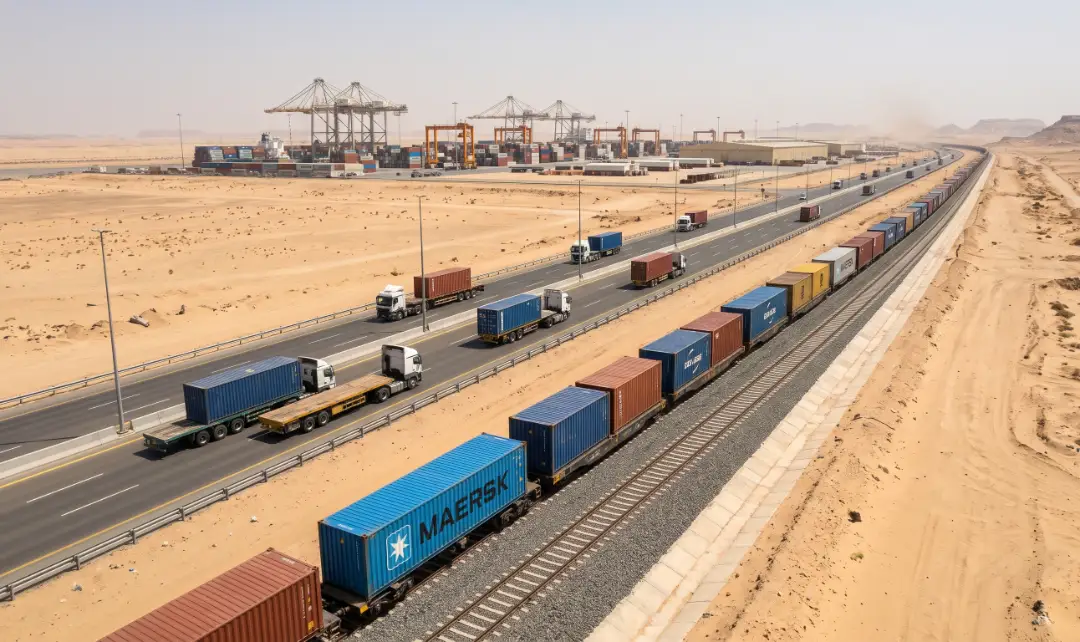
Maersk's latest market update has identified a notable shift in shipper behavior across the Middle East, with increased utilization of the Saudi Landbridge during October as companies seek alternatives to ocean routings affected by disruption around the Strait of Hormuz and evolving conditions at Khor Fakkan. The landbridge, which connects Saudi Arabia's eastern and western coasts by rail and road, has emerged as a practical option for cargo seeking to reach Saudi and Gulf markets without transiting the most volatile segments of the regional maritime network.
The disruption around the Strait of Hormuz has been a persistent feature of the Middle East logistics landscape, with security incidents, navigational restrictions, and insurance concerns combining to make the waterway less reliable than in normal times. Khor Fakkan, a key container terminal on the UAE's east coast, has also experienced evolving conditions that have affected vessel schedules and cargo flows. Together, these factors have pushed shippers and carriers to explore land-based alternatives that bypass the most affected areas.
The Saudi Landbridge offers a compelling proposition for certain cargo flows. By moving containers by rail and road between the Red Sea coast and the Gulf coast, shippers can avoid the need to route vessels through the Strait of Hormuz entirely. For cargo destined for Riyadh, the eastern provinces, or onward to other Gulf markets, the landbridge can provide a more direct and potentially more reliable path. The corridor has been developed with significant investment in rail and road infrastructure, and it has the capacity to handle growing volumes.
However, Maersk's update cautions that the landbridge is not a simple solution. Capacity, border processing, and onward delivery requirements remain variable, and shippers must coordinate ocean and landside planning carefully to avoid bottlenecks. The landbridge involves multiple handoffs between modes and jurisdictions, each of which introduces complexity and potential delay. Customs procedures, documentation requirements, and infrastructure constraints can all affect transit times, and shippers need to build flexibility into their plans.
The trend toward landbridge usage reflects a broader pattern of adaptation in the Middle East logistics market. Shippers and carriers have been developing contingency plans and alternative routings to cope with persistent uncertainty. The landbridge is one of several options, alongside road transport, air freight, and alternative port calls, that companies are using to maintain supply chain continuity. The willingness to experiment with new routings suggests that the market is maturing in its response to risk.
Air connectivity in the region remains fluid, according to Maersk's update, with Jeddah and Dammam serving as key gateways. The two airports have been handling increased cargo volumes as shippers seek faster alternatives for time-sensitive goods. Jeddah, on the Red Sea coast, and Dammam, on the Gulf coast, provide complementary access points, and their combined capacity gives shippers flexibility in routing air cargo. The air freight option is particularly important for high-value and perishable goods that cannot tolerate the delays associated with surface transport.
For Maersk, the surge in landbridge usage is an opportunity to offer integrated logistics solutions that combine ocean, rail, and road. The company has been investing in landside capabilities across the Middle East, including rail connections, trucking fleets, and warehousing, to support customers seeking end-to-end solutions. The ability to coordinate ocean and landside planning is a competitive advantage in a market where reliability and flexibility are at a premium.
Looking ahead, the use of the Saudi Landbridge is expected to remain elevated as long as disruption affects the Strait of Hormuz and Khor Fakkan. However, the long-term trajectory will depend on the resolution of security issues and the improvement of infrastructure and processes along the corridor. For shippers, the landbridge is a valuable addition to their toolkit, but it is not a substitute for a stable and reliable maritime network. The Middle East logistics market will continue to require diversified routing options and robust contingency planning.