
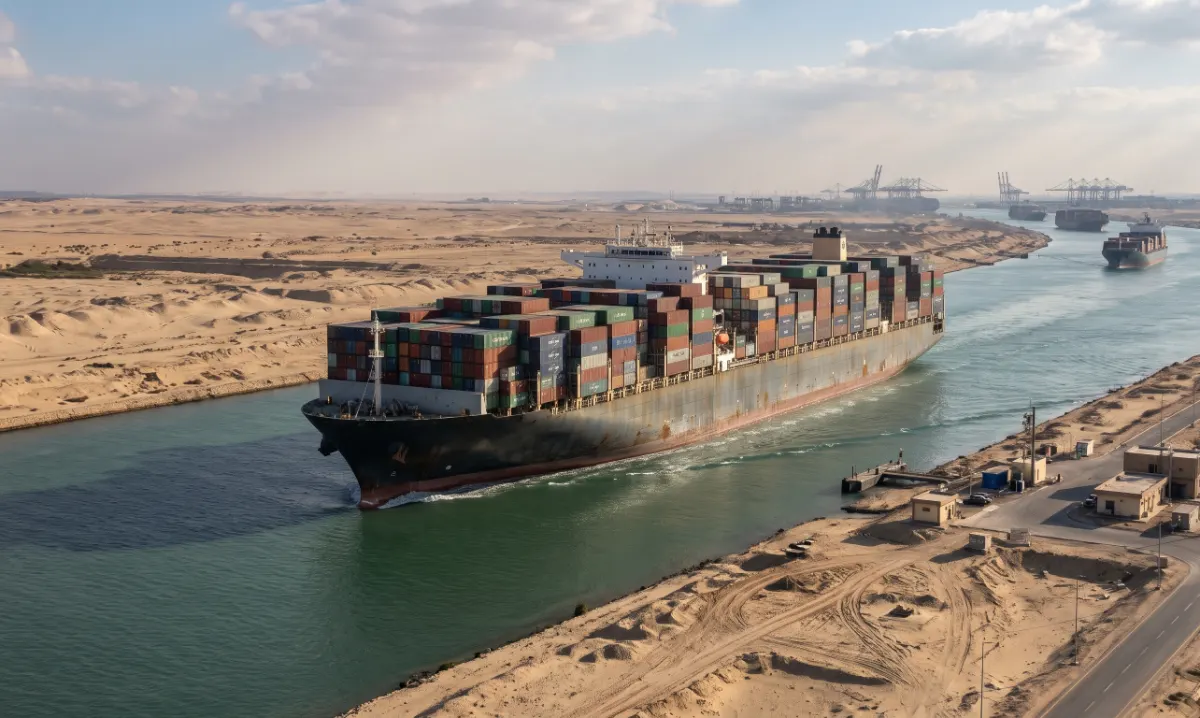
DHL Global Forwarding's latest market advisory delivers a sobering message to shippers who had hoped that the return of container lines to the Suez Canal would quickly restore predictability to Asia-Europe supply chains. While the direction of travel is positive, the logistics giant warns that schedule reliability will take six to twelve months to normalize, as the industry works through the complex process of redeploying vessels, rebalancing networks, and clearing congestion that built up during the prolonged diversion around the Cape of Good Hope.
The advisory notes that about 60% of Asia-Europe headhaul services now have planned Suez routings, a significant increase from the depths of the Red Sea crisis when nearly all carriers diverted. However, planned routings do not translate immediately into reliable schedules. Vessels must be physically repositioned, port rotations must be re-sequenced, and alliance partners must coordinate their networks. Each of these steps introduces complexity and delay, and the effects ripple across the entire system.
The scale of vessel redeployment is a major constraint. Moving ships from the Cape route back to Suez requires careful planning to avoid gaps in service and to ensure that capacity is available where demand is strongest. The process is further complicated by the fact that many vessels were deployed on longer rotations with different port calls, and adjusting those rotations takes time. Carriers are also balancing the need to restore Suez services with the risk of another security incident that could force a fresh diversion.
Port congestion is another critical factor. DHL reports that over 10% of global fleet capacity is currently tied up, a figure that reflects both the absorption of capacity by longer routes and the bottlenecks that have developed at key ports. When vessels return to Suez, they arrive in bursts rather than in a smooth flow, which can overwhelm terminal capacity and create queues. The resulting congestion can be as disruptive as the original diversion, albeit in a different way.
Gulf ports are experiencing particularly acute delays, with berthing delays exceeding two weeks in some cases. The congestion reflects a combination of factors, including the rerouting of cargo flows, labor and equipment constraints, and the sheer volume of vessels converging on the region as services are restored. For shippers using Gulf ports as transshipment points or final destinations, the delays are adding weeks to transit times and complicating inventory planning.
The advisory also highlights the challenge of restoring schedule reliability, which deteriorated sharply during the Red Sea crisis and has been slow to recover. Shippers have become accustomed to significant variability in transit times, and many have built buffer stocks and diversified their routing options to cope. DHL's message is that these adaptations will need to remain in place for some time, as the industry transitions back to Suez and works through the resulting operational challenges.
For exporters and importers, the implications are practical. DHL is advising customers to plan for continued variability, to maintain safety stock where feasible, and to engage early with carriers and forwarders on booking and routing decisions. The advisory also suggests that shippers should consider multi-modal options and alternative ports where congestion is less severe, and should build flexibility into their contracts to accommodate changes in schedules.
The broader takeaway is that the return to Suez is a process, not an event. While the direction is encouraging and the long-term benefits of the shorter route are clear, the transition period will be marked by congestion, schedule instability, and operational friction. DHL's warning serves as a reminder that supply chain resilience requires patience as well as planning, and that the effects of the Red Sea crisis will be felt in global logistics networks well into 2027.