
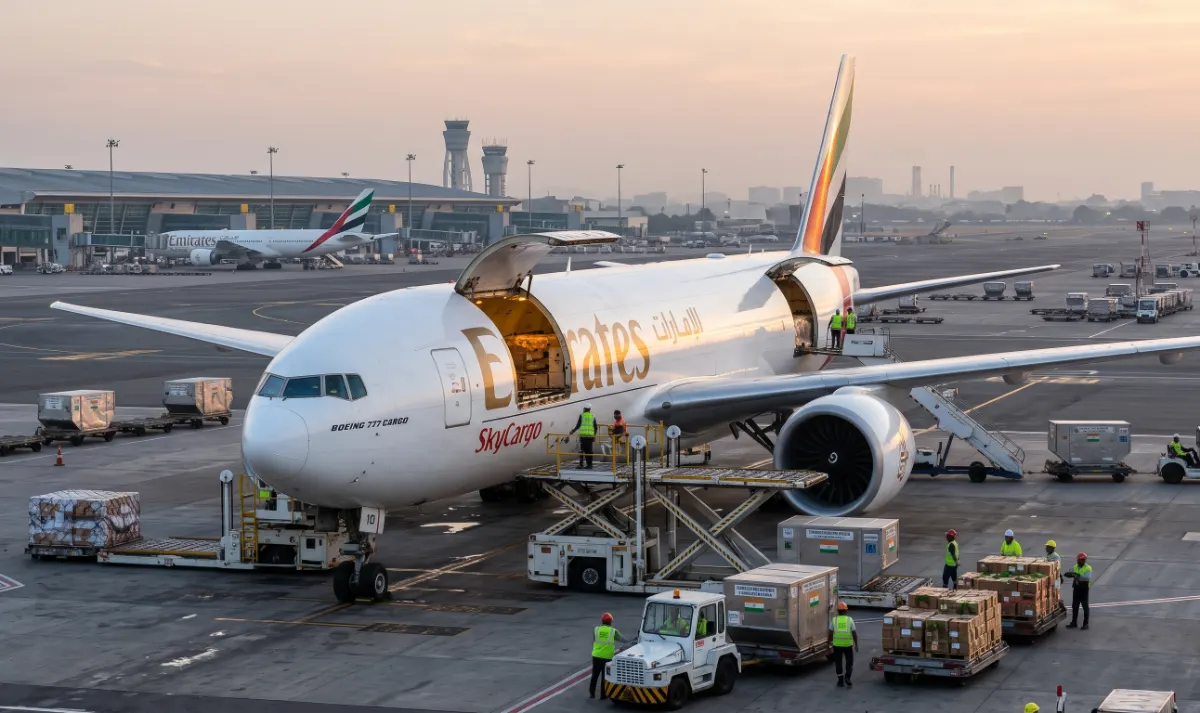
Emirates SkyCargo's latest figures underscore India's growing importance as an air cargo origin market and the deepening trade links between the subcontinent and the Gulf. Weekly cargo volumes from India have surpassed 4,100 tonnes in November 2026, a milestone that places the country among the carrier's top three markets globally. The numbers reflect both the resilience of Indian export manufacturing and the appetite for high-value, time-sensitive goods in Middle Eastern, European, and North American markets.
Pharmaceuticals remain the single largest commodity category, accounting for over 650 tonnes per week and growing more than 15% year-on-year. India's pharmaceutical sector has been expanding its global footprint, particularly in generic medicines, vaccines, and active pharmaceutical ingredients, and air cargo is the preferred mode for temperature-sensitive and high-value shipments. Emirates SkyCargo's investment in cool-chain infrastructure and dedicated pharma handling at its Dubai hub has positioned it well to capture this growth.
Perishables form another major category, with volumes exceeding 600 tonnes weekly. Indian fresh produce, including fruits, vegetables, seafood, and flowers, has found strong demand in Gulf markets and beyond. The perishables segment is highly time-sensitive, and the carrier's extensive passenger and freighter network from Indian gateways allows for rapid connection to destinations across the Middle East, Europe, and North America. The growth in perishables also reflects improved cold-chain practices at Indian origin airports.
The carrier's India network is extensive, with 167 weekly passenger flights and seven dedicated freighters operating from nine Indian gateways. This combination of belly capacity and freighter lift gives Emirates SkyCargo significant flexibility in matching capacity to demand across different regions of India. The nine gateways span the major metros and key regional hubs, ensuring that exporters from across the country can access international air cargo services without lengthy domestic repositioning.
India's emergence as a top-three market for Emirates SkyCargo is consistent with broader trends in global air cargo. The country has been investing heavily in airport infrastructure, cargo terminals, and cold-chain facilities, and its export profile is shifting toward higher-value goods that justify air freight. Electronics, engineering goods, and specialty chemicals are joining pharmaceuticals and perishables as significant air cargo categories, broadening the base of demand.
For Indian exporters, the availability of reliable air cargo capacity is a critical competitive factor. Air freight is expensive relative to ocean shipping, but for high-value, perishable, or urgent shipments, it is indispensable. The frequency and reach of Emirates SkyCargo's network from India give exporters access to markets that would otherwise be difficult to serve, and the carrier's investment in handling infrastructure at both origin and destination adds reliability.
The Gulf carrier's success in India also reflects the broader strategic importance of the India-Gulf trade corridor. The UAE is one of India's largest trading partners, and air cargo plays a vital role in moving goods between the two countries. Emirates SkyCargo's Dubai hub serves as a global connecting point, allowing Indian exports to reach destinations across Europe, Africa, and the Americas through a single transit point, which simplifies logistics for exporters.
Looking ahead, Emirates SkyCargo is expected to continue expanding its India operations, with potential for additional freighter frequencies and enhanced cold-chain capabilities. The carrier has been investing in digital tools for booking, tracking, and documentation, which are increasingly important for pharma and perishable shippers who require end-to-end visibility. For India's air cargo sector, the growth story is one of rising volumes, improving infrastructure, and deeper integration into global trade networks.