
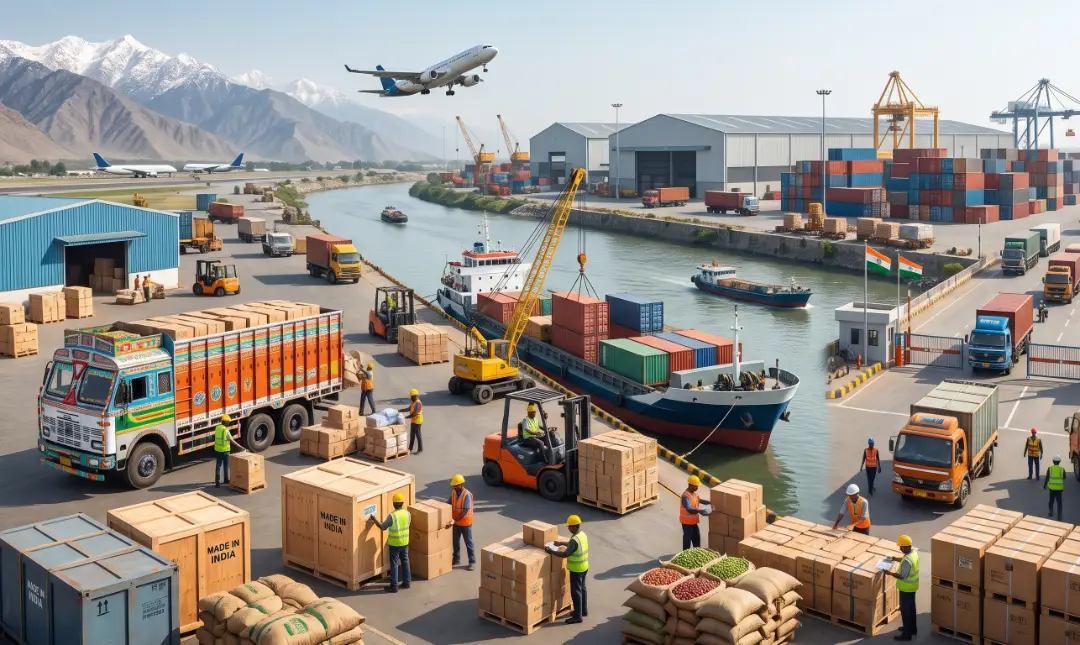
The amendments, notified by the Department of Commerce, represent one of the most substantial revisions to the Export Promotion Mission since its inception. The changes are aimed squarely at reducing the logistics cost burden on small and medium exporters, who have long complained that high freight and certification expenses erode their competitiveness in international markets. By broadening the scope of support across transport modes and geographies, the government is signaling that export promotion must reach beyond the traditional coastal clusters.
The most far-reaching change is the expansion of air freight support to Jammu & Kashmir and Ladakh. Exporters in these regions have historically faced a severe disadvantage, relying on costly air shipments for perishables, handicrafts, and high-value goods due to limited surface connectivity. Bringing these union territories under the air freight support umbrella is expected to unlock export potential in horticulture, saffron, handicrafts, and other niche products that command premium prices in overseas markets but are highly sensitive to logistics costs and transit times.
Equally significant is the addition of waterways as an eligible transport mode under the mission. India has been actively developing inland waterways and coastal shipping as cost-effective alternatives to road and rail, and the policy change aligns with the broader push toward multi-modal logistics. Exporters using National Waterways or coastal routes will now be able to claim benefits that were previously limited to road, rail, and air, potentially shifting a share of cargo toward greener and cheaper modes.
The extension of coverage to Land Customs Stations and Integrated Check Posts addresses a long-standing gap for exporters trading with neighbouring countries. Trade with Bangladesh, Nepal, Bhutan, and Myanmar moves predominantly through land border points, yet these routes had been largely excluded from the mission's benefits. By bringing them into the fold, the government is acknowledging the importance of land-based trade and providing support to exporters in the northeastern states and border regions who depend on these corridors.
The increase in the maximum eligible export turnover for airfare reimbursement from ₹75 lakh to ₹50 crore is a game-changer for MSMEs. Previously, the low turnover cap meant that many small exporters could not claim meaningful benefits, while those just above the threshold were excluded entirely. The new ceiling ensures that a much wider band of small and medium enterprises can access support for participating in international trade fairs, buyer-seller meets, and market exploration visits, which are critical for breaking into new export markets.
The expansion of the list of reimbursable quality certifications from 462 to 600 reflects the growing importance of compliance with international standards. For MSMEs, the cost of obtaining certifications such as those for food safety, organic produce, and industrial quality can be prohibitive. By reimbursing a broader set of certifications, the government is helping small exporters meet the requirements of buyers in the US, EU, and other stringent markets, thereby improving their access to high-value segments.
Export industry bodies have welcomed the amendments, describing them as a timely intervention. MSME exporters, in particular, have long argued that logistics and compliance costs are the biggest barriers to scaling their overseas sales. The revised guidelines are expected to improve the utilization of Export Promotion Mission funds and make the scheme more relevant to the current structure of India's export economy, where small firms play a dominant role in employment and value addition.
Officials indicated that the amendments will be backed by an outreach campaign to ensure that exporters, especially in tier-2 and tier-3 cities, are aware of the expanded benefits and can navigate the application process. The Department of Commerce is also expected to monitor uptake closely and make further refinements based on feedback. For India's MSME export sector, the changes represent a meaningful step toward a more inclusive and logistics-efficient export promotion framework.