
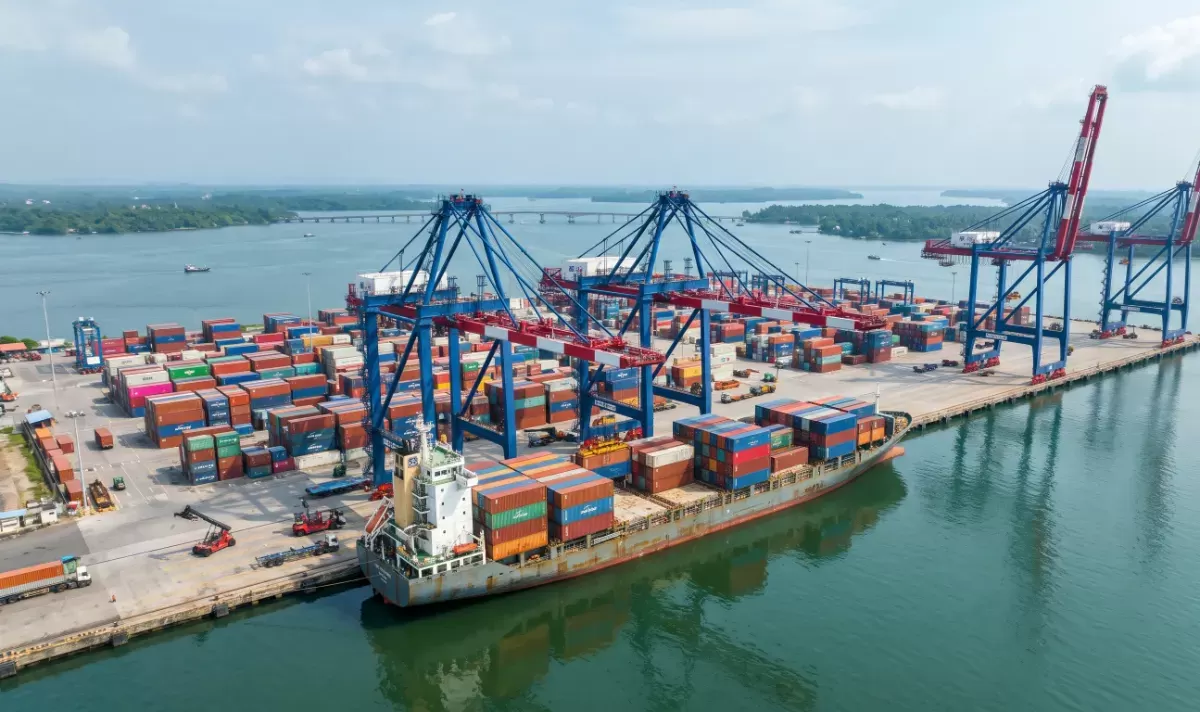
The launch of the second weekly service marks a significant strengthening of the shipping corridor between India's southwestern coast and Sri Lanka's premier transshipment hub. The new rotation, operated by Bengal Tiger Line under a slot arrangement with DP World, connects Mangalore, Cochin, and Colombo in a fixed weekly loop. The inaugural call at the International Container Transshipment Terminal (ICTT) at Vallarpadam was marked by the arrival of MV TC Symphony, a vessel with a capacity of around 1,000 TEU, underscoring the scale of the feeder operation that underpins the service.
For exporters in Kerala and Karnataka, the additional weekly call represents a meaningful improvement in connectivity. Until now, shippers in the region have had limited feeder options to Colombo, which remains the primary gateway for transshipment cargo moving to Europe, the Mediterranean, and East Asia. With two weekly sailings, exporters gain greater flexibility in scheduling, reduced waiting times at the terminal, and a lower risk of missing mother-vessel connections at Colombo.
DP World's ICTT at Vallarpadam has been positioning itself as a key node in South India's maritime logistics network, leveraging its deep-water berths and proximity to the main east-west shipping lanes. The terminal has invested in productivity improvements, including crane upgrades and digital systems, to handle growing feeder volumes efficiently. The addition of a second weekly service is expected to increase throughput at the terminal and reinforce its role as a transshipment gateway for the region.
Bengal Tiger Line, the operator of the service, is a well-established intra-Asia feeder carrier with a network spanning the Indian subcontinent, Southeast Asia, and the Middle East. Its decision to expand the Cochin-Colombo rotation reflects confidence in the growth of South Indian trade and the reliability of ICTT's operations. The carrier has indicated that vessel deployment and schedule integrity will be key priorities as it scales up the service.
For Southern Indian businesses, the benefits extend beyond convenience. Improved feeder connectivity translates into more competitive transit times and freight costs, particularly for time-sensitive cargo such as seafood, spices, coir products, and engineering goods. Exporters who previously relied on road transport to distant ports or faced uncertain feeder schedules now have a more predictable route to global markets via Colombo.
The service also aligns with broader efforts to develop Cochin as a logistics hub on India's western coast. The port's strategic location, close to the international shipping lane that passes south of Sri Lanka, gives it a natural advantage for transshipment and feeder operations. State authorities and port stakeholders have been pushing for greater integration of Cochin into regional shipping networks, and the new service is seen as a step in that direction.
Industry observers note that intra-Asia and India-Sri Lanka feeder services have become increasingly important as global supply chains diversify and regional trade grows. Colombo's role as a transshipment hub remains central to South Asia's maritime logistics, and Indian ports that can offer efficient feeder connections stand to benefit from the resulting cargo flows. The Cochin-Colombo corridor is one of the busiest in the region, and competition among operators is intensifying.
For DP World, the expanded service is part of a wider strategy to build integrated logistics capabilities across India. The company has been investing in terminals, inland container depots, and multimodal connections to capture growing trade volumes. The second weekly Cochin-Colombo call reinforces its commitment to the South Indian market and its ambition to make ICTT a preferred gateway for the region's EXIM trade.