
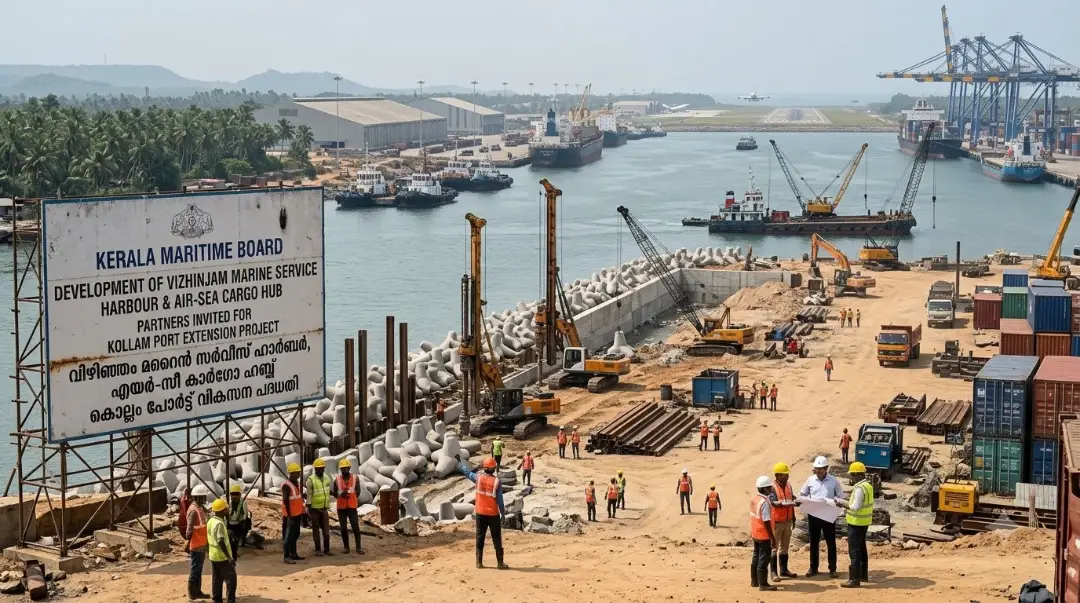
Kerala is moving to build a logistics ecosystem around Vizhinjam International Seaport, with senior government officials assessing potential maritime support facilities at Kovalam-Vizhinjam and Valiyathura, and the Kerala Maritime Board inviting logistics operators to partner at Kollam Port . The developments, reported by India Shipping News and The Hindu on 17–18 November 2026, signal that the state is treating Vizhinjam not as an isolated port project but as the anchor for a broader maritime services and cargo cluster.
The inspection at Kovalam-Vizhinjam and Valiyathura was led by Dr. Rathan U. Kelkar, Secretary to the Chief Minister and Secretary of the Ports Department, alongside Jeromic George, Managing Director of Vizhinjam International Seaport Limited . At the Kovalam-Vizhinjam minor port, officials examined the possibility of developing a dedicated marine service harbour that would cater to growing demand for maritime support services from vessels operating in the region, which sits approximately 10 nautical miles from the international East-West shipping route . Such a facility would provide bunkering, ship repairs, provisions supply, and crew change services, functions that are distinct from the container handling at Vizhinjam itself.
At Valiyathura, officials assessed the damaged pier and examined the possibility of establishing an air-sea transshipment hub supported by warehouses and logistics infrastructure . The proposed facility would facilitate cargo movement between air and sea transport networks, creating additional trade opportunities for Thiruvananthapuram and leveraging the proximity of the airport to the coast. Commercial utilisation of five acres of Kerala Maritime Board-owned land at Vizhinjam is also under consideration.
A parallel initiative focuses on Kollam Port, which the state is positioning as a logistics extension of Vizhinjam. The Kerala Maritime Board issued an expression of interest on 13 November inviting shipping lines, freight forwarders, and logistics operators to register as partners at Kollam, with submissions opening on 4 December . The model envisages import containers discharged at Vizhinjam moving to Kollam under customs bond for clearance and onward delivery, effectively extending Vizhinjam's gateway function to a second port without requiring the cargo to be cleared at Vizhinjam itself.
These developments form part of Kerala's Rs 400 crore Mission Samudra initiative, launched in August 2026 alongside the commencement of export-import operations at Vizhinjam . The programme is intended to transform Kerala's coastline into a maritime economic corridor, and the logistics ecosystem around Vizhinjam is a critical component of that vision. A trade facilitation meeting on 18 November, jointly organised by Vizhinjam International Seaport Limited and the Trivandrum Chamber of Commerce and Industry, decided to focus on developing Vizhinjam as a major EXIM and maritime hub, with quarterly consultations planned to sustain engagement among Customs, Immigration, shipping lines, port operators, and the trading community .
For India's logistics sector, Kerala's plans illustrate the landside and services infrastructure that a transshipment port requires to function as a full gateway. Vizhinjam has demonstrated its ability to handle large container vessels, but its long-term success depends on the supporting ecosystem—marine services, warehousing, customs facilitation, and inland connectivity—that determines whether shippers can use the port efficiently for their entire supply chain. The Kollam bonded extension is particularly notable because it addresses a constraint that Vizhinjam faces: the absence of a container freight station at the port itself, which currently limits it to full-container-load cargo.
Looking ahead, the key milestones are the completion of the assessments at Kovalam-Vizhinjam and Valiyathura, the registration of partners at Kollam Port by the 4 December deadline, and the operationalisation of the bonded cargo movement between Vizhinjam and Kollam. The state has not disclosed investment figures or construction timelines for the marine service harbour and air-sea hub, and their viability will depend on demand from vessel operators and cargo owners. For now, Kerala is building the supporting infrastructure that Vizhinjam needs to evolve from a container-handling facility into a comprehensive maritime gateway, and the progress of these initiatives will indicate whether the state can translate its maritime ambitions into an operational logistics ecosystem.