
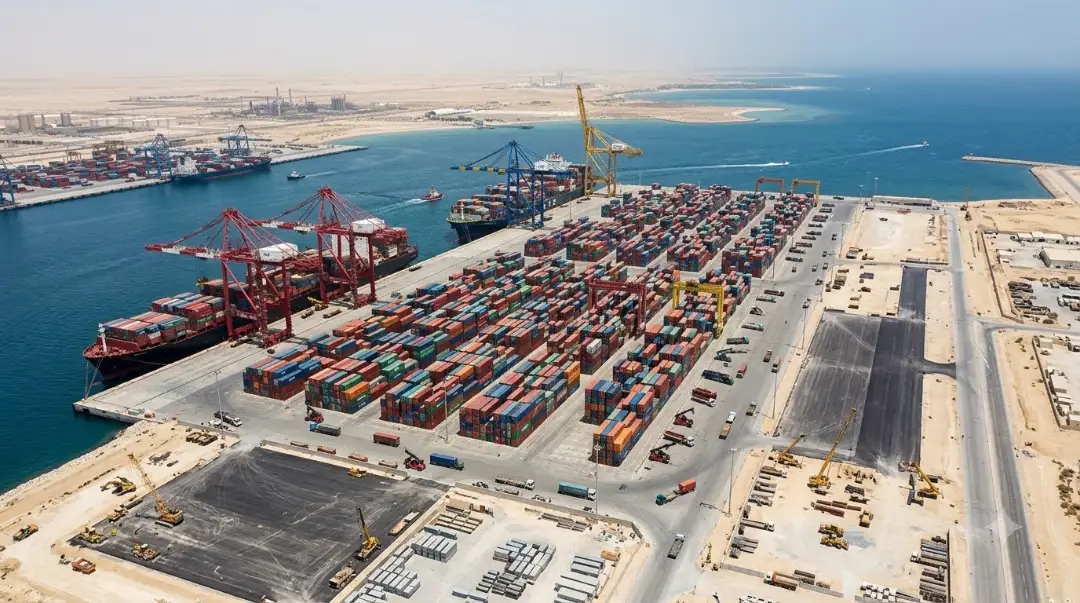
Saudi Global Ports has secured a concession agreement with the Saudi Ports Authority to develop, operate, and manage the container terminal at Jubail Commercial Port, in a project involving investments exceeding SAR 2 billion, equivalent to approximately $528 million . The agreement, reported by Gulf Construction on 16 November 2026, is part of Mawani's broader programme to expand port capacity and logistics infrastructure across the Kingdom in line with Saudi Vision 2030.
Jubail Commercial Port serves the Eastern Province's industrial belt, which includes petrochemical complexes, manufacturing facilities, and the Royal Commission for Jubail and Yanbu's industrial cities. The port is one of Saudi Arabia's key gateways on the Gulf coast, and the container terminal expansion is intended to increase handling capacity to accommodate growing trade volumes. The investment will cover infrastructure development, equipment procurement, and operational upgrades, though the specific capacity targets and construction timeline were not disclosed in the initial announcement.
The concession reflects the broader pattern of port privatisation and private-sector participation that Mawani has been pursuing across Saudi Arabia's port network. The authority has signed a series of agreements with international operators, including DP World's 30-year concession for the Jeddah South Container Terminal, which involves up to $500 million in investment to upgrade capacity from 2.4 million to 3.6 million TEUs . The Jubail concession adds another major terminal to the portfolio of privately operated facilities, extending the model to the Gulf coast as well as the Red Sea.
The timing of the agreement aligns with the strong performance of Saudi ports in recent months. Container handling across Saudi ports rose 14% year-on-year in October 2026 to approximately 866,200 TEUs, with Jeddah Islamic Port setting an all-time monthly record of 582,900 TEUs . The growth has been driven by both inbound and outbound containers, and it reflects the kingdom's increasing role as a logistics hub connecting Asia, Europe, and Africa. The Jubail expansion is intended to build on this momentum by adding capacity on the Gulf coast, which serves different hinterland markets than the Red Sea ports.
For India's trade with Saudi Arabia, the Jubail expansion has indirect but relevant implications. India exports a range of goods to Saudi Arabia, including engineering products, chemicals, textiles, and food commodities, and imports crude oil and petrochemicals from the kingdom. Jubail's industrial base is a significant destination for Indian engineering and chemical exports, and improved container handling capacity at the port could reduce congestion and turnaround times for vessels serving the Eastern Province. The expansion also complements the broader Saudi investment in logistics infrastructure that Indian companies are increasingly engaging with, from port operations to warehousing and distribution.
Looking ahead, the key milestones are the finalisation of the concession terms, the commencement of construction, and the commissioning of the expanded terminal. Mawani has not disclosed the specific capacity targets, the timeline for completion, or the operational structure of the concession. For now, the agreement signals that Saudi Arabia is continuing to invest in port infrastructure at scale, and that the privatisation model that has transformed Jeddah and other Red Sea ports is being extended to the Gulf coast as part of the broader Vision 2030 logistics agenda.