
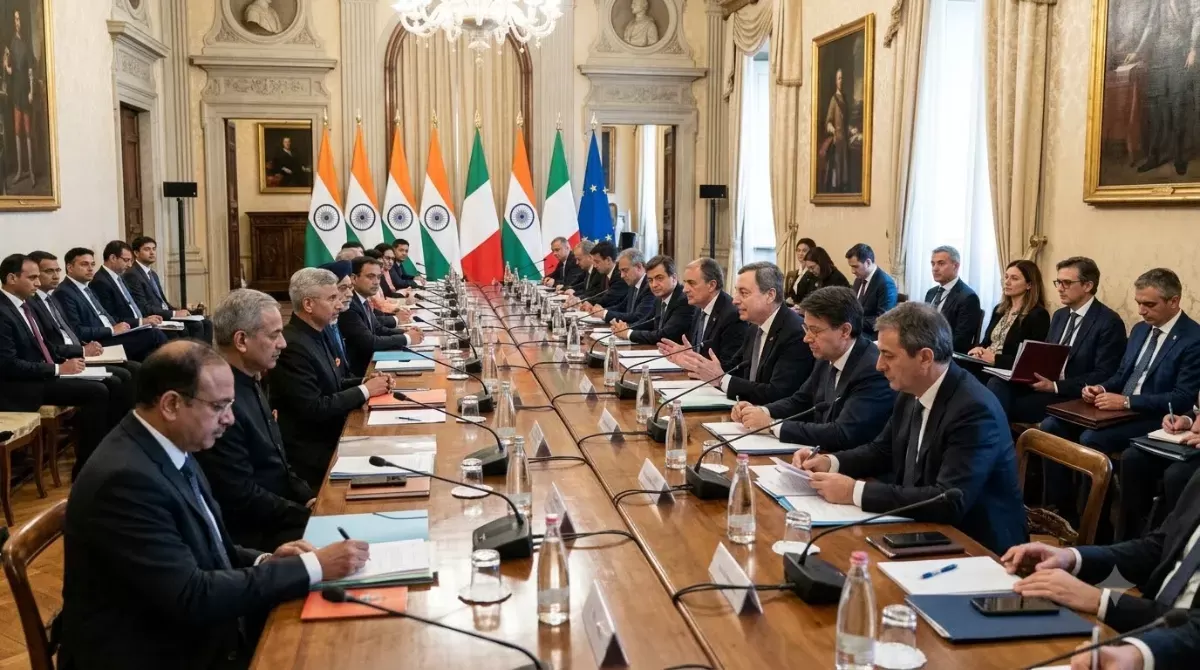
India and Italy have reaffirmed their commitment to achieving €20 billion in bilateral trade by 2029, with connectivity and supply chain integration featuring prominently in the discussions at the 23rd Session of the India–Italy Joint Commission for Economic Cooperation in Rome . Commerce and Industry Minister Piyush Goyal co-chaired the session with Italian Deputy Prime Minister and Minister of Foreign Affairs Antonio Tajani on 18 November 2026, according to a PIB release issued on 19 November.
The discussions covered a broad agenda that reflects the complementarities between the two economies. Cooperation in automotive and aerospace, Industry 4.0, agriculture and agri-technology, connectivity and energy, critical minerals, science and innovation, and skills development were all on the table . The reference to connectivity and energy is particularly relevant in the context of India's logistics priorities, as it encompasses the infrastructure and supply chain links that support bilateral trade. Both sides highlighted the complementarities between India's growing manufacturing capabilities and skilled workforce and Italy's strengths in advanced manufacturing, engineering, machinery, and technology.
The India–EU Free Trade Agreement provided a significant backdrop to the discussions. The ministers welcomed the successful conclusion of negotiations on the India–EU FTA and discussed its potential to expand market access, increase trade and investment flows, and strengthen supply chains . This connects the bilateral India–Italy relationship to the broader India–EU framework, which is expected to enter into force in early to mid-2027 and will govern the terms of trade between India and all EU member states, including Italy.
Goyal also engaged directly with the Italian business community. He addressed the India–Italy Business and Innovation Forum in Rome, which brought together senior government leaders, industry associations, and Italian companies, along with around 80 Indian business delegates, including 12 startups . He held one-on-one meetings with CEOs and senior leaders of leading Italian companies including Walter Tosto S.p.A., Nordimpianti System, Atitech, Magaldi Group, and Bracco Group, with discussions focused on investment, manufacturing, and technology partnership opportunities in India.
Three sectoral roundtables were organised as part of the Forum, covering pharmaceuticals and chemicals, industrial machinery and agri-food, and automotive. The industrial machinery and agri-food roundtable highlighted opportunities in automation, technology transfer, food-processing machinery, cold-chain infrastructure, and packaging, aimed at reducing post-harvest losses and enhancing value addition . This connects the bilateral trade agenda to logistics infrastructure, as cold-chain and packaging investments are prerequisites for expanding India's processed food exports to Europe.
For India's logistics sector, the India–Italy engagement is part of a broader pattern of European outreach that has accelerated in 2026. India has been deepening maritime cooperation with the Netherlands, Denmark, and Belgium, and the India–EU FTA provides an overarching framework for trade and investment flows. Italy's strengths in advanced manufacturing and machinery are relevant to India's port and logistics equipment needs, and the discussions on connectivity and critical minerals touch on the supply chains that support India's infrastructure and energy transition.
Looking ahead, the key milestone is the implementation of the India–EU FTA, which will provide the legal framework for the trade and investment flows that the Joint Commission discussed. The €20 billion bilateral trade target is a benchmark against which the relationship can be measured, and the sectoral roundtables have identified specific areas where Italian and Indian businesses can collaborate. For now, the Joint Commission has reaffirmed the political commitment to deepening economic ties, and the business forum has provided a platform for translating that commitment into commercial partnerships.