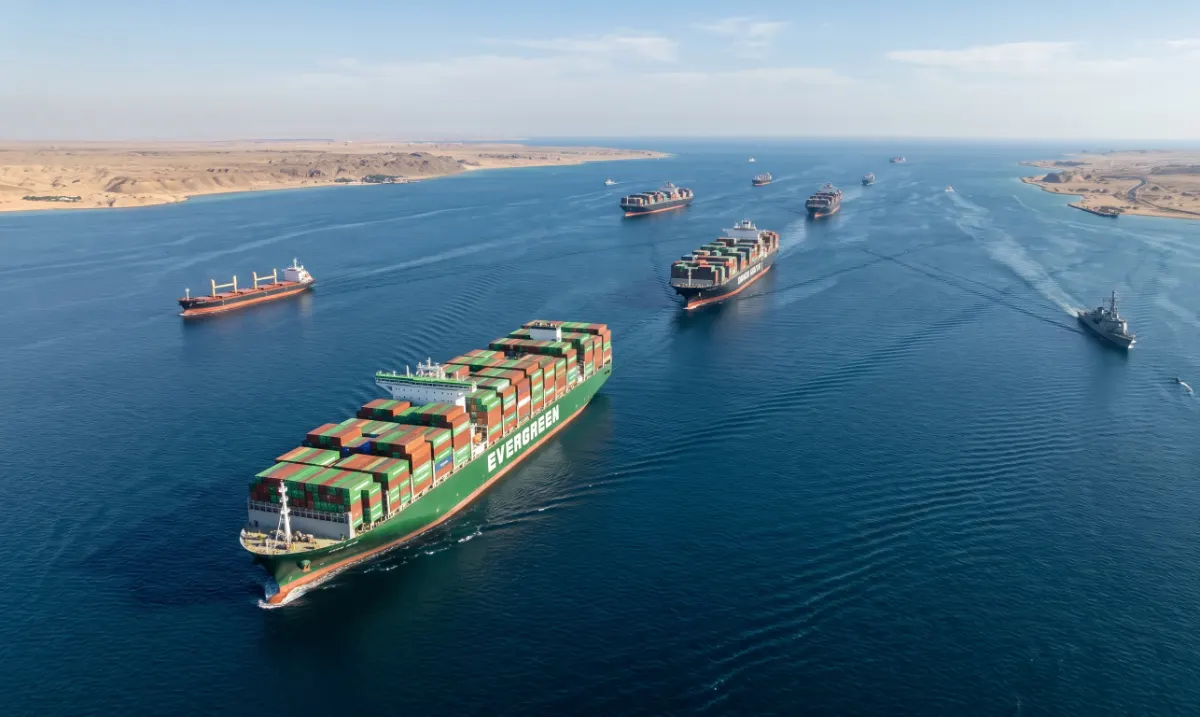
<p dir="ltr" data-path-to-node="4"><b data-path-to-node="4" data-index-in-node="0">JEDDAH / DUBAI</b> — The container shipping industry’s strategic transition back toward the Suez Canal and Red Sea trade corridor has accelerated sharply this month as major ocean carriers—led by Taiwan-headquartered Evergreen Marine Corporation and Dubai-based Emirates Shipping Line (ESL)—restore direct vessel rotations across the waterway. Following months of phased trial transits by rival liner alliances, the coordinated November network restorations signal a decisive structural shift away from lengthy detours around Africa’s Cape of Good Hope, with Suez Canal container transit volumes now surpassing 50% of pre-disruption levels.</p><p dir="ltr" data-path-to-node="5">Evergreen Marine Corporation officially ended its nearly three-year absence from the Red Sea corridor in early November when its 16,556-TEU container ship <i data-path-to-node="5" data-index-in-node="155">Ever Eon</i> completed a northbound transit through the Suez Canal on its Asia–North Europe loop. With Evergreen’s Ocean Alliance partners CMA CGM and COSCO already operating trans-Suez rotations, the Taiwanese carrier’s return effectively brings the entire Ocean Alliance back onto the Suez route. Evergreen has quickly lined up additional ultra-large containerships—including the <i data-path-to-node="5" data-index-in-node="533">Ever Edit</i> on its NEU7/CES string and the 20,124-TEU <i data-path-to-node="5" data-index-in-node="585">Ever Gifted</i> on its MD2 Mediterranean service—to resume direct east-west waterway transits.</p><p dir="ltr" data-path-to-node="6">In parallel with its mainline Suez return, Evergreen is restarting its dedicated China–Red Sea (OGRD) service in mid-November, deploying four 7,000- to 9,000-TEU cellular vessels on a fortnightly rotation. Connecting Qingdao, Shanghai, Ningbo, Shekou, and Singapore directly to Jeddah, Ain Sokhna, and Aqaba, the restored service eliminates the need for regional cargo to be transshipped via Singapore or Jebel Ali. For Saudi, Egyptian, and Jordanian importers, restoring direct mainline calls removes intermediate re-handling costs, lowers cargo damage exposure, and shaves several days off regional supply chain lead times.</p><p dir="ltr" data-path-to-node="7">Reinforcing the regional network recovery, UAE-based Emirates Shipping Line has rolled out an extensive Red Sea schedule overhaul anchored by its newly launched China Red Sea Connector (CRC). Deploying four vessels of roughly 2,500 TEU each on a fortnightly cadence, the new service directly links Shanghai, Ningbo, and Nansha with Ain Sokhna, Aqaba, and Jeddah. Maritime logistics analysts note that the service represents one of the first dedicated, post-reopening China–Red Sea loops built specifically around direct Saudi and Jordanian port access, providing importers with a direct waterborne alternative to overland landbridge relays from the Persian Gulf.</p><p dir="ltr" data-path-to-node="8">Alongside its Far East expansion, Emirates Shipping Line has bifurcated its Indian Subcontinent–Red Sea network into two focused, higher-velocity strings to eliminate multi-port rotation delays. Under the restructuring, ESL’s South Red Sea Service (SRS) has been converted into a dedicated, point-to-point shuttle connecting Jawaharlal Nehru Port Authority (Nhava Sheva) directly with Jeddah Islamic Port every nine days. Simultaneously, the carrier’s revised North Red Sea Service (NRS) deploys dedicated tonnage on a fortnightly loop linking Nhava Sheva with Djibouti, Aqaba, Ain Sokhna, and Sohar, separating high-volume Saudi bilateral trade from broader regional distribution calls.</p><p dir="ltr" data-path-to-node="9">From an operational and macroeconomic perspective, bypassing the Cape of Good Hope circumnavigation shaves roughly 3,300 to 4,000 nautical miles off Asia–Europe and Asia–Middle East linehauls, compressing port-to-port transit times by 10 to 14 days. Shorter direct voyages substantially lower daily bunker fuel burn and reduce carrier greenhouse gas liabilities under decarbonization frameworks such as the EU Emissions Trading System (EU ETS) and FuelEU Maritime. Furthermore, eliminating two-week detours releases significant effective vessel tonnage back into global liner grids, easing chronic container equipment imbalances across Asian export hubs.</p><p dir="ltr" data-path-to-node="10">However, maritime intelligence providers and port operators warn that the rapid transition back to direct Red Sea and Suez routing introduces short-term schedule volatility and terminal bunching risks. Because vessels routed through the Suez Canal arrive up to two weeks earlier than sister ships still completing Cape of Good Hope voyages, European, Mediterranean, and Red Sea terminals face overlapping arrival waves in November and December. Forwarders caution cargo owners to closely monitor vessel ETAs and pre-arrange inland drayage and warehousing to avoid sudden berth congestion and destination demurrage charges.</p><p dir="ltr" data-path-to-node="11">Despite localized operational growing pains, industry executives view the return of Evergreen and the expansion of UAE regional direct services as a watershed moment for global trade normalization. As naval security escorts and regional monitoring protocols stabilize commercial transit confidence across the Bab el-Mandeb corridor, the restoration of direct, predictable liner schedules is expected to steadily unwind pandemic-style floating inventory buffers and restore normal cadence to East-West maritime supply chains.</p>
Red Sea Normalization Accelerates as Evergreen and UAE Shipping Add Direct Services
Global container shipping’s return to the Red Sea and Suez Canal corridor has gained decisive momentum as Taiwan’s Evergreen Marine Corporation and Dubai-based Emirates Shipping Line (ESL) restore direct maritime services in November 2026. Evergreen has resumed Suez Canal transits after a near three-year hiatus and restarted its direct China–Red Sea (OGRD) loop calling at Jeddah, Ain Sokhna, and Aqaba, while ESL has launched a new China Red Sea Connector alongside restructured, high-frequency India–Red Sea direct shuttles, sharply cutting transit times and bypassing intermediate transshipment hubs.