
Maersk and Hapag-Lloyd both reported year-on-year declines in loaded container volumes during the third quarter of 2026, a divergence from global market growth that initially raised questions about the carriers' commercial performance and the effectiveness of their Gemini Cooperation alliance. Global container volumes expanded approximately 5.0% in the third quarter, yet Maersk recorded a 0.8% decline and Hapag-Lloyd a 0.5% reduction, according to data compiled by Container Trades Statistics . The contrast was striking enough to prompt scrutiny of capacity deployment and network scheduling within the Gemini framework.
Vespucci Maritime analyst Lars Jensen has offered a direct interpretation of the data: the volume declines do not signal weakness in either carrier's commercial position, but rather reflect constrained capacity under conditions of significant external disruption . "It sounds more like they don't necessarily have enough capacity," Jensen stated, characterizing the situation as one of vessel shortages or insufficient "effective capacity" rather than a demand-side problem . This distinction matters for how the market interprets carrier performance: a volume decline driven by lack of demand would suggest competitive weakness, while one driven by inability to deploy sufficient capacity to meet available demand suggests the opposite.
The trade-lane breakdown supports Jensen's assessment. Hapag-Lloyd reported a decline of nearly 6% on Asia-Europe routes and approximately 3% on transpacific services in the third quarter . These are precisely the lanes most exposed to the operational disruptions that have plagued Asian port operations throughout 2026. Hapag-Lloyd CEO Rolf Habben Jansen attributed the volume contraction to the ongoing Middle East conflict, port congestion, and "limited space availability" . Notably, he explicitly stated that the decline was unrelated to the Gemini Cooperation arrangement, pushing back against speculation that the alliance structure itself was constraining volumes.
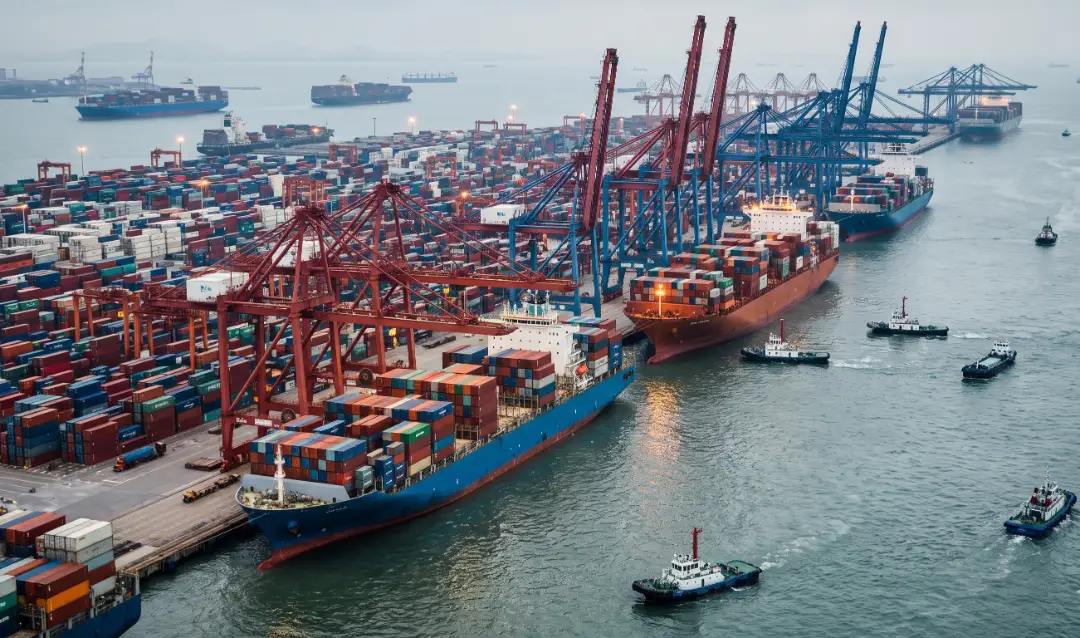
Jensen concurred with Habben Jansen's assessment, noting that the causes likely stem from operational constraints, partly attributable to congestion at Asian ports . Sea-Intelligence data from mid-2026 painted a stark picture of the congestion environment: global container vessel schedule reliability had dropped to 56.4% in July, the sharpest single-month decline since January 2021, with Shanghai's reliability plunging to just 21% . When vessels are delayed by days or weeks at Asian load ports, the effective capacity available to carriers is materially reduced, regardless of nominal fleet size. Ships waiting outside congested terminals are, in practical terms, removed from the market.
Xeneta chief analyst Peter Sand offered a complementary perspective on the capacity question. He observed that carriers maintaining a larger fleet buffer—excess vessels held as redundancy—are better positioned to sustain or grow loaded volumes when disruptions occur . Sand further noted that across global trade, factors including tariffs, trade disputes, typhoons, and restrictions at the Panama and Suez Canals carry greater weight on freight rates than underlying capacity and demand dynamics alone . This carries a strategic implication: in an environment of recurring disruption, capacity elasticity itself becomes a component of effective operating capability, and comparisons based on nominal fleet size may inadequately reflect a carrier's ability to move actual cargo.
The conditions responsible for the volume declines are now evolving. The typhoon season has concluded, and the return of Red Sea transits—led by Maersk and Hapag-Lloyd through the Gemini Cooperation—is accelerating . As vessels shift from the longer Cape of Good Hope routing back to the Suez Canal, transit times shorten, vessel rotations speed up, and effective capacity is released. This simultaneous restoration of routing efficiency and release of constrained capacity could materially alter the supply picture in the coming quarters. Jensen identified the question of whether the carriers' volumes can grow as capacity returns as one of considerable significance: "In the coming quarters, with a large amount of capacity being released, will their volumes be able to grow?" .
For shippers and freight forwarders, the implications extend beyond carrier market share. If Maersk and Hapag-Lloyd's volume declines were indeed capacity-driven rather than demand-driven, the restoration of effective capacity through Suez normalization could increase available slot supply on key trade lanes, potentially easing the rate pressure that has characterized 2026. The Global Price Index stood 62% above its year-earlier level in September, reflecting the cumulative effect of route disruptions and capacity constraints on pricing . Whether the release of capacity through Suez restoration translates into rate relief will depend on the pace of the transition, the durability of demand growth, and whether port congestion at both ends of the corridor eases sufficiently to allow the released capacity to be utilized effectively.