
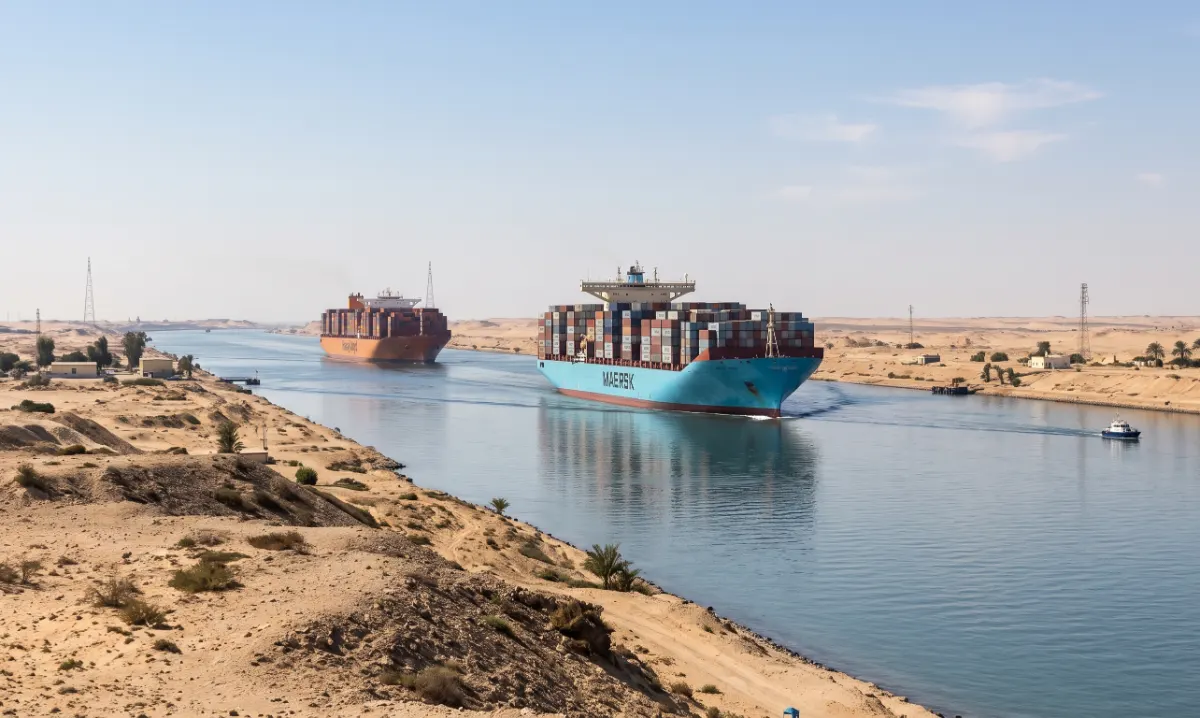
Maersk and Hapag-Lloyd have confirmed the next phase of their return to the Suez Canal, announcing that three more Gemini Cooperation services—AE1, AE2, and AE3—will transition from the Cape of Good Hope routing to the Red Sea corridor between December 2026 and January 2027 . The announcement, made on 16 November, marks a significant acceleration in the carriers' gradual restoration of the shorter Asia-Europe route that had been largely abandoned since late 2023 due to security threats in the Red Sea . With these three services, the Gemini Cooperation moves closer to a complete restoration of its Asia-Europe network through Suez.
The transition schedule is staggered across the coming weeks. The AE2 service, connecting Asia, Europe, and the Middle East, will be the first to switch, with the Mary Maersk departing Ningbo on 4 December 2026 . The AE3 service follows on 20 December with the Alette Maersk departing Shanghai, while the AE1 service completes the trio on 14 January 2027 with the Damietta Express, also from Shanghai . According to Maersk's advisory, the eastbound sailings will also revert to Suez transits, with corresponding vessels scheduled for the return legs .
The operational implications of these routing changes extend beyond simple distance savings. The Suez route removes roughly 3,000 to 4,000 nautical miles and approximately ten days each way compared with the Cape of Good Hope diversion . For carriers, this translates into improved vessel utilization: ships complete more round voyages per year, generating higher revenue without additional fleet investment. The Loadstar reported that the AE2 service will see its vessel count reduced from 14 to 13, while the AE3 will drop from 13 to 11 ships, reflecting the efficiency gains from shorter rotations .
From a capacity perspective, the return to Suez effectively releases vessel space that had been absorbed by the longer Cape routings. When ships spend less time at sea, the same nominal fleet can carry more cargo. Industry analysts have noted that this released capacity could exert downward pressure on Asia-Europe freight rates, particularly if other carriers follow the Gemini lead in restoring Suez transits . However, the actual impact on rates will depend on the pace of further service restorations, cargo demand, and the security situation in the Red Sea.
The port rotations for the three services have been published, revealing adjustments to network design. The AE2 rotation includes Ningbo, Shanghai, Tanjung Pelepas, Suez Canal, Rotterdam, Wilhelmshaven, Bremerhaven, Rotterdam, Suez Canal, Salalah, Singapore, and Ningbo . The AE3 rotation features Shanghai, Yantian, Tanjung Pelepas, Suez Canal, London, Gothenburg, Aarhus, Rotterdam, Southampton, Suez Canal, Singapore, and Shanghai . Notably, none of the three services includes a call at Algeciras, a change linked to the October reorganization that consolidated Strait of Gibraltar port calls into the new AE18 service .
The carriers have been explicit that the return remains conditional. Maersk and Hapag-Lloyd stated they will continue closely monitoring developments in the Middle East, with any further changes to the Gemini network dependent on continued stability in the Red Sea . Hapag-Lloyd emphasized that the safety of crews, ships, and cargo remains the top priority, and that schedules are approximate and subject to operational conditions . This cautious framing reflects the reality that routing decisions can be reversed if security deteriorates, as has happened before during the Red Sea crisis.
With these three services, the Gemini Cooperation has now announced Suez restoration for all nine of its Asia-Europe mainline services, including AE1, AE2, AE3, AE5, AE11, AE12, AE15, AE18, and AE19 . The full transition is expected to be substantially complete by the end of the first quarter of 2027, barring a major security regression. For shippers, the gradual normalization of Suez routings offers the prospect of shorter transit times and more predictable schedules, though the benefits will materialize progressively as each service completes its transition and the network stabilizes around the restored corridor.